
Friday, November 13, 2026
Browse by Genre
Industrial Music / Industrial Metal / Aggro Industrial / Electro Metal
Industrial Noise / Power Noise / Harsh Noise
Synth Pop / Electro Pop / Synth-Electronica
Techno / Trance / Goa / Drum'n'Bass / Jungle / Tribal / Trip-Hop
Ambient / Electronica / Ethereal / Dub / Soundscapes / Abstract
Experimental / Avantgarde / Weird & Wired / Glitch / Noise / Field Recording
Dark / Gothic / Wave / New Wave / Dark Wave / Industrial Gothic
New Music / Downtown / Avantgarde Jazz / New Classical / World
Search Reviews
Music Reviews
Open to the Sea: Beyond the Emotional Flood
Artist: Open to the Sea (@)
Title: Beyond the Emotional Flood
Format: CD + Download
Label: Silentes (@)
Rated:

Title: Beyond the Emotional Flood
Format: CD + Download
Label: Silentes (@)
Rated:
There is something both touching and faintly absurd about the idea of three musicians attempting to make sense of their emotional lives by sending sounds across cities. Most people resort to long messages, badly timed phone calls or the occasional ill-advised purchase. Enrico Coniglio, Saverio Rosi and Matteo Uggeri have chosen a more elaborate method: turning a collection of intense personal experiences, gathered over five months in 2023, into a ten-part musical work. The result, "Beyond the Emotional Flood", is the seventh album by Open to the Sea, and perhaps one of the project's most explicitly narrative undertakings.
The circumstances behind its creation are central to the record. Conceived between Venice, Amsterdam and Milan, it grew out of experiences lived separately by the three musicians, yet connected by a curious sense of synchronicity. Messages, fragments of conversations and personal accounts became material for an album divided into four Acts. The idea of parallel lives intersecting without necessarily touching is an appealing one, although it also carries a certain risk: emotional significance can be difficult to translate into music without making the result feel like an illustrated diary. Open to the Sea avoid that trap by treating these experiences less as stories to be explained than as impressions to be rearranged, filtered and allowed to acquire a life of their own.
The trio's working method has always encouraged this kind of transformation. Originally formed in 2016 by Coniglio and Uggeri, Open to the Sea became a permanent three-piece with Saverio Rosi's arrival in 2022. Their music has gradually developed through an exchange of instrumental fragments, electronic treatments and compositional interventions, rather than the conventional rehearsal-room dynamics of a band. Coniglio's guitar work provides much of the project's melodic and harmonic character; Rosi brings the OP-1 and acoustic guitar into the equation, while Uggeri handles laptop processing, rhythmic interventions and the final assembly of the material. The latter's credit for random drumming is particularly welcome: randomness is one of those concepts that sounds considerably more romantic before somebody has to organise it into a finished record.
There is a recognisable continuity with "Tales from an Underground River" and "Ten Rooms Under the Sea", both of which explored the relationship between acoustic instrumentation, electronics and narrative suggestion. Yet "Beyond the Emotional Flood" seems to place greater emphasis on the human material behind its construction. Its ten titles function almost like entries in an unconventional correspondence: "Deficit di accudimento (Crying while Running)", "The Secret Bathroom on the Moon (Her Big Dark Hands)", the two-part "Conversations Between Houses", "When are We Lost in Paris" and "A Love Letter Disguised into a Book List". These are not exactly the sort of chapter headings one would expect in a conventional song cycle. They suggest private jokes, unresolved conversations, fleeting encounters and the peculiar vocabulary that develops between people who have accumulated too much shared experience to explain everything from the beginning.
The titles are often disarmingly specific, occasionally surreal, and sometimes funny in a way that seems to have escaped the authors' attempts to be serious. "The Secret Bathroom on the Moon" sounds like an exceptionally niche architectural problem; "Waterproof White Horses" might be the title of a children's book whose illustrator has had a difficult week. But this eccentricity serves a purpose. It prevents the emotional framework from becoming too solemn, allowing intimate material to coexist with a degree of mystery and even playfulness. The album does not insist that every image must be decoded, nor does it offer a neat sequence of revelations. Its narrative is deliberately incomplete, much like the stories we construct from other people's messages when we lack the context to understand what really happened.
The presence of Andrea Serrapiglio's cello on four tracks adds another human dimension to the instrumental palette. His contribution is particularly appropriate within a project that has consistently favoured acoustic timbres without treating them as decorative gestures. The cello can suggest vulnerability and gravity, but it can also introduce a physical warmth that resists the more abstract qualities of electronic processing. Vocal samples by Amanda, Max, Vanè, Celeste and Basil further complicate the relationship between musical texture and personal testimony. Voices are among the most immediate signs of human presence, yet once detached from their original circumstances and placed within a composition, they become something else: traces of people, no longer entirely belonging to the situations from which they came.
This tension between intimacy and distance is perhaps the most interesting aspect of the album's concept. The musicians were not necessarily sharing the same events, but they were experiencing emotional intensity within the same period. Their eventual collaboration creates a kind of indirect portrait of connection, one that does not depend on conventional storytelling or a single protagonist. The four Acts offer a framework, but the ten pieces retain the fragmented quality of recollection. Some titles point towards particular locations, such as Paris, Milan and Amsterdam; others seem to belong to a private symbolic vocabulary. Together, they form a loose constellation of emotional states rather than a chronological account. The listener is invited to make associations, but not given the responsibility of solving somebody else's life. There are limits to how much unpaid psychological work one should be expected to perform while listening to an album.
The project's musical identity is well suited to this approach. Open to the Sea have long occupied a space between ambient, post-rock, electroacoustic composition and modern classical sensibilities, with an interest in melody that keeps their work from becoming merely an exercise in texture. Their first album, released through Dronarivm in 2017, already established the combination of Coniglio's instrumental writing and Uggeri's treatments, while subsequent releases expanded the arrangement through additional musicians and increasingly elaborate structures. The arrival of Rosi gave the project another source of instrumental colour and a more flexible exchange of ideas. On the evidence of this evolving catalogue, the trio's strength lies not in maintaining a fixed sound but in allowing its components to be recombined according to the demands of each project.
The delay between the album's composition in 2023 and its eventual release in September 2026 also seems significant, even if it should not be mistaken for an additional narrative chapter. Time has passed between the original experiences and their public presentation. What was once immediate has had an opportunity to settle, change shape and perhaps lose some of its original urgency. The album's title suggests a movement beyond emotional overwhelm, but not necessarily a clean escape from it. Floods leave deposits; they alter the appearance of familiar places, and sometimes the damage becomes visible only after the water has receded. The music's underlying premise seems to acknowledge that emotional events are rarely resolved simply because we have found a way to describe them.
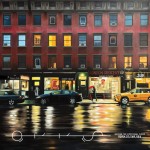
The visual presentation reinforces the record's narrative ambitions. Polish artist Marta Mez provides the painting used for the cover, while Matteo Uggeri's graphics extend the artwork through the inner posters. This unfolding presentation is more than a packaging detail: it gives the physical edition an additional dimension, suggesting that the album's story is revealed gradually rather than delivered in a single explanatory statement. In an age when much music is encountered as a small rectangle on a screen, the decision to make the artwork part of the experience feels refreshingly deliberate. The CD edition comes in a gatefold card case, while the vinyl release is issued through Secret Lovers in the United States, with Silentes handling the Italian CD edition.
"Beyond the Emotional Flood" is ultimately an album about the strange ways in which separate experiences can acquire a shared form. Its emotional centre is personal, but its method is collaborative; its source material is rooted in particular moments, but its presentation avoids the confessional directness that might have made it overly literal. Open to the Sea continue to favour subtle transformations over dramatic gestures, and their willingness to leave certain connections unexplained gives the record room to breathe. The result is less a musical account of emotional recovery than an attempt to understand what remains when intense experiences have been translated into something that can be shared.
Perhaps that is the most persuasive aspect of the project: the recognition that connection does not always require proximity, complete understanding or even a particularly sensible explanation. Sometimes it takes three musicians, several cities, a handful of messages and a considerable amount of editing to establish that other people have been feeling something vaguely similar. It is an elaborate procedure, admittedly, but considerably more productive than sending another message beginning with "We need to talk".
mHz: Prime Frequencies

There are records that invite you to lose yourself in sound, and then there are records that would quite like you to know exactly what sound is made of before you start losing yourself. "Prime Frequencies", the latest work by Mo H. Zareei under his mHz alias, belongs firmly to the latter category. Its starting point is deceptively modest: the sine wave, that elementary building block of electronic sound, and the prime number, that stubborn mathematical entity divisible only by itself and one. Put the two together and you have the basis for a rather unusual compositional system. Put 47 pieces on a CD and you have something that might initially look like an especially demanding mathematics examination, although the prospect is considerably more entertaining than it sounds.
The connection is more than a clever intellectual exercise. A sine wave represents the simplest form of periodic oscillation, while prime numbers occupy a foundational position in arithmetic. Both are elementary structures from which more complicated systems can be assembled. Zareei takes this parallel as the organising principle for a collection of sonic studies, each corresponding to a particular category of prime numbers. Frequencies and time-domain values are determined by the relevant primes, with algorithmic and aleatoric procedures developed in ChucK, a programming language designed for audio synthesis and real-time sound processing. The result is a work in which mathematical properties are not merely illustrated by sound: they become the parameters through which sound is generated.
The distinction matters. "Prime Frequencies" does not attempt to make mathematics sound beautiful by adding a suitably tasteful electronic soundtrack to it. Instead, it asks what happens when mathematical relationships are allowed to determine the material and behaviour of a composition. The sine wave is stripped of much of the expressive baggage traditionally associated with musical instruments. There are no guitars yearning for a lost summer, no strings performing their customary emotional blackmail, no percussion pretending that every human experience can be resolved through a well-timed crescendo. The basic ingredients are frequencies, durations, numerical relationships and the procedures that connect them.
That reduction does not necessarily mean an absence of complexity. A pure tone may be elementary, but the interaction between multiple frequencies can produce interference, beating and shifting perceptual relationships. Small changes in frequency or duration can have consequences that are disproportionate to their apparent simplicity. The listener is therefore confronted with a peculiar paradox: the materials are minimal, but the system governing them is anything but trivial. What appears to be a straightforward electronic tone can become an investigation into how we perceive difference, repetition and organisation. The ear, meanwhile, is expected to do its part without demanding a melody every thirty seconds. Not everybody will consider this a reasonable arrangement.
The tracklist reinforces the work's unusual character. Its 47 titles read like a gathering of mathematical personalities, some familiar enough to suggest a school textbook, others apparently determined to make the average listener regret having skipped a few lessons. "Fibonacci", "Mersenne", "Fermat" and "Factorial" sit alongside "Wieferich", "Wagstaff", "Woodall", "Motzkin" and "Newman-Shanks-Williams". There are also combinations of categories, including "Safe + Sophie Germain", "Good + Happy + Lucky + Super" and the rather imposing "Centered Square + Centered Triangular + Centered Heptagonal + Centered Decagonal". One might reasonably suspect that the last title was devised by someone who had run out of room on a conference badge.
Yet the nomenclature has a useful effect. It gives each miniature a distinct conceptual identity while making the album feel like a catalogue of related but non-identical experiments. The pieces vary considerably in duration, from fleeting gestures lasting only a few seconds to longer studies such as "Quintuplets", "Quadruplets", "Circular", "Solinas" and "Sextuplets". This difference in scale is not incidental. The short works offer concentrated encounters with a particular numerical category, while the longer ones provide more time for the underlying processes to unfold. The sequence consequently resists the expectation of a conventional album in which every track must contribute to a continuous emotional arc. It is closer to a collection of specimens, although specimens that happen to have been given the opportunity to make themselves heard.
There is a risk in this approach. When a work is built around a clearly articulated conceptual framework, the explanatory text can become more fascinating than the listening experience itself. The danger is that the listener ends up admiring the mechanism rather than engaging with its results, rather like someone spending an entire evening discussing the engineering of a clock without noticing that it has stopped. Zareei's decision to make the compositional code available alongside the album is therefore especially important. It prevents the project from becoming a sealed intellectual object and offers another way into its construction.
The two versions also establish a revealing distinction between composition as a finished recording and composition as an executable process. The CD presents a single rendering of the code, subjected to basic audio processing to provide a more consistent listening experience. The accompanying code version, available in both browser-based and locally compiled formats, dispenses with that additional processing. It allows the pieces to be navigated interactively, displays the numerical values responsible for the active frequencies and, where generative or aleatoric procedures are involved, produces slightly different results each time they are played. In other words, the CD offers a fixed document of the experiment, while the code version exposes the experiment as an ongoing event.
This is not simply a bonus for people who enjoy rummaging around in programming environments. It changes the nature of the work. The code becomes both score and instrument, while the listener is given access to the rules that shape the audible result. The distinction between composition and performance becomes less straightforward: the system establishes its conditions, but its real-time execution can introduce variations that prevent every encounter from being identical. The listener's equipment and hearing also become part of the equation, particularly in the unprocessed version, where the perceived loudness of different frequencies can vary substantially. A computer may be perfectly indifferent to the listener's comfort, but the human auditory system has its own rather uncompromising quality-control department.
The artist's background makes this combination of mathematical thinking and sonic investigation entirely coherent. Mo H. Zareei, an Iranian sound artist and researcher based in New Zealand, has a BSc in physics from Shahid Beheshti University in Tehran, a BFA in Music Technology from the California Institute of the Arts and a PhD in Sonic Arts from Victoria University of Wellington, where he works as a lecturer. Under the mHz name, he has released music through labels including Room40, LINE, Important Records, leerraum and KASUGA, while his wider practice encompasses electronic composition, kinetic sound sculptures and audiovisual installations. His work has repeatedly examined the relationship between noise and formal structures, often using custom-built software and hardware to turn apparently restrictive systems into sources of unexpected activity. His installation "Rasping Music" received the first prize in the Sound Art category at the 2015 Sonic Arts Award, while "Material Sequencer" was shortlisted for the Aesthetica Art Prize in 2024. This is an artist for whom the machinery behind a sound is not an invisible technical detail but an essential part of its identity.
The project also has a significant research context. "Prime Frequencies" was commissioned by Laboratoire formes•ondes as part of "Towards an Aesthetic of the Sine Wave", a research-creation initiative led by Nicolas Bernier at the University of Montreal. The project investigates the aesthetic possibilities of the sine wave through commissioned works, research papers, a database and the development of different approaches to composition and performance. Zareei's contribution is particularly apt because it takes the investigation beyond the familiar question of what a sine wave sounds like. It considers how an elementary acoustic unit might be organised according to a different elementary system, and what aesthetic possibilities emerge from that correspondence.
There is something quietly provocative about this proposition. Electronic music has often celebrated the machine as a means of expanding the possibilities of sound, but "Prime Frequencies" moves in the opposite direction, reducing its resources to an almost austere minimum and then examining the consequences. Its conceptual ambition is not to make the simple appear complicated, but to demonstrate that simplicity is not necessarily the same thing as predictability. A handful of numerical rules can produce an extensive range of relationships, and the most basic ingredients can still resist complete anticipation. The process may be mathematical, but the experience remains dependent on perception, attention and the peculiar ways in which the ear responds to patterns.
The album's 47 pieces could easily have become an academic demonstration with an accompanying audio file, but the decision to present them as individual compositions gives the project a more open character. Their titles are informative without being entirely explanatory, and their different durations suggest that no single formal solution is imposed on every category. The result is a work that can be approached through its underlying theory or simply through the succession of sounds. Neither approach invalidates the other, although the code version clearly rewards listeners willing to look beyond the conventional boundaries of a recording.
"Prime Frequencies" is not an invitation to hum along, unless one's idea of a memorable chorus involves a mathematical constant and a particularly disciplined oscillator. Its pleasures are more cerebral, but not exclusively so. It encourages a heightened awareness of elementary sonic events and the relationships that emerge when they are arranged according to precise conditions. More importantly, it demonstrates that conceptual rigour need not suffocate curiosity. Zareei has devised a system with clear rules, yet the system's output remains open to variation and interpretation. There is a certain elegance in that balance: the numbers provide the discipline, the sound supplies the uncertainty, and the listener is left to negotiate the distance between them.
In the end, "Prime Frequencies" makes a persuasive case for listening to the smallest possible components without assuming that smallness means insignificance. It is a record about foundations, but not one that spends its time gazing nostalgically at the ground floor. Instead, it examines what can be built from apparently indivisible elements, and how much activity can be concealed within a single, unadorned tone. The universe may or may not be humming in prime numbers, but Zareei has at least provided a rather convincing reason to pay closer attention to its basic ingredients.
Brian House: Synchronizing Uncertainty
Artist: Brian House (@)
Title: Synchronizing Uncertainty
Format: Download Only (MP3 + Lossless)
Label: Line (@)
Rated:

Title: Synchronizing Uncertainty
Format: Download Only (MP3 + Lossless)
Label: Line (@)
Rated:
The idea of getting everyone to move in time has occupied humanity for quite a while. We have marching armies, religious ceremonies, factory shifts, football chants, dancefloors and those increasingly alarming corporate team-building exercises. Synchrony can be reassuring, even exhilarating, but it also has a darker side: the collective rhythm of a crowd can become an instrument of conformity, while the individual who refuses to follow it is quickly identified as a nuisance. Brian House approaches this peculiar human obsession from a different direction on "Synchronizing Uncertainty", a recording of his sound installation presented at ArtYard in Frenchtown, New Jersey, in the summer of 2025. Rather than composing a piece and asking performers to follow it, he creates a system in which rhythm emerges through the interactions of autonomous electronic organisms. The result is an intriguing exercise in organised instability, where the music is neither entirely composed nor genuinely left to chance.
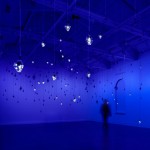
The installation consists of hundreds of independent electronic circuits, each equipped with a nonlinear mechanism that allows it to listen and respond to nearby oscillators. They pulse at their own rates, occasionally adjusting their behaviour in response to others. Gradually, temporary relationships develop: rhythms converge, diverge, overlap and occasionally produce larger patterns. Visitors moving through the gallery can influence these processes, triggering cascades of activity simply by changing their position within the space. The system is therefore neither a conventional musical performance nor an entirely autonomous machine. It is a network of relationships in which human presence becomes one more variable.
This is an important distinction. House is not interested in presenting technology as a neutral instrument obediently executing an artistic intention. His circuits possess a degree of independence, and their interactions generate results that cannot be fully anticipated. Synchronisation is possible, but never guaranteed; even when several oscillators fall into step, the arrangement remains vulnerable to further changes. The title captures this condition with considerable precision. Uncertainty is not an obstacle that must eventually be overcome, but the very circumstance that makes the system productive.
The LINE release translates this installation into three recordings, each exploring a different set of conditions. "One person moving" lasts just over six minutes and documents the system responding to the presence of a single visitor. "Two people moving" extends the experiment to nine minutes, introducing another source of interference and another possible set of relationships. The final and longest piece, "Spontaneous activation only", runs for more than nineteen minutes and removes visitor movement from the equation, allowing the circuits to activate and interact independently. This progression is conceptually neat without becoming excessively didactic. The titles provide enough information to understand the parameters, while the actual sound remains open to interpretation.
What emerges is a shifting field of electronic pulses, clicks and overlapping rhythmic structures. There is no conventional melody to follow, no harmonic progression waiting to deliver emotional closure, and certainly no kick drum with a contractual obligation to arrive every four bars. Instead, the listener encounters a collection of small events whose relationships become increasingly fascinating as the recording develops. Some patterns seem to establish themselves briefly before being displaced by competing rhythms. Others produce intricate polyrhythmic exchanges, with different pulse rates occupying the same acoustic environment. The effect can be hypnotic, but it is not the smooth, reassuring hypnosis associated with much minimalist music. It has a nervous quality, as though the system were constantly reconsidering its own decisions.
The most compelling aspect of the work is the way it makes an abstract principle perceptible without reducing it to a demonstration. We can hear individual pulses, but the interest lies in what happens between them. A single oscillator is hardly remarkable; hundreds interacting create a much more complex situation. The smallest adjustments acquire significance because they affect neighbouring components, which in turn influence others. The resulting patterns resemble biological activity, but also the behaviour of social groups, where individual actions produce collective consequences that nobody entirely controls. It is a form of musical organisation in which the whole is more than the sum of its parts, although the parts would probably object to being told what to do by the whole.
House's artistic background makes this approach particularly coherent. His practice investigates the rhythms of human and nonhuman systems, often using sound, custom technology and data as ways of examining relationships that ordinarily remain difficult to perceive. His earlier projects have included "Quotidian Record" (2012), which transformed a year of personal geolocation data into a vinyl record, and works exploring the sounds and behaviour of urban rats. More recently, "Everyday Infrasound in an Uncertain World", released by Gruenrekorder in 2025, investigated extremely low-frequency phenomena and the largely inaccessible acoustic dimensions of the environment. Across these projects, House repeatedly asks how technology might help us listen to processes that are normally outside the limits of everyday perception.
His academic background is equally relevant. House holds a PhD in Computer Music from Brown University and has worked in research environments concerned with spatial data, digital media and experimental technology. He is currently an Assistant Professor of Art at Amherst College, and his work has appeared at institutions including MoMA, Los Angeles MOCA, Ars Electronica and ZKM. This is not simply an artist who happens to know how to build electronic devices. His practice combines technical investigation with a broader interest in the political and social implications of systems, particularly the ways in which apparently independent entities become interconnected. In "Synchronizing Uncertainty", that concern finds an unusually direct sonic expression.
The recording also raises an interesting question about the relationship between an installation and its documentation. In the gallery, the work occupied a substantial physical space, with hundreds of circuits distributed throughout the environment. Visitors could move among them and influence their behaviour, experiencing the system from different positions. A recording necessarily changes that relationship. The listener is no longer physically implicated in the installation and cannot trigger its responses. Instead, the binaural documentation offers a fixed perspective on processes that were originally spatial and participatory. Something is inevitably lost in the translation, particularly the freedom to explore the installation bodily, but the recording gains a different kind of concentration. It allows the listener to attend to the internal behaviour of the system without the distractions of navigating a gallery.
The three-track structure is therefore more than a convenient division of the material. It gives the listener a basic framework for comparing different forms of interaction. The first two recordings introduce human movement as an external influence, while the third reveals what happens when the circuits are left to their own devices. The contrast is subtle but meaningful. Human intervention does not simply add activity; it changes the conditions under which the system negotiates its rhythms. The absence of visitors, meanwhile, does not produce silence or a return to some imaginary natural equilibrium. The circuits continue to interact, demonstrating that complexity does not require a human conductor.
There is also a quietly provocative social dimension here. House draws connections between synchronisation in nature and culture, from the collective behaviour of crickets and fireflies to the beating of heart cells, applause, military marching and political protest. These examples are not interchangeable, of course. Some forms of synchrony emerge through mutual adaptation, others through external pressure or coercion. The installation does not offer a simplistic moral distinction between good and bad forms of collective behaviour. Instead, it makes the underlying mechanism audible: independent entities responding to one another, producing temporary agreements that may be disrupted at any moment. In an era when digital platforms can rapidly turn individual impulses into collective reactions, the analogy feels particularly pertinent.
One could argue that the conceptual framework is more immediately impressive than the listening experience itself. Without access to the installation, some of the system's complexity inevitably remains invisible, and listeners expecting a conventional album may find the material austere. The absence of melody and harmonic development can make the pieces feel deliberately resistant, while the gradual evolution of their rhythmic structures demands patience. But this is not a record that should be judged according to how successfully it behaves like a collection of conventional compositions. Its purpose is different, and its musical vocabulary emerges from the very conditions that House has established.
The final track is particularly effective in this respect. At nineteen minutes, "Spontaneous activation only" gives the autonomous system sufficient time to reveal its internal dynamics. Without visitors acting as additional stimuli, the circuits still generate a surprisingly varied rhythmic environment. Patterns appear and disappear, temporary alignments form, and the overall texture changes through countless small adjustments. There is no final resolution because the process itself has no reason to conclude. The music simply continues to negotiate its own existence.
"Synchronizing Uncertainty" is an intelligent and genuinely engaging work that occupies an unusual position between experimental music, sound art and technological research. Its most valuable achievement is not the novelty of making electronic circuits produce sound, but the way it uses their behaviour to examine a fundamental condition of collective life. Synchronisation can create cooperation, beauty and shared purpose, but it can also become rigid, coercive and dangerously uniform. House's system offers no definitive answer, and wisely avoids pretending that one exists. It suggests instead that meaningful coexistence depends on the capacity to adjust without surrendering individuality.
Perhaps the most human thing about these machines is that they never quite manage to agree. And perhaps that is precisely why their conversation is worth listening to.
Victor Davies: Be The One

Artist: Victor Davies (@)
Title: Be The One
Format: Download Only (MP3 + Lossless)
Label: Compost Records (@)
Rated:
Title: Be The One
Format: Download Only (MP3 + Lossless)
Label: Compost Records (@)
Rated:
There are comebacks that arrive with a considerable amount of noise, as if the artist were obliged to remind everyone of their existence before even playing a note. Victor Davies takes a more agreeable approach. With "Be The One", he returns to Compost Records, the German label that released his self-titled debut in 2001, reconnecting with a musical environment in which soul, jazz, house and sophisticated pop were never particularly interested in respecting their respective property boundaries. The result is a warmly melodic single that feels familiar without being entirely trapped by its own history. No grand reinvention, no desperate attempt to sound twenty years younger: just a good song, delivered with the kind of confidence that makes such things seem deceptively easy.
Davies has a rather interesting history behind him. Born in East London to an English mother and a father from Sierra Leone, he began playing music at fourteen, initially developing his skills as a guitarist before finding his own way as a singer, songwriter and producer. His early career included a publishing deal that ultimately proved restrictive, prompting him to abandon the prospect of writing according to somebody else's commercial expectations. He subsequently developed his own material, with the independent People Records providing an early platform for his work. His 2001 debut, "Victor Davies", introduced a distinctive combination of acoustic instrumentation, soul, jazz, Latin influences and electronic production. The follow-up, "Hoxton Popstars" (2004), achieved considerable success in Japan, where the single "Fire" reached the top of the charts for two consecutive weeks. "Hear the Sound" (2006), featuring Brazilian vocalist Bebel Gilberto, further demonstrated his ability to move between musical traditions without turning eclecticism into a marketing strategy.
His subsequent collaborations have included artists such as Quincy Jones, Richard Bona, Roy Hargrove and Louie Vega, while his work as a producer has extended into projects for other performers. Davies is also a painter and filmmaker, and his visual work shares an interest in colour, movement and expressive texture with his music. This multidisciplinary background is relevant because his songwriting has always been concerned with atmosphere and emotional communication as much as with the mechanics of genre. His approach is not particularly academic: he seems to regard musical categories as useful descriptions rather than instructions that must be followed to the letter. That attitude is audible in "Be The One", which combines an accessible pop sensibility with the more refined rhythmic instincts of someone who has spent a considerable amount of time around jazz and dance music.
The original version is a compact, four-and-a-half-minute piece built around Davies' unmistakable vocal presence. His delivery is relaxed and intimate, with a soulful warmth that avoids the temptation to turn every melodic phrase into a demonstration of vocal ability. There is a certain generosity in the way the song is presented: the melody is immediately approachable, the arrangement remains uncluttered, and the overall mood is positive without becoming aggressively cheerful. This is not music that insists on changing your life before breakfast. It is content to make the morning considerably more pleasant, which is arguably a more realistic ambition.
The title could easily suggest a conventional declaration of romantic devotion, and the song certainly operates within familiar territory. Yet Davies' interpretation avoids excessive sentimentality. His voice has a slightly weathered quality that gives the performance character, while the melodic writing balances sweetness with enough restraint to prevent the track from becoming an exercise in manufactured uplift. The production also benefits from its relatively modest proportions. Rather than burying the song beneath layers of studio decoration, it allows the vocal and the melodic structure to remain central. The result is catchy in the best sense: it leaves something behind after the track has finished, without resorting to the psychological equivalent of superglue.
The acoustic version provides an alternative perspective on the same material. Sharing the original's 4:27 running time, it is not simply an abbreviated promotional extra, but an opportunity to consider how much of the song's appeal resides in its composition rather than its production. Stripped of the more explicitly polished presentation, the melody becomes the main attraction, and Davies' voice takes on an even more direct role. There is a useful lesson here for anyone who assumes that a song becomes interesting only when surrounded by elaborate arrangements: sometimes the underlying writing has to do the actual work. The acoustic treatment also brings out the singer-songwriter side of Davies, recalling the more intimate foundations of his early recordings.
The two remixes by M-Scape and Yoshi Horino then move the material towards the dancefloor, although neither seems particularly interested in sacrificing its melodic identity. The Japanese producers approach the song through two complementary interpretations, extending its duration and shifting the emphasis towards deeper house territory. "Deep Love Remix", at 7:49, gives the original a more expansive club-oriented treatment, while "Deep Soul Remix", running for just over seven minutes, explores a different balance between rhythmic movement and soulful atmosphere. Their contribution is not simply to make the track longer, which is a fairly common occupational hazard in dance music, but to demonstrate how naturally Davies' vocal performance can inhabit a more electronic setting.
The involvement of Yoshi Horino is particularly fitting. A DJ and producer associated with Japan's deep-house community and the UNKNOWN season label, he has maintained a musical relationship with M-Scape that makes their joint approach to the remixes feel well established rather than opportunistic. Their work here also reflects the historical connection between Japanese club culture and the European nu-jazz scene, a relationship in which Compost Records has played a significant role. The remixes do not attempt to reconstruct the early-2000s sound of that scene as a museum exhibit. Instead, they preserve its appreciation for musicality, warmth and carefully shaped grooves while applying a contemporary deep-house sensibility.
There is something satisfying about the structure of this release. Four versions of one song might initially look like a rather modest proposition, but each serves a distinct purpose. The original establishes Davies' current musical identity; the acoustic version tests the strength of the composition without relying on production; and the two remixes reveal its potential within a club context. The package is therefore more coherent than a collection of unrelated reinterpretations, and the differences between the versions are substantial enough to justify their presence.
The broader significance of "Be The One" lies in its relationship with Davies' earlier work. His return to Compost is not merely a matter of revisiting an old professional address. The label helped introduce his music to an international audience at a time when the boundaries between jazz, soul, electronic production and sophisticated pop were being explored with considerable imagination. Davies was part of that wider movement, but his songwriting always had a recognisable personality of its own. This new single reconnects with that sensibility without pretending that the intervening years never happened.
Spanish and Brazilian Portuguese versions were also announced for the autumn, an interesting extension of a song whose melodic directness lends itself naturally to different languages. It will be worth seeing how the lyrics adapt, particularly because vocal phrasing and emotional nuance are not always as easily transferable as record-company announcements would have us believe. Still, the idea fits Davies' broader artistic outlook, which has consistently embraced different cultural influences rather than treating them as decorative additions.
"Be The One" is not an attempt to redefine contemporary soul, nor does it need to be. Its pleasures are more immediate and, in their own way, more durable: a memorable melody, a distinctive voice, an arrangement that knows when to step aside, and remixes that understand the value of the original rather than treating it as raw material for an entirely different product. Victor Davies sounds comfortable in his own musical skin, and that is perhaps the most encouraging aspect of this return. In a business that regularly confuses reinvention with changing one's haircut and acquiring a new social-media strategy, there is something refreshing about an artist simply returning to what he does well.
Some songs are designed to make a statement. Others just make you want to hear them again. "Be The One" belongs to the latter category, and there is no reason to consider that a lesser achievement.
Gary Holldman: Traveler

Artist: Gary Holldman
Title: Traveler
Format: 12" x 2 + Download
Label: International Day Off
Rated:
Title: Traveler
Format: 12" x 2 + Download
Label: International Day Off
Rated:
A journey can be measured in kilometres, border crossings, delayed trains and the number of questionable meals one has consumed in unfamiliar surroundings. It can also be measured in changes of tempo, shifts in atmosphere and the gradual alteration of one's mental furniture. For Gary Holldman, the latter seems considerably more interesting. "Traveler", his first full-length album after more than fifteen years of releasing music, is a record shaped by geographical experiences but not particularly interested in reproducing the usual postcard version of them. Instead, it translates the impressions of different places into ten pieces of electronic music, allowing techno to become a language for recollection rather than merely an efficient method of keeping people moving until closing time.
Released by International Day Off as IDO027, the album arrives on double vinyl and digital formats, and represents a significant step for an artist whose reputation has largely been built through singles, EPs and DJ activity. Holldman, whose real name is Szymon Krzywosz, made his debut at a Tresor Night event at Pozna's now-defunct Eskulap club in 2009. His first vinyl releases followed in 2010 through the German labels RELAX2000 and Ware Records. In 2015, he co-founded International Day Off, a label that has developed a distinctive identity around minimal, deep and hypnotic techno, bringing together Polish producers and international names. Holldman has since established himself as one of its central figures, while his own productions have attracted support from DJs including Laurent Garnier, DVS1, Ben Klock and Marcel Dettmann. These credentials might suggest a straightforward club-oriented debut. "Traveler", however, has other plans.
In an interview published shortly before the album's release, Holldman explained that he wanted to avoid the predictable structure of a long player consisting of ten variations on essentially the same track. His intention was to create something diverse yet coherent, approaching the record more like a book than an extended DJ tool. It is an ambition that makes sense when considering the album's sequencing. The ten compositions are individually identifiable, with their own rhythmic profiles and emotional temperatures, but they also belong to a larger design. The music does not abandon the physical appeal of techno; it simply refuses to regard functionality as its only legitimate purpose.
"Sand" opens proceedings with a relatively relaxed disposition, closer to the lingering atmosphere of a beachside afterparty than an invitation to storm the dancefloor. Its extended duration allows the rhythmic components to establish themselves without immediately demanding attention. There is a certain spaciousness to the piece, a sense of activity taking place at a distance, while the underlying pulse maintains enough tension to prevent the whole affair from dissolving into ambient wallpaper. "Waves" continues with a more pronounced rhythmic presence, its title suggesting a natural movement that is reflected in the music's gradual shifts and recurring patterns. Neither track needs to announce its intentions particularly loudly. They are more interested in establishing conditions than delivering instructions.
"Tribe" introduces a more assertive, percussive character, with tribal accents giving the rhythm a distinctly physical quality. It is followed by "Bui Vien", whose broken, heavier construction marks one of the album's more noticeable changes of direction. The title refers to a street in Ho Chi Minh City, and Holldman has identified both this track and "Sapa" as musical recollections of Vietnam. The latter moves differently, maintaining a more conventional techno framework while allowing its internal details to develop with considerable patience. There is no attempt to reproduce the sounds of a particular location through obvious samples or exotic decoration. Instead, the geographical references seem to function as emotional coordinates: the music recalls an experience without needing to illustrate it.
The Scottish connection emerges with "Sgurr" and "Skye", two titles associated with the country's mountainous landscapes and islands. Holldman has described these places in terms of their demanding physical conditions, changing weather and particular sense of movement. That perspective offers an interesting way of approaching the tracks. "Sgurr" carries a more determined rhythmic momentum, while "Skye" feels comparatively open, its propulsion allowing for a little more room around the beat. The contrast is subtle but meaningful. Travel, after all, is not simply a succession of new views; it involves adapting to different circumstances, and these compositions seem to understand that distinction.
One of the album's strengths is the way it uses repetition without becoming imprisoned by it. The rhythmic structures are often economical, but the details are not. Small changes in percussion, modulation and texture gradually alter the listener's perception of a pattern that might initially seem straightforward. The low frequencies provide much of the music's physical weight, while the more delicate electronic elements prevent the arrangements from becoming unnecessarily muscular. Holldman's production has a carefully controlled quality, but it does not feel sterile. There is enough movement within the structures to suggest that the machinery is being operated by someone with a genuine interest in what happens between the obvious beats.
"The Butterfly Effect" develops this approach through a more intricate arrangement, its title hinting at the relationship between small interventions and larger consequences. It is an appropriate metaphor for music in which minor adjustments can significantly change the character of an otherwise stable rhythmic framework. "EXO" offers a more compact, concentrated episode, before "Skye" returns to the album's geographical thread. Finally, "The End" closes the sequence without turning the title into an unnecessarily dramatic announcement. After more than an hour of music, the conclusion feels measured rather than conclusive. There is no grand orchestral farewell, no sudden revelation, and certainly no need for an airport announcement.
The album's melodic side is another important element. Holldman's relationship with Detroit techno is apparent, particularly in the way he balances propulsion with a melancholic undertow. Yet "Traveler" is not an exercise in historical reconstruction. Its references to Motor City are filtered through a contemporary production sensibility, with modular-inspired modulation, carefully shaped bass frequencies and a preference for gradual development. The result sits comfortably between deep and hypnotic techno, occasionally approaching more experimental territory without losing its rhythmic centre. It is music designed to function in a club, but it does not become entirely dependent on the club environment for its meaning.
Holldman's broader musical interests help explain this flexibility. In a 2024 interview, he mentioned Boards of Canada's "Music Has the Right to Children" and the house music of Chez Damier among his listening choices, while also expressing a preference for exploring genres beyond techno in his free time. That distinction is revealing. Rather than treating his own musical specialisation as a sealed environment, he seems to regard it as one area of a much larger listening experience. His work for the Italian brand Davines, composing original music for fashion and performance events, also demonstrates an interest in contexts beyond the conventional dancefloor. The ability to move between ambient passages, more eclectic material and tightly structured grooves is therefore not an accidental feature of "Traveler", but part of an established creative approach.
There is, admittedly, a potential weakness in the album's conceptual framework. The association between travel and electronic music can become rather convenient, especially when track titles begin to resemble the destinations on an airline's departure board. But Holldman mostly avoids that trap because the music is not dependent on the listener recognising the places involved. Someone unfamiliar with Bui Vien, Sapa or the Isle of Skye can still appreciate the differences in mood and construction. The titles add another layer to the experience rather than functioning as explanatory captions. The album is at its best when it allows those references to remain suggestive.
Ultimately, "Traveler" is a convincing debut precisely because it does not behave like a debut. There is little evidence of an artist attempting to prove that he can make an album simply by increasing the number of tracks or stretching familiar ideas beyond their natural duration. Instead, Holldman uses the longer format to explore the diversity already present in his work, giving individual compositions enough room to establish their own identities while maintaining a recognisable musical perspective. The double-vinyl format feels appropriate for a record that values sequencing and gradual development, rather than treating its contents as a collection of interchangeable dancefloor utilities.
After fifteen years of working within the discipline of electronic production, Holldman has finally assembled a substantial statement under his own name. "Traveler" is not a radical reinvention of techno, nor does it need to be. Its achievement lies in making familiar materials feel personal through careful arrangement, considered pacing and a willingness to let different experiences influence the music's internal logic. It is a record for dancers who occasionally look beyond the lights, and for listeners who understand that a good journey is not necessarily about reaching somewhere. Sometimes it is about discovering that the same road can sound entirely different on the way back.