
Browse by Genre
Industrial Music / Industrial Metal / Aggro Industrial / Electro Metal
Industrial Noise / Power Noise / Harsh Noise
Synth Pop / Electro Pop / Synth-Electronica
Techno / Trance / Goa / Drum'n'Bass / Jungle / Tribal / Trip-Hop
Ambient / Electronica / Ethereal / Dub / Soundscapes / Abstract
Experimental / Avantgarde / Weird & Wired / Glitch / Noise / Field Recording
Dark / Gothic / Wave / New Wave / Dark Wave / Industrial Gothic
New Music / Downtown / Avantgarde Jazz / New Classical / World
Search Reviews
Music Reviews
Design: Faithless

Artist: Design (@)
Title: Faithless
Format: CD & 12" + Download
Label: Overdub Recordings (@)
Rated:

Title: Faithless
Format: CD & 12" + Download
Label: Overdub Recordings (@)
Rated:
There is a peculiar honesty in calling an album "Faithless". Not because disbelief is fashionable, but because certainty has become exhausting. The third full-length by Italian quartet Design does not wage war against religion so much as it mourns the disappearance of dependable foundations altogether. God, politics, institutions, even memory itself are placed on trial, not through slogans but through the slow erosion of confidence. It is an album about discovering that the floor beneath your feet was made of fog all along.
Formed in 2008, Design have steadily evolved from an industrial-tinged alternative rock act into something darker and more psychologically nuanced. Their early releases flirted with electronic rock and new wave, but "Faithless" feels like the record where those influences finally become a coherent language rather than a collection of references. Produced by Enrico Tiberi between Italy and Berlin and mastered by Pete Maher, whose résumé spans artists from Nine Inch Nails to Depeche Mode and Nick Cave & The Bad Seeds, the album sounds expansive without becoming overproduced. Every synth pulse, guitar scrape and programmed beat has room to breathe, as though silence itself had been invited into the mix.
The title track establishes the emotional coordinates immediately. Inspired by the helplessness of standing beside a deathbed, it transforms personal mourning into something universal. The absence of divine answers is not met with theatrical rage but with an almost desperate longing for tangible human connection. Rather than searching heaven for miracles, the song suggests that another person's embrace may be the closest thing we have.
That tension between intimate grief and societal collapse runs throughout the record. "Cold War" shifts the battlefield indoors, portraying domestic conflict with unsettling restraint. Instead of explosions, there are closed doors, suppressed emotions and the suffocating politeness that often surrounds private suffering. It is one of the album's strongest moments precisely because it understands that the loudest violence is sometimes whispered.
Musically, Design navigate the fertile ground between post-punk, darkwave and contemporary electronic rock with confidence. Echoes of Depeche Mode and New Order appear in the melodic instincts, while sharper industrial textures recall the mechanical anxiety of Nine Inch Nails or the sleek emotional abrasion of Crosses. Yet these influences rarely become imitation. The band avoids the museum-piece nostalgia that often burdens revivalist acts, preferring to reinterpret familiar aesthetics through the lens of today's fractured emotional landscape.
The sequencing deserves particular praise. "Sweet Surrender" dances defiantly through cultural decay, offering one of the record's few moments of bitter exhilaration. Its vision of celebrating while the empire burns feels less nihilistic than oddly liberating, as if acknowledging collapse were healthier than endlessly pretending stability still exists. "Blame" follows with painful introspection, refusing the increasingly fashionable habit of outsourcing responsibility. Personal accountability, it turns out, is heavier than conspiracy theories but considerably more useful.
Even the brief instrumental "12 | 12" serves a purpose, functioning as a deep breath before the second half descends further into paranoia and confrontation. "Evil Eye" dismantles toxic attachment through sharp rhythmic tension, while "Red Dragon" expands outward into biblical imagery refracted through environmental destruction and endless warfare. Rather than preaching, the lyrics present symbolic landscapes where mythology and contemporary headlines blur into each other.
The album's final stretch becomes increasingly philosophical. "Loner's Dream" offers fragile tenderness amidst existential uncertainty, asking whether love itself might simply be someone's fading dream. "Keyhole" examines media manipulation with uncommon subtlety, questioning not only what we see but our willingness to participate in carefully staged spectacles. In an era where outrage is monetized by the minute, peeking through a keyhole starts to resemble scrolling endlessly through social media. The monkey with golden chains may have upgraded to a touchscreen.
Everything ultimately converges in the magnificent closer, "The Belly of the Whale". Drawing simultaneously on literary and biblical symbolism, the whale becomes sanctuary, tomb and womb all at once. It is the place where grief ceases to be an enemy and instead becomes something one learns to inhabit. Emerging from its darkness does not erase loss; it simply allows life to continue carrying it differently.
"Faithless" doesn't surrender entirely to despair. Even when confronting death, manipulation, violence and ideological collapse, Design leave open the possibility that redemption survives through empathy, self-awareness and love rather than dogma. That is a surprisingly radical proposition in an age where certainty is sold in convenient packages and doubt is treated like a defect.
"Faithless" is not interested in providing answers. It builds a cathedral from unanswered questions, fills it with pulsing basslines, spectral synthesizers and wounded melodies, then quietly reminds us that perhaps belief has never been about possessing certainty. Sometimes it is simply the courage to keep walking after the lights have gone out. In that sense, Design have crafted one of the more emotionally mature darkwave records in recent memory: bleak without becoming cynical, introspective without becoming self-indulgent, and heavy enough to leave a bruise that lingers well after the final note fades.
Formed in 2008, Design have steadily evolved from an industrial-tinged alternative rock act into something darker and more psychologically nuanced. Their early releases flirted with electronic rock and new wave, but "Faithless" feels like the record where those influences finally become a coherent language rather than a collection of references. Produced by Enrico Tiberi between Italy and Berlin and mastered by Pete Maher, whose résumé spans artists from Nine Inch Nails to Depeche Mode and Nick Cave & The Bad Seeds, the album sounds expansive without becoming overproduced. Every synth pulse, guitar scrape and programmed beat has room to breathe, as though silence itself had been invited into the mix.
The title track establishes the emotional coordinates immediately. Inspired by the helplessness of standing beside a deathbed, it transforms personal mourning into something universal. The absence of divine answers is not met with theatrical rage but with an almost desperate longing for tangible human connection. Rather than searching heaven for miracles, the song suggests that another person's embrace may be the closest thing we have.
That tension between intimate grief and societal collapse runs throughout the record. "Cold War" shifts the battlefield indoors, portraying domestic conflict with unsettling restraint. Instead of explosions, there are closed doors, suppressed emotions and the suffocating politeness that often surrounds private suffering. It is one of the album's strongest moments precisely because it understands that the loudest violence is sometimes whispered.
Musically, Design navigate the fertile ground between post-punk, darkwave and contemporary electronic rock with confidence. Echoes of Depeche Mode and New Order appear in the melodic instincts, while sharper industrial textures recall the mechanical anxiety of Nine Inch Nails or the sleek emotional abrasion of Crosses. Yet these influences rarely become imitation. The band avoids the museum-piece nostalgia that often burdens revivalist acts, preferring to reinterpret familiar aesthetics through the lens of today's fractured emotional landscape.
The sequencing deserves particular praise. "Sweet Surrender" dances defiantly through cultural decay, offering one of the record's few moments of bitter exhilaration. Its vision of celebrating while the empire burns feels less nihilistic than oddly liberating, as if acknowledging collapse were healthier than endlessly pretending stability still exists. "Blame" follows with painful introspection, refusing the increasingly fashionable habit of outsourcing responsibility. Personal accountability, it turns out, is heavier than conspiracy theories but considerably more useful.
Even the brief instrumental "12 | 12" serves a purpose, functioning as a deep breath before the second half descends further into paranoia and confrontation. "Evil Eye" dismantles toxic attachment through sharp rhythmic tension, while "Red Dragon" expands outward into biblical imagery refracted through environmental destruction and endless warfare. Rather than preaching, the lyrics present symbolic landscapes where mythology and contemporary headlines blur into each other.
The album's final stretch becomes increasingly philosophical. "Loner's Dream" offers fragile tenderness amidst existential uncertainty, asking whether love itself might simply be someone's fading dream. "Keyhole" examines media manipulation with uncommon subtlety, questioning not only what we see but our willingness to participate in carefully staged spectacles. In an era where outrage is monetized by the minute, peeking through a keyhole starts to resemble scrolling endlessly through social media. The monkey with golden chains may have upgraded to a touchscreen.
Everything ultimately converges in the magnificent closer, "The Belly of the Whale". Drawing simultaneously on literary and biblical symbolism, the whale becomes sanctuary, tomb and womb all at once. It is the place where grief ceases to be an enemy and instead becomes something one learns to inhabit. Emerging from its darkness does not erase loss; it simply allows life to continue carrying it differently.
"Faithless" doesn't surrender entirely to despair. Even when confronting death, manipulation, violence and ideological collapse, Design leave open the possibility that redemption survives through empathy, self-awareness and love rather than dogma. That is a surprisingly radical proposition in an age where certainty is sold in convenient packages and doubt is treated like a defect.
"Faithless" is not interested in providing answers. It builds a cathedral from unanswered questions, fills it with pulsing basslines, spectral synthesizers and wounded melodies, then quietly reminds us that perhaps belief has never been about possessing certainty. Sometimes it is simply the courage to keep walking after the lights have gone out. In that sense, Design have crafted one of the more emotionally mature darkwave records in recent memory: bleak without becoming cynical, introspective without becoming self-indulgent, and heavy enough to leave a bruise that lingers well after the final note fades.
Space Travel Is Boring: The Horror! The Horror!
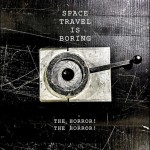
Artist: Space Travel Is Boring
Title: The Horror! The Horror!
Format: Tape + Download
Label: Zoharum (http://zoharum.com/) (@)
Rated:
Title: The Horror! The Horror!
Format: Tape + Download
Label: Zoharum (http://zoharum.com/) (@)
Rated:
There are records that attempt to describe troubled times by raising their voice. "The Horror! The Horror!" chooses the opposite strategy. It whispers, and somehow that makes it more unsettling. The debut full-length from Space Travel Is Boring, the collaboration between Polish musicians Bartosz Leniewski and Michal Smolicki, was assembled patiently over several years, absorbing the psychological residue of pandemics, wars and humanitarian crises until those events became less a topic than a permanent weather system hanging over the music. It is not an album about headlines. It is an album about what headlines do to the nervous system after months and years of accumulation.
Both musicians come from guitar-oriented backgrounds, yet they wisely resist treating ambient music as rock played in slow motion. Instead, guitars become fragments of atmosphere, dissolving into restrained synthesizers, distant voices and carefully measured rhythms. The result sits somewhere between post-rock, dark ambient and minimalist electronica, without ever feeling obliged to settle into any of those territories. Every track seems to move forward reluctantly, as though aware that progress is rarely synonymous with improvement.
The seven compositions unfold like reports filed from an exhausted conscience. "A Useful Trigger" introduces recurring pulses that feel almost reassuring until subtle harmonic shifts reveal cracks beneath the surface. "Smouldering Tyres" expands into one of the album's emotional peaks, allowing dissonance to accumulate with the slow inevitability of smoke filling a room. "The Solar Panels Are Broken", aided by the ghostly voices of Tekla and Helga, offers one of the few explicitly human presences, yet even those voices appear less as protagonists than as fragile signals trying to survive overwhelming interference.
Titles such as "Blood Diamonds", "Thick Smog Blankets a Festival Town" and "Save for Later, Stay Tuned" carry a dry irony that borders on black humour. They read almost like scrolling news notifications generated by an algorithm that has finally developed existential anxiety. Humans have achieved the remarkable feat of compressing catastrophe into clickable headlines; Space Travel Is Boring stretches them back into something that must actually be inhabited.
The duo demonstrates admirable restraint throughout. Many contemporary dark ambient releases mistake volume or density for emotional weight. Here, silence performs as much work as sound. Small rhythmic cells repeat with hypnotic insistence while electronic textures breathe rather than overwhelm, allowing melancholy to emerge naturally instead of being theatrically imposed. Even when distortion enters the frame, it feels organic, like corrosion spreading across metal rather than an effect added for dramatic emphasis.
There are echoes of post-industrial ambience, modern drone composition and cinematic minimalism, yet the album rarely sounds derivative. Its greatest strength lies in refusing obvious climaxes. Every apparent resolution opens another question, every comforting harmony carries the suspicion that it may soon collapse. The music inhabits uncertainty without romanticising despair.
"The Horror! The Horror!" definitely refuses to offer catharsis. There is no triumphant escape from contemporary anxiety, no comforting illusion that beauty automatically heals historical trauma. Instead, Leniewski and Smolicki suggest something quieter: creating attentive, fragile spaces may itself be a meaningful response when certainty has become a scarce resource.
The album's title inevitably recalls Joseph Conrad's famous final words, yet the music avoids literary grandstanding. Its horror is neither spectacular nor supernatural. It resides in accumulated helplessness, in the background hum of a world permanently on edge. Fortunately, despite the project's self-deprecating name, Space Travel Is Boring proves the opposite. This journey may never leave Earth's orbit, but it ventures deep into the strange geography of contemporary unease, discovering that sometimes the darkest landscapes are the ones we have slowly learned to call ordinary.
Both musicians come from guitar-oriented backgrounds, yet they wisely resist treating ambient music as rock played in slow motion. Instead, guitars become fragments of atmosphere, dissolving into restrained synthesizers, distant voices and carefully measured rhythms. The result sits somewhere between post-rock, dark ambient and minimalist electronica, without ever feeling obliged to settle into any of those territories. Every track seems to move forward reluctantly, as though aware that progress is rarely synonymous with improvement.
The seven compositions unfold like reports filed from an exhausted conscience. "A Useful Trigger" introduces recurring pulses that feel almost reassuring until subtle harmonic shifts reveal cracks beneath the surface. "Smouldering Tyres" expands into one of the album's emotional peaks, allowing dissonance to accumulate with the slow inevitability of smoke filling a room. "The Solar Panels Are Broken", aided by the ghostly voices of Tekla and Helga, offers one of the few explicitly human presences, yet even those voices appear less as protagonists than as fragile signals trying to survive overwhelming interference.
Titles such as "Blood Diamonds", "Thick Smog Blankets a Festival Town" and "Save for Later, Stay Tuned" carry a dry irony that borders on black humour. They read almost like scrolling news notifications generated by an algorithm that has finally developed existential anxiety. Humans have achieved the remarkable feat of compressing catastrophe into clickable headlines; Space Travel Is Boring stretches them back into something that must actually be inhabited.
The duo demonstrates admirable restraint throughout. Many contemporary dark ambient releases mistake volume or density for emotional weight. Here, silence performs as much work as sound. Small rhythmic cells repeat with hypnotic insistence while electronic textures breathe rather than overwhelm, allowing melancholy to emerge naturally instead of being theatrically imposed. Even when distortion enters the frame, it feels organic, like corrosion spreading across metal rather than an effect added for dramatic emphasis.
There are echoes of post-industrial ambience, modern drone composition and cinematic minimalism, yet the album rarely sounds derivative. Its greatest strength lies in refusing obvious climaxes. Every apparent resolution opens another question, every comforting harmony carries the suspicion that it may soon collapse. The music inhabits uncertainty without romanticising despair.
"The Horror! The Horror!" definitely refuses to offer catharsis. There is no triumphant escape from contemporary anxiety, no comforting illusion that beauty automatically heals historical trauma. Instead, Leniewski and Smolicki suggest something quieter: creating attentive, fragile spaces may itself be a meaningful response when certainty has become a scarce resource.
The album's title inevitably recalls Joseph Conrad's famous final words, yet the music avoids literary grandstanding. Its horror is neither spectacular nor supernatural. It resides in accumulated helplessness, in the background hum of a world permanently on edge. Fortunately, despite the project's self-deprecating name, Space Travel Is Boring proves the opposite. This journey may never leave Earth's orbit, but it ventures deep into the strange geography of contemporary unease, discovering that sometimes the darkest landscapes are the ones we have slowly learned to call ordinary.
Sea of Sin: The Shape Of A Lonely Soul

Artist: Sea of Sin (@)
Title: The Shape Of A Lonely Soul
Format: Download Only (MP3 + Lossless)
Label: self-released
Rated:

Title: The Shape Of A Lonely Soul
Format: Download Only (MP3 + Lossless)
Label: self-released
Rated:
Loneliness has always been one of pop music's favorite raw materials. Entire genres have been built upon it, polished into chart-friendly heartbreak, wrapped in catchy choruses, and sold back to listeners who, for three minutes at a time, get to feel less alone by hearing someone else articulate the feeling. On "The Shape Of A Lonely Soul", German synthpop veterans Sea Of Sin return to this familiar territory, but they do so with the perspective of artists who have spent decades observing how loneliness itself has evolved. The result is an album that understands isolation not merely as a private emotion but as one of the defining conditions of contemporary life.
Sea Of Sin occupy an interesting position within the European synthpop landscape. Founded during the fertile years of the early 1990s by vocalist Frank Zwicker and multi-instrumentalist Klaus Schill, the duo emerged at a time when the genre was enjoying one of its most creative periods. Their debut releases benefited from the involvement of Heiko Maile of Camouflage, helping establish a sound that balanced electronic sophistication with melodic accessibility. After a lengthy hiatus, their return in the late 2010s demonstrated something many reunion projects struggle to achieve: genuine artistic momentum rather than simple nostalgia. Each subsequent release has suggested a band more interested in refining its identity than recreating old successes.
That maturity is evident throughout "The Shape Of A Lonely Soul". While firmly rooted in synthpop and new wave traditions, the album avoids becoming a museum piece. Instead, it treats those influences as a language still capable of expressing contemporary anxieties. The production is polished without becoming sterile, melodic without becoming predictable, and emotionally direct without slipping into melodrama.
The opening quartet of songs forms the conceptual backbone of the album. Released individually throughout 2025, "Faith!", "No Excuse", "Bang Bang Bang", and "Save Me" function as interconnected chapters chronicling a psychological descent. Yet what makes this sequence compelling is that it never feels trapped within despair. Even at its darkest moments, there remains a sense of movement, as though the protagonist is searching for an exit even while wandering deeper into the maze.
"Faith!" establishes the record's emotional terrain immediately. Driven by energetic rhythms and gleaming synthesizer textures, it presents hope not as certainty but as an act of persistence. Sea Of Sin have always excelled at this particular balancing act. Their songs frequently explore melancholy, yet they rarely sound defeated. The music keeps moving forward even when the lyrics are looking back.
This tension between emotional darkness and musical propulsion becomes one of the album's defining characteristics. "No Excuse" and "Bang Bang Bang" push the tempo higher, layering sharp electronic hooks with a growing sense of urgency. There is something almost paradoxical about dancing to songs concerned with existential unease, but synthpop has always thrived on precisely that contradiction. Humans, after all, possess a remarkable ability to process emotional crises while simultaneously nodding along to a good beat.
"Save Me" provides the emotional culmination of this opening sequence. Its title risks cliché, yet the song succeeds because it treats vulnerability as something complex rather than merely dramatic. The plea at its centre feels less like surrender than an acknowledgment that self-sufficiency has limits.
The second half of the album broadens its focus. "Renegades" introduces a more reflective atmosphere, bridging personal concerns with larger social currents. By this point, Sea Of Sin seem increasingly interested in the relationship between individual alienation and collective uncertainty. The lonely soul of the title is no longer isolated in a vacuum but moving through a world that often appears equally disoriented.
One of the record's standout moments arrives with "Dark Revelations". Here the duo channel contemporary anxieties into a darker sonic palette without abandoning their gift for memorable songwriting. The track captures a sense of societal tension that feels recognizably modern. Political instability, information overload, and perpetual crisis hover in the background like distant storm clouds. Yet the song avoids becoming overtly political or didactic. Instead, it focuses on the emotional consequences of living through turbulent times.
What distinguishes Sea Of Sin from many of their contemporaries is their commitment to melody. Even during the album's darker passages, memorable hooks continue to emerge. Klaus Schill's production demonstrates a deep understanding of classic synthpop architecture while incorporating enough contemporary detail to prevent the music from feeling trapped in the past. The synthesizers shimmer and pulse, guitars add texture and momentum, and Frank Zwicker's vocals remain grounded and expressive throughout.
"Let It Rain" and "Neverending" close the album on a note of cautious resilience. Rather than offering neat resolutions, they suggest acceptance of uncertainty itself. This proves a fitting conclusion. Loneliness, the album implies, is not a puzzle to be solved once and for all. It is a recurring condition of human experience, shaped by circumstances but never entirely defeated.
There is something admirable about Sea Of Sin's refusal to chase trends. After decades within the synthpop world, they understand their strengths and lean into them without apology. The result is music that feels confident rather than fashionable. In an era where many artists seem preoccupied with reinvention for its own sake, Sea Of Sin demonstrate the value of refinement.
The album's title proves particularly apt. A soul has no obvious shape, yet we spend our lives trying to define it through memory, desire, fear, and connection. Sea Of Sin approach this mystery not through grand philosophical statements but through carefully crafted songs that balance introspection with immediacy.
"The Shape Of A Lonely Soul" succeeds because it recognizes that loneliness is rarely a purely negative state. It can sharpen perception, deepen reflection, and illuminate what truly matters. Sea Of Sin transform that understanding into eight finely constructed songs that manage to be melancholic without becoming gloomy, reflective without becoming static, and accessible without sacrificing depth.
In a world increasingly crowded with noise, distractions, and algorithmically optimized attention spans, there is something quietly refreshing about a band still willing to write songs for the heart's more complicated weather patterns. Even lonely souls, it turns out, appreciate a strong chorus.
Sea Of Sin occupy an interesting position within the European synthpop landscape. Founded during the fertile years of the early 1990s by vocalist Frank Zwicker and multi-instrumentalist Klaus Schill, the duo emerged at a time when the genre was enjoying one of its most creative periods. Their debut releases benefited from the involvement of Heiko Maile of Camouflage, helping establish a sound that balanced electronic sophistication with melodic accessibility. After a lengthy hiatus, their return in the late 2010s demonstrated something many reunion projects struggle to achieve: genuine artistic momentum rather than simple nostalgia. Each subsequent release has suggested a band more interested in refining its identity than recreating old successes.
That maturity is evident throughout "The Shape Of A Lonely Soul". While firmly rooted in synthpop and new wave traditions, the album avoids becoming a museum piece. Instead, it treats those influences as a language still capable of expressing contemporary anxieties. The production is polished without becoming sterile, melodic without becoming predictable, and emotionally direct without slipping into melodrama.
The opening quartet of songs forms the conceptual backbone of the album. Released individually throughout 2025, "Faith!", "No Excuse", "Bang Bang Bang", and "Save Me" function as interconnected chapters chronicling a psychological descent. Yet what makes this sequence compelling is that it never feels trapped within despair. Even at its darkest moments, there remains a sense of movement, as though the protagonist is searching for an exit even while wandering deeper into the maze.
"Faith!" establishes the record's emotional terrain immediately. Driven by energetic rhythms and gleaming synthesizer textures, it presents hope not as certainty but as an act of persistence. Sea Of Sin have always excelled at this particular balancing act. Their songs frequently explore melancholy, yet they rarely sound defeated. The music keeps moving forward even when the lyrics are looking back.
This tension between emotional darkness and musical propulsion becomes one of the album's defining characteristics. "No Excuse" and "Bang Bang Bang" push the tempo higher, layering sharp electronic hooks with a growing sense of urgency. There is something almost paradoxical about dancing to songs concerned with existential unease, but synthpop has always thrived on precisely that contradiction. Humans, after all, possess a remarkable ability to process emotional crises while simultaneously nodding along to a good beat.
"Save Me" provides the emotional culmination of this opening sequence. Its title risks cliché, yet the song succeeds because it treats vulnerability as something complex rather than merely dramatic. The plea at its centre feels less like surrender than an acknowledgment that self-sufficiency has limits.
The second half of the album broadens its focus. "Renegades" introduces a more reflective atmosphere, bridging personal concerns with larger social currents. By this point, Sea Of Sin seem increasingly interested in the relationship between individual alienation and collective uncertainty. The lonely soul of the title is no longer isolated in a vacuum but moving through a world that often appears equally disoriented.
One of the record's standout moments arrives with "Dark Revelations". Here the duo channel contemporary anxieties into a darker sonic palette without abandoning their gift for memorable songwriting. The track captures a sense of societal tension that feels recognizably modern. Political instability, information overload, and perpetual crisis hover in the background like distant storm clouds. Yet the song avoids becoming overtly political or didactic. Instead, it focuses on the emotional consequences of living through turbulent times.
What distinguishes Sea Of Sin from many of their contemporaries is their commitment to melody. Even during the album's darker passages, memorable hooks continue to emerge. Klaus Schill's production demonstrates a deep understanding of classic synthpop architecture while incorporating enough contemporary detail to prevent the music from feeling trapped in the past. The synthesizers shimmer and pulse, guitars add texture and momentum, and Frank Zwicker's vocals remain grounded and expressive throughout.
"Let It Rain" and "Neverending" close the album on a note of cautious resilience. Rather than offering neat resolutions, they suggest acceptance of uncertainty itself. This proves a fitting conclusion. Loneliness, the album implies, is not a puzzle to be solved once and for all. It is a recurring condition of human experience, shaped by circumstances but never entirely defeated.
There is something admirable about Sea Of Sin's refusal to chase trends. After decades within the synthpop world, they understand their strengths and lean into them without apology. The result is music that feels confident rather than fashionable. In an era where many artists seem preoccupied with reinvention for its own sake, Sea Of Sin demonstrate the value of refinement.
The album's title proves particularly apt. A soul has no obvious shape, yet we spend our lives trying to define it through memory, desire, fear, and connection. Sea Of Sin approach this mystery not through grand philosophical statements but through carefully crafted songs that balance introspection with immediacy.
"The Shape Of A Lonely Soul" succeeds because it recognizes that loneliness is rarely a purely negative state. It can sharpen perception, deepen reflection, and illuminate what truly matters. Sea Of Sin transform that understanding into eight finely constructed songs that manage to be melancholic without becoming gloomy, reflective without becoming static, and accessible without sacrificing depth.
In a world increasingly crowded with noise, distractions, and algorithmically optimized attention spans, there is something quietly refreshing about a band still willing to write songs for the heart's more complicated weather patterns. Even lonely souls, it turns out, appreciate a strong chorus.
Monocube & Troum: Contemplation Caeli

Artist: Monocube & Troum
Title: Contemplation Caeli
Format: CD + Download
Label: Zoharum (http://zoharum.com/) (@)
Rated:
Title: Contemplation Caeli
Format: CD + Download
Label: Zoharum (http://zoharum.com/) (@)
Rated:
There are records that ask for attention, records that ask for patience, and then there are records like "Contemplator Caeli", which seem to ask something altogether stranger: that the listener temporarily abandon the comforting illusion of being at the center of things. Not an easy request in an age where every device insists that we are the protagonist of every story. Monocube and Troum, thankfully, have other priorities.
The collaboration between these two respected names in the drone and dark ambient underground always seemed less like a meeting of musicians and more like the convergence of two weather systems. On one side stands Monocube, the long-running project of Ukrainian artist Oleg Kolyada, whose work has often explored themes of spirituality, memory, and metaphysical inquiry through vast sonic landscapes. On the other is Troum, the German duo formed by Stefan Knappe and Martin Gitschel following the dissolution of the influential industrial-ambient project Maeror Tri, a group whose shadow still stretches across much of contemporary drone music. Together, they create something that feels both monumental and elusive.
Originally released only on vinyl, "Contemplator Caeli" now receives a deserved wider edition on CD and cassette, complete with remastering by James Plotkin and a previously unreleased bonus composition. The title itself, roughly translating as "Observer of the Heavens," offers an important clue. This is not an album concerned with earthly narratives or emotional confession. It gazes upward, outward, and inward simultaneously, tracing invisible geometries between stars, silence, and consciousness.
The opening piece, "Circularis Et Perpetua", unfolds with the patience of celestial mechanics. Layers of drone emerge slowly from the darkness, not as melodies but as gravitational fields. Sounds drift, intersect, and recede according to a logic that feels older than composition itself. One is reminded that the universe conducts its affairs without consulting our schedules.
Throughout the album, Monocube and Troum demonstrate a remarkable command of scale. "Precessio Aequinoctiorum", named after the gradual shift of Earth's rotational axis, mirrors its subject matter through subtle, almost imperceptible transformations. Nothing dramatic happens, yet everything changes. It is a composition that rewards surrender rather than analysis, though naturally critics will attempt analysis anyway. Humans have an admirable inability to leave mysteries alone.
What distinguishes "Contemplator Caeli" from many contemporary drone releases is its sense of depth. Too often, drone music becomes a contest of endurance, where sustained tones are mistaken for profundity. Here, however, every layer appears carefully positioned within a three-dimensional space. Sounds seem to arrive from impossible distances, as though transmitted from forgotten observatories orbiting abandoned planets. The result is immersive without becoming overwhelming, expansive without collapsing into formlessness.
"Stellae Errantis" perhaps best captures the album's peculiar beauty. The title refers to wandering stars, an ancient term for planets, and the music itself feels similarly nomadic. Textures drift through one another with a quiet elegance, generating a sense of movement without destination. This is not music about arrival. It is music about the act of travelling through uncertainty.
The influence of both projects remains audible throughout. Monocube contributes a contemplative, almost mystical dimension, while Troum's long experience with drone architectures provides structural weight and textural richness. Yet neither dominates. Instead, the collaboration achieves something increasingly rare: genuine synthesis. The individual identities dissolve into a shared language.
The remastering by James Plotkin serves the material exceptionally well. Known for his ability to preserve detail within immense sonic masses, Plotkin enhances the album's spatial qualities without sacrificing its organic character. The music breathes more deeply, revealing subtle harmonics and hidden currents that might otherwise remain unnoticed.
The bonus track, "Via Astorum", proves more than a mere archival appendage. Rather than feeling tacked on, it functions as a final chapter, extending the album's cosmological meditation with understated grace. It leaves the listener not with closure but with continuation, as if the journey extends beyond the final audible frequencies.
I particularly appreciated the fat that "Contemplator Caeli" doesn't dramatize transcendence. There are no grand crescendos announcing revelation, no cinematic gestures insisting upon significance. Instead, Monocube and Troum understand something fundamental: genuine wonder rarely shouts. It whispers. It lingers. It emerges in the spaces between certainty and doubt.
Listening to this album feels less like hearing music and more like standing beneath a clear night sky far from artificial light, confronted by the uncomfortable realization that the cosmos is simultaneously indifferent to your existence and unimaginably beautiful. Curiously, these two facts do not cancel each other out.
Years after its original appearance, "Contemplator Caeli" remains a remarkable achievement within the drone and dark ambient canon. Not because it seeks to overwhelm the listener, but because it invites them into a state of attentive stillness. Few records ask so little and offer so much in return.
Some albums fill a room. This one expands it.
The collaboration between these two respected names in the drone and dark ambient underground always seemed less like a meeting of musicians and more like the convergence of two weather systems. On one side stands Monocube, the long-running project of Ukrainian artist Oleg Kolyada, whose work has often explored themes of spirituality, memory, and metaphysical inquiry through vast sonic landscapes. On the other is Troum, the German duo formed by Stefan Knappe and Martin Gitschel following the dissolution of the influential industrial-ambient project Maeror Tri, a group whose shadow still stretches across much of contemporary drone music. Together, they create something that feels both monumental and elusive.
Originally released only on vinyl, "Contemplator Caeli" now receives a deserved wider edition on CD and cassette, complete with remastering by James Plotkin and a previously unreleased bonus composition. The title itself, roughly translating as "Observer of the Heavens," offers an important clue. This is not an album concerned with earthly narratives or emotional confession. It gazes upward, outward, and inward simultaneously, tracing invisible geometries between stars, silence, and consciousness.
The opening piece, "Circularis Et Perpetua", unfolds with the patience of celestial mechanics. Layers of drone emerge slowly from the darkness, not as melodies but as gravitational fields. Sounds drift, intersect, and recede according to a logic that feels older than composition itself. One is reminded that the universe conducts its affairs without consulting our schedules.
Throughout the album, Monocube and Troum demonstrate a remarkable command of scale. "Precessio Aequinoctiorum", named after the gradual shift of Earth's rotational axis, mirrors its subject matter through subtle, almost imperceptible transformations. Nothing dramatic happens, yet everything changes. It is a composition that rewards surrender rather than analysis, though naturally critics will attempt analysis anyway. Humans have an admirable inability to leave mysteries alone.
What distinguishes "Contemplator Caeli" from many contemporary drone releases is its sense of depth. Too often, drone music becomes a contest of endurance, where sustained tones are mistaken for profundity. Here, however, every layer appears carefully positioned within a three-dimensional space. Sounds seem to arrive from impossible distances, as though transmitted from forgotten observatories orbiting abandoned planets. The result is immersive without becoming overwhelming, expansive without collapsing into formlessness.
"Stellae Errantis" perhaps best captures the album's peculiar beauty. The title refers to wandering stars, an ancient term for planets, and the music itself feels similarly nomadic. Textures drift through one another with a quiet elegance, generating a sense of movement without destination. This is not music about arrival. It is music about the act of travelling through uncertainty.
The influence of both projects remains audible throughout. Monocube contributes a contemplative, almost mystical dimension, while Troum's long experience with drone architectures provides structural weight and textural richness. Yet neither dominates. Instead, the collaboration achieves something increasingly rare: genuine synthesis. The individual identities dissolve into a shared language.
The remastering by James Plotkin serves the material exceptionally well. Known for his ability to preserve detail within immense sonic masses, Plotkin enhances the album's spatial qualities without sacrificing its organic character. The music breathes more deeply, revealing subtle harmonics and hidden currents that might otherwise remain unnoticed.
The bonus track, "Via Astorum", proves more than a mere archival appendage. Rather than feeling tacked on, it functions as a final chapter, extending the album's cosmological meditation with understated grace. It leaves the listener not with closure but with continuation, as if the journey extends beyond the final audible frequencies.
I particularly appreciated the fat that "Contemplator Caeli" doesn't dramatize transcendence. There are no grand crescendos announcing revelation, no cinematic gestures insisting upon significance. Instead, Monocube and Troum understand something fundamental: genuine wonder rarely shouts. It whispers. It lingers. It emerges in the spaces between certainty and doubt.
Listening to this album feels less like hearing music and more like standing beneath a clear night sky far from artificial light, confronted by the uncomfortable realization that the cosmos is simultaneously indifferent to your existence and unimaginably beautiful. Curiously, these two facts do not cancel each other out.
Years after its original appearance, "Contemplator Caeli" remains a remarkable achievement within the drone and dark ambient canon. Not because it seeks to overwhelm the listener, but because it invites them into a state of attentive stillness. Few records ask so little and offer so much in return.
Some albums fill a room. This one expands it.
Petrolio: Club Atletico Voces y Gritos

Artist: Petrolio (@)
Title: Club Atletico Voces y Gritos
Format: CD & 12" + Download
Label: Subsound Records (@)
Rated:
Title: Club Atletico Voces y Gritos
Format: CD & 12" + Download
Label: Subsound Records (@)
Rated:
Petrolio’s "Club Atletico Voces y Gritos" doesn’t really behave like an album in the comforting, consumer-friendly sense of the word. It behaves more like a sealed room you’re asked to enter voluntarily, with the lights already off and history sitting in the corner, breathing slowly.
Enrico Cerrato, operating under the Petrolio moniker, has long occupied that uneasy Italian intersection where experimental music, noise aesthetics, and theatrical composition overlap without ever fully agreeing on terms. His background in soundtracks and stage work shows here not as ornament but as structure: this is music that thinks in scenes, bodies, and offstage voices rather than tracks.
The conceptual spine is explicit and heavy: Argentina’s dictatorship-era clandestine detention centers, memory as wound rather than archive, and the refusal of history to stay politely in the past. The album doesn’t dramatize this material so much as it lets it leak into everything, like ink in water. There is no safe distance engineered between listener and subject, which is precisely the point - and also where the discomfort begins doing its work.
Opening piece “2403” (with Pallas Athene) sets the tone in a restrained, almost deceptive way. Pallas Athene’s background in alt-pop and electronic reconfiguration of acoustic fragility introduces a voice that feels suspended, as if trying to remember how melody used to feel before it became evidence. It doesn’t “build” so much as it surfaces, briefly, before being pulled under again.
The shift into “Y Nadie Queria Saber” with Alòs tightens the atmosphere. Alòs - Stefania Pedretti, long active in Italian noise and industrial circles - brings a vocal presence that refuses decoration. Her contribution doesn’t sit on top of the music; it is already inside it, like something carved rather than added. The piece carries the sense of testimony that is always slightly too late, and therefore unbearable in a very specific, human way.
“La Picana”, featuring Pierpaolo Capovilla, is the album’s most direct confrontation. Capovilla’s history in Italian independent rock (from One Dimensional Man to Il Teatro degli Orrori) gives him a voice already shaped by political tension and theatrical gravitas, but here it is stripped of performance comfort. The subject matter - torture and coercion - removes any possibility of aesthetic distance. Petrolio’s sound design doesn’t illustrate violence; it refuses to translate it into something digestible. The result is not catharsis, but residue.
“El Silencio” with Julinko shifts the register again. Julinko’s slow, symbolic and ritual-adjacent approach introduces a kind of suspended myth-making, where silence is not absence but pressure. The track feels like it is circling something it cannot ethically touch directly, which makes it paradoxically more revealing. Dark folk tendencies appear not as style but as method: repetition as invocation, not comfort.
Closing piece “Strangled Cry” with Bestial Mouths pushes the album into its most physically intense territory. Lynette Cerezo’s project has always leaned toward emotional extremity and industrial-goth abrasion, and here that energy becomes almost confrontational in its refusal to soften edges. The track doesn’t conclude the narrative; it fractures it. Which, again, feels more honest than resolution.
What ties all of this together is Petrolio’s compositional discipline. Despite the multiplicity of vocal identities, the album never collapses into anthology. Cerrato’s production acts like a forensic space: controlled, detailed, and unwilling to romanticize the material it handles. The “voices and screams” of the title are not metaphorically amplified - they are structurally embedded, each guest functioning less as feature and more as temporary inhabitant of a shared collapse.
There is also an uncomfortable clarity in the project’s intention. It does not pretend that listening is neutral. It positions the listener as someone walking through reconstructed fragments of violence and memory, fully aware that reconstruction is already a form of interpretation, and therefore a risk.
"Club Atletico Voces y Gritos" ultimately behaves like an archive that refuses to be archived properly. It leaks, it resists categorization, and it insists that certain histories are not past tense material but ongoing acoustic pressure. If there is anything resembling beauty here, it is not decorative. It is the kind that appears when something refuses to disappear quietly.
Enrico Cerrato, operating under the Petrolio moniker, has long occupied that uneasy Italian intersection where experimental music, noise aesthetics, and theatrical composition overlap without ever fully agreeing on terms. His background in soundtracks and stage work shows here not as ornament but as structure: this is music that thinks in scenes, bodies, and offstage voices rather than tracks.
The conceptual spine is explicit and heavy: Argentina’s dictatorship-era clandestine detention centers, memory as wound rather than archive, and the refusal of history to stay politely in the past. The album doesn’t dramatize this material so much as it lets it leak into everything, like ink in water. There is no safe distance engineered between listener and subject, which is precisely the point - and also where the discomfort begins doing its work.
Opening piece “2403” (with Pallas Athene) sets the tone in a restrained, almost deceptive way. Pallas Athene’s background in alt-pop and electronic reconfiguration of acoustic fragility introduces a voice that feels suspended, as if trying to remember how melody used to feel before it became evidence. It doesn’t “build” so much as it surfaces, briefly, before being pulled under again.
The shift into “Y Nadie Queria Saber” with Alòs tightens the atmosphere. Alòs - Stefania Pedretti, long active in Italian noise and industrial circles - brings a vocal presence that refuses decoration. Her contribution doesn’t sit on top of the music; it is already inside it, like something carved rather than added. The piece carries the sense of testimony that is always slightly too late, and therefore unbearable in a very specific, human way.
“La Picana”, featuring Pierpaolo Capovilla, is the album’s most direct confrontation. Capovilla’s history in Italian independent rock (from One Dimensional Man to Il Teatro degli Orrori) gives him a voice already shaped by political tension and theatrical gravitas, but here it is stripped of performance comfort. The subject matter - torture and coercion - removes any possibility of aesthetic distance. Petrolio’s sound design doesn’t illustrate violence; it refuses to translate it into something digestible. The result is not catharsis, but residue.
“El Silencio” with Julinko shifts the register again. Julinko’s slow, symbolic and ritual-adjacent approach introduces a kind of suspended myth-making, where silence is not absence but pressure. The track feels like it is circling something it cannot ethically touch directly, which makes it paradoxically more revealing. Dark folk tendencies appear not as style but as method: repetition as invocation, not comfort.
Closing piece “Strangled Cry” with Bestial Mouths pushes the album into its most physically intense territory. Lynette Cerezo’s project has always leaned toward emotional extremity and industrial-goth abrasion, and here that energy becomes almost confrontational in its refusal to soften edges. The track doesn’t conclude the narrative; it fractures it. Which, again, feels more honest than resolution.
What ties all of this together is Petrolio’s compositional discipline. Despite the multiplicity of vocal identities, the album never collapses into anthology. Cerrato’s production acts like a forensic space: controlled, detailed, and unwilling to romanticize the material it handles. The “voices and screams” of the title are not metaphorically amplified - they are structurally embedded, each guest functioning less as feature and more as temporary inhabitant of a shared collapse.
There is also an uncomfortable clarity in the project’s intention. It does not pretend that listening is neutral. It positions the listener as someone walking through reconstructed fragments of violence and memory, fully aware that reconstruction is already a form of interpretation, and therefore a risk.
"Club Atletico Voces y Gritos" ultimately behaves like an archive that refuses to be archived properly. It leaks, it resists categorization, and it insists that certain histories are not past tense material but ongoing acoustic pressure. If there is anything resembling beauty here, it is not decorative. It is the kind that appears when something refuses to disappear quietly.