
Tuesday, September 29, 2026
Browse by Genre
Industrial Music / Industrial Metal / Aggro Industrial / Electro Metal
Industrial Noise / Power Noise / Harsh Noise
Synth Pop / Electro Pop / Synth-Electronica
Techno / Trance / Goa / Drum'n'Bass / Jungle / Tribal / Trip-Hop
Ambient / Electronica / Ethereal / Dub / Soundscapes / Abstract
Experimental / Avantgarde / Weird & Wired / Glitch / Noise / Field Recording
Dark / Gothic / Wave / New Wave / Dark Wave / Industrial Gothic
New Music / Downtown / Avantgarde Jazz / New Classical / World
Search Reviews
Music Reviews
Musica Mosaica: Clock In, Clock Out


There are records that use experimentalism as a promise of freedom, and there are records that use it as an excuse for not having decided what they are doing. "Clock In, Clock Out" belongs to a more interesting category: music in which the rules are quite clearly there, but their main purpose seems to be making ordinary musical behaviour increasingly difficult. Musica Mosaica, the Brussels duo of Xavier García Bardón and Emmanuel Gonay, have been developing this peculiar sensibility for years, following their 2021 7-inch on Les Disques Lexi with an album that feels less like a collection of compositions than a collection of situations. Their materials are often tiny, dry, percussive and strangely precise, yet the relationships between them remain sufficiently unstable to make each piece feel as though it might suddenly acquire a different set of physical laws.
The title is already a small joke about the relationship between music and time. To clock in and clock out is to surrender time to measurement, routine and labour, while music traditionally promises the opposite: duration that becomes subjective, elastic, occasionally even useless. Musica Mosaica place the two ideas in the same apparatus and then start tampering with the clock. Their metronomic principles do not simply impose a common pulse; they generate divergences, overlaps and little conflicts between simultaneous temporalities. The result is rhythmic music without the comforting implication that rhythm has necessarily been hired to keep everyone together.
“Interlocking” establishes this immediately. Its sounds are sharply delineated, almost touchable, with percussive electronic figures and acoustic elements appearing less as parts of a conventional arrangement than as objects being placed beside one another. The piece has an odd mechanical elegance, but there is nothing particularly efficient about the machine. It clicks, hesitates, repeats, veers sideways. One of the more intriguing details is the use of material derived from the E-mu Emulator II's “Loon Garden” sample, a fragment with its own strange history through 1980s electronic music and 808 State. Here, however, nostalgia is almost beside the point. The old digital residue becomes raw material, stripped of its original context and made to participate in a much stranger little economy.
“Codex Sybaris” makes the record's archaeological quality more apparent without becoming retro music. There are sounds here that seem to belong simultaneously to obsolete electronics, percussion practice, laboratory equipment and some imaginary instrument whose manufacturer went bankrupt before writing the manual. This is one reason the album is so difficult to place historically. The FM timbres can suggest early electronic music, yet their treatment avoids the warm nostalgia usually attached to vintage synthesis. The sounds are too exposed, too matter-of-fact. They do not arrive wearing period costume. They simply sit there, behaving oddly.
Then “Tempistica Metronomica” begins multiplying the problem. Its glassy, sliding gestures seem to have rhythm without quite behaving rhythmically, as if several clocks had been instructed to measure different phenomena and had subsequently decided that coordination was an optional feature. This is where Musica Mosaica's method becomes audible rather than theoretical. A constraint is established, but the constraint does not dictate the result. It produces circumstances in which sounds can react to one another. The distinction matters. A composition based on rigid processes can become predictable; here, the process is sufficiently narrow to make every deviation conspicuous.
“Concaténations” is perhaps the most mischievous piece in this respect. Its percussive figures suggest an ensemble of objects rather than instruments, with a peculiar resonance that makes one think of bottles, small pieces of metal, primitive machinery and electronic ghosts all attempting to join the same conversation. Yet the track never becomes cute. That is an important achievement because this kind of miniature sound theatre can very easily collapse into the sonic equivalent of a whimsical museum display. Musica Mosaica keep the materials austere enough that their strangeness remains slightly uncomfortable.
The five pieces were composed between 2022 and 2025 and recorded across several Brussels locations, with Eitan Efrat, Laszlo Umbreit and Iris García Bardón contributing to the project, Umbreit also handling the mix. This is significant because "Clock In, Clock Out" sounds unusually conscious of the difference between collecting sounds and composing with them. The musicians seem to preserve the individuality of their materials rather than melting everything into an undifferentiated electronic surface. There is very little of the fashionable fog that experimental electronics sometimes uses to disguise its own construction. Instead, things are left naked enough for us to hear their edges, their repetitions, their collisions and their sudden disappearances.
The final “Endnotes” complicates the record retrospectively. Its slower, more archaic-sounding elements introduce acoustic and historical associations that were largely concealed beneath the synthetic surfaces of the preceding tracks. Suddenly the album's peculiar objects seem less like products of a particular technology and more like pieces of a much older problem: how to organise sound, duration and repetition without turning them into obedient servants. The effect is not a revelation so much as a shift in perspective. After four tracks of apparently artificial behaviour, the distinction between old and new, acoustic and electronic, composed and found begins to look rather less stable than it did at the beginning.
This is also where the album's scientific vocabulary becomes useful, provided one does not take it too literally. Musica Mosaica are not making laboratory music in the sense of producing demonstrations of a predetermined theory. Their achievement is closer to constructing conditions in which musical consequences become difficult to predict. Their accumulated sound materials function almost like a peculiar collection of specimens, but the interesting thing is what happens when those specimens are forced into proximity. The compositions are therefore neither pure improvisations nor rigidly fixed constructions. They are controlled circumstances with room for accidents, which may be one of the few forms of control genuinely worth having.
The cover drawing by John Merlin from 1950 adds another deliciously inappropriate temporal layer, especially alongside a record that concerns itself so insistently with clocks, obsolete electronics and manufactured systems. Even the physical object seems unwilling to settle on one historical moment. And then there is the instruction that the LP should be played at 45 RPM, which is the sort of practical information that immediately makes the modern listener suspect that there must be a trap. There isn't, presumably. But after listening to "Clock In, Clock Out", suspicion feels like a perfectly reasonable listening method.
At barely twenty-one minutes, the album is over before its mechanisms have had time to become familiar. That brevity is crucial. Musica Mosaica do not explain their procedures through repetition, and they wisely avoid turning their sonic experiments into demonstrations that the audience is expected to admire on schedule. Five pieces arrive, establish their peculiar circumstances, interfere with one another indirectly, and disappear. The record leaves behind not a grand theory of sound but a more modest and much more useful disturbance: the feeling that rhythm, technology, history and even musical "objects" are considerably less fixed than we habitually pretend.
Perhaps that is the real joke hidden inside "Clock In, Clock Out". We spend our lives inventing devices for measuring time, then spend our leisure listening to people trying to escape the measurements. Musica Mosaica simply clock in, dismantle the clock, and clock out again before anyone from Human Resources notices.
The title is already a small joke about the relationship between music and time. To clock in and clock out is to surrender time to measurement, routine and labour, while music traditionally promises the opposite: duration that becomes subjective, elastic, occasionally even useless. Musica Mosaica place the two ideas in the same apparatus and then start tampering with the clock. Their metronomic principles do not simply impose a common pulse; they generate divergences, overlaps and little conflicts between simultaneous temporalities. The result is rhythmic music without the comforting implication that rhythm has necessarily been hired to keep everyone together.
“Interlocking” establishes this immediately. Its sounds are sharply delineated, almost touchable, with percussive electronic figures and acoustic elements appearing less as parts of a conventional arrangement than as objects being placed beside one another. The piece has an odd mechanical elegance, but there is nothing particularly efficient about the machine. It clicks, hesitates, repeats, veers sideways. One of the more intriguing details is the use of material derived from the E-mu Emulator II's “Loon Garden” sample, a fragment with its own strange history through 1980s electronic music and 808 State. Here, however, nostalgia is almost beside the point. The old digital residue becomes raw material, stripped of its original context and made to participate in a much stranger little economy.
“Codex Sybaris” makes the record's archaeological quality more apparent without becoming retro music. There are sounds here that seem to belong simultaneously to obsolete electronics, percussion practice, laboratory equipment and some imaginary instrument whose manufacturer went bankrupt before writing the manual. This is one reason the album is so difficult to place historically. The FM timbres can suggest early electronic music, yet their treatment avoids the warm nostalgia usually attached to vintage synthesis. The sounds are too exposed, too matter-of-fact. They do not arrive wearing period costume. They simply sit there, behaving oddly.
Then “Tempistica Metronomica” begins multiplying the problem. Its glassy, sliding gestures seem to have rhythm without quite behaving rhythmically, as if several clocks had been instructed to measure different phenomena and had subsequently decided that coordination was an optional feature. This is where Musica Mosaica's method becomes audible rather than theoretical. A constraint is established, but the constraint does not dictate the result. It produces circumstances in which sounds can react to one another. The distinction matters. A composition based on rigid processes can become predictable; here, the process is sufficiently narrow to make every deviation conspicuous.
“Concaténations” is perhaps the most mischievous piece in this respect. Its percussive figures suggest an ensemble of objects rather than instruments, with a peculiar resonance that makes one think of bottles, small pieces of metal, primitive machinery and electronic ghosts all attempting to join the same conversation. Yet the track never becomes cute. That is an important achievement because this kind of miniature sound theatre can very easily collapse into the sonic equivalent of a whimsical museum display. Musica Mosaica keep the materials austere enough that their strangeness remains slightly uncomfortable.
The five pieces were composed between 2022 and 2025 and recorded across several Brussels locations, with Eitan Efrat, Laszlo Umbreit and Iris García Bardón contributing to the project, Umbreit also handling the mix. This is significant because "Clock In, Clock Out" sounds unusually conscious of the difference between collecting sounds and composing with them. The musicians seem to preserve the individuality of their materials rather than melting everything into an undifferentiated electronic surface. There is very little of the fashionable fog that experimental electronics sometimes uses to disguise its own construction. Instead, things are left naked enough for us to hear their edges, their repetitions, their collisions and their sudden disappearances.
The final “Endnotes” complicates the record retrospectively. Its slower, more archaic-sounding elements introduce acoustic and historical associations that were largely concealed beneath the synthetic surfaces of the preceding tracks. Suddenly the album's peculiar objects seem less like products of a particular technology and more like pieces of a much older problem: how to organise sound, duration and repetition without turning them into obedient servants. The effect is not a revelation so much as a shift in perspective. After four tracks of apparently artificial behaviour, the distinction between old and new, acoustic and electronic, composed and found begins to look rather less stable than it did at the beginning.
This is also where the album's scientific vocabulary becomes useful, provided one does not take it too literally. Musica Mosaica are not making laboratory music in the sense of producing demonstrations of a predetermined theory. Their achievement is closer to constructing conditions in which musical consequences become difficult to predict. Their accumulated sound materials function almost like a peculiar collection of specimens, but the interesting thing is what happens when those specimens are forced into proximity. The compositions are therefore neither pure improvisations nor rigidly fixed constructions. They are controlled circumstances with room for accidents, which may be one of the few forms of control genuinely worth having.
The cover drawing by John Merlin from 1950 adds another deliciously inappropriate temporal layer, especially alongside a record that concerns itself so insistently with clocks, obsolete electronics and manufactured systems. Even the physical object seems unwilling to settle on one historical moment. And then there is the instruction that the LP should be played at 45 RPM, which is the sort of practical information that immediately makes the modern listener suspect that there must be a trap. There isn't, presumably. But after listening to "Clock In, Clock Out", suspicion feels like a perfectly reasonable listening method.
At barely twenty-one minutes, the album is over before its mechanisms have had time to become familiar. That brevity is crucial. Musica Mosaica do not explain their procedures through repetition, and they wisely avoid turning their sonic experiments into demonstrations that the audience is expected to admire on schedule. Five pieces arrive, establish their peculiar circumstances, interfere with one another indirectly, and disappear. The record leaves behind not a grand theory of sound but a more modest and much more useful disturbance: the feeling that rhythm, technology, history and even musical "objects" are considerably less fixed than we habitually pretend.
Perhaps that is the real joke hidden inside "Clock In, Clock Out". We spend our lives inventing devices for measuring time, then spend our leisure listening to people trying to escape the measurements. Musica Mosaica simply clock in, dismantle the clock, and clock out again before anyone from Human Resources notices.
CHEER-ACCIDENT: You Smile – The Song Is Over

Artist: CHEER-ACCIDENT (@)
Title: You Smile – The Song Is Over
Format: CD + DVD
Label: Cuneiform (http://www.cuneiformrecords.com/) (@)
Rated:

Title: You Smile – The Song Is Over
Format: CD + DVD
Label: Cuneiform (http://www.cuneiformrecords.com/) (@)
Rated:
There is something wonderfully unreasonable about a band releasing its 27th full-length album and deciding that what the world really needs is not simplification, consolidation or a dignified summing-up, but another large, unruly organism capable of occupying an entire hour without once apologising for its appetite. CHEER-ACCIDENT have been doing this sort of thing since 1981, when Thymme Jones helped turn a name spotted in a Hallmark greeting-card display into one of Chicago's most stubbornly individual musical institutions. Since then the band's personnel have continually shifted, while Jones and guitarist Jeff Libersher have remained among the central figures in a practice that has moved freely between art-rock, progressive music, pop, noise, improvisation and the sort of compositional mischief that makes genre labels look like forms someone forgot to submit. "You Smile – The Song Is Over" does not attempt to tidy any of that history. It gleefully makes more of it.
The opening “Episode 34” is almost a warning disguised as an introduction: four and a half minutes are enough to establish that conventional song architecture will be treated here as a useful suggestion rather than a legal requirement. Then “Behind Your Smile” expands into a twelve-minute construction whose melodic passages, instrumental density and gradual changes of perspective suggest a band perfectly comfortable with taking its time, provided that time remains sufficiently populated. “They Won't Talk To Me” pushes the principle further, accumulating voices, winds, rhythm-section movement and abrupt changes in emphasis until the piece seems to contain several competing versions of itself. The presence of John Bruce Yeh, assistant principal clarinet of the Chicago Symphony Orchestra, is particularly telling: the clarinet does not arrive as some tasteful classical ornament placed on top of a rock arrangement, but as another active colour in an already overcrowded palette.
That overcrowding is actually one of the album's great strengths. CHEER-ACCIDENT understand density differently from bands that simply pile things on. Instruments are frequently allowed to retain their own personalities, so that guitar, piano, drums, horns, strings, keyboards, percussion and voices can collide without necessarily being reduced to a single block of "big sound." The result is closer to a complicated conversation in which everyone has been given permission to interrupt. “The Next Fog” and “Incoming Angles” compress this appetite into miniature forms, while the seven-second “Moon Homecoming” is almost a practical joke at the centre of an otherwise lavishly furnished house. It is difficult to imagine a more efficient way of reminding us that duration is not the same thing as importance.
The longer pieces are where the band's peculiar balance between composition and instability becomes most persuasive. “Tin Pan Galaxy” can flirt with something approaching conventional melodic pleasure before CHEER-ACCIDENT begin moving the furniture around. “Graffiti Eyes” generates a nervous forward pull without surrendering its compositional control, while “The Blue Lie” is perhaps the album's most convincing demonstration of how much can happen inside a single extended form without turning the music into a mere catalogue of events. There is always a recognisable intention underneath the eccentricity. Even when the arrangements appear to be multiplying in different directions, the music retains an almost suspicious sense of proportion.
This is partly what distinguishes CHEER-ACCIDENT from the more predictable varieties of avant-prog. Their eccentricity is not based on permanent ugliness, nor on the assumption that difficulty automatically equals seriousness. They can be angular without worshipping angularity, sophisticated without sounding as though they have recently discovered the word "sophisticated," and funny without converting every musical decision into a gag. There are moments here where the band's fondness for pop, orchestral colour and straightforward emotional communication becomes just as important as the fractured rhythms and elaborate structures. The title itself carries that contradiction: "You Smile – The Song Is Over" sounds simultaneously affectionate and faintly threatening, as though somebody has just announced the end of the party while quietly plugging another amplifier into the wall.
The final stretch of the studio album makes that ambiguity particularly effective. “Absence Moving Backwards” creates a more spacious, reflective atmosphere, and “Epilogue” refuses the usual temptation to treat the word "epilogue" as an instruction to disappear politely. Then comes an edited version of “They Won't Talk To Me”, which makes the whole sequence feel less like a conventional conclusion than like a return to a previously visited room, except that the furniture has moved. CHEER-ACCIDENT are unusually good at this sort of circular thinking: endings become modifications of beginnings, fragments acquire retrospective weight, and a supposedly finished composition leaves behind the irritating suspicion that it might have another trick hidden somewhere.
The deluxe edition's DVD is consequently more important than the phrase "bonus material" would suggest. The two Chicago concerts, recorded at CheerAx Basement in 2022 and Reggie's in 2023, document the first officially released live performances in the group's history and reveal another side of the CHEER-ACCIDENT principle. On stage, the floating membership becomes a feature rather than a biographical footnote. The expanded personnel allow older material and newer arrangements to breathe differently, with guitars, brass, keyboards, percussion and multiple voices creating a much more physical version of the band's compositional logic. The CheerAx set moves through pieces such as “Learning How To Fly”, “Drag You Down,” “Humanizing The Distance” and “Even Has a Half-Life”, while the Reggie's performance ranges through “Heaven”, “Failure”, “You Know, You Know”, “Crazy” and an appropriately named “Improv”. Hearing these performances after the studio record makes the latter seem less like an elaborately constructed object and more like one possible configuration of a much larger musical ecosystem.
There is also something quietly impressive about the fact that a band formed in the early 1980s can still sound less interested in preserving its identity than in testing it. CHEER-ACCIDENT's history contains abrasive avant-rock, meticulously arranged pop, progressive complexity, improvisation, absurdist performance and numerous changes of personnel, but "You Smile – The Song Is Over" does not behave like an archive of those achievements. It behaves like a present-tense band record. The musicians are not demonstrating that they remember how to be CHEER-ACCIDENT. They are demonstrating that they still have no particularly strong desire to find out what that would mean.
Perhaps that is why the album's title is so apt. The song is over, apparently. Except there is another track, then another concert, then another version, then another turn in the arrangement, and eventually the whole thing has lasted long enough for the distinction between endurance and pleasure to become pleasantly unreliable. Some records ask for attention. This one keeps manufacturing reasons for attention to become impossible to withdraw. In an age devoted to shortening everything, CHEER-ACCIDENT have made an hour-long argument for excess, patience and the continuing usefulness of having far too many ideas at once. Human civilisation has survived worse strategies.
The opening “Episode 34” is almost a warning disguised as an introduction: four and a half minutes are enough to establish that conventional song architecture will be treated here as a useful suggestion rather than a legal requirement. Then “Behind Your Smile” expands into a twelve-minute construction whose melodic passages, instrumental density and gradual changes of perspective suggest a band perfectly comfortable with taking its time, provided that time remains sufficiently populated. “They Won't Talk To Me” pushes the principle further, accumulating voices, winds, rhythm-section movement and abrupt changes in emphasis until the piece seems to contain several competing versions of itself. The presence of John Bruce Yeh, assistant principal clarinet of the Chicago Symphony Orchestra, is particularly telling: the clarinet does not arrive as some tasteful classical ornament placed on top of a rock arrangement, but as another active colour in an already overcrowded palette.
That overcrowding is actually one of the album's great strengths. CHEER-ACCIDENT understand density differently from bands that simply pile things on. Instruments are frequently allowed to retain their own personalities, so that guitar, piano, drums, horns, strings, keyboards, percussion and voices can collide without necessarily being reduced to a single block of "big sound." The result is closer to a complicated conversation in which everyone has been given permission to interrupt. “The Next Fog” and “Incoming Angles” compress this appetite into miniature forms, while the seven-second “Moon Homecoming” is almost a practical joke at the centre of an otherwise lavishly furnished house. It is difficult to imagine a more efficient way of reminding us that duration is not the same thing as importance.
The longer pieces are where the band's peculiar balance between composition and instability becomes most persuasive. “Tin Pan Galaxy” can flirt with something approaching conventional melodic pleasure before CHEER-ACCIDENT begin moving the furniture around. “Graffiti Eyes” generates a nervous forward pull without surrendering its compositional control, while “The Blue Lie” is perhaps the album's most convincing demonstration of how much can happen inside a single extended form without turning the music into a mere catalogue of events. There is always a recognisable intention underneath the eccentricity. Even when the arrangements appear to be multiplying in different directions, the music retains an almost suspicious sense of proportion.
This is partly what distinguishes CHEER-ACCIDENT from the more predictable varieties of avant-prog. Their eccentricity is not based on permanent ugliness, nor on the assumption that difficulty automatically equals seriousness. They can be angular without worshipping angularity, sophisticated without sounding as though they have recently discovered the word "sophisticated," and funny without converting every musical decision into a gag. There are moments here where the band's fondness for pop, orchestral colour and straightforward emotional communication becomes just as important as the fractured rhythms and elaborate structures. The title itself carries that contradiction: "You Smile – The Song Is Over" sounds simultaneously affectionate and faintly threatening, as though somebody has just announced the end of the party while quietly plugging another amplifier into the wall.
The final stretch of the studio album makes that ambiguity particularly effective. “Absence Moving Backwards” creates a more spacious, reflective atmosphere, and “Epilogue” refuses the usual temptation to treat the word "epilogue" as an instruction to disappear politely. Then comes an edited version of “They Won't Talk To Me”, which makes the whole sequence feel less like a conventional conclusion than like a return to a previously visited room, except that the furniture has moved. CHEER-ACCIDENT are unusually good at this sort of circular thinking: endings become modifications of beginnings, fragments acquire retrospective weight, and a supposedly finished composition leaves behind the irritating suspicion that it might have another trick hidden somewhere.
The deluxe edition's DVD is consequently more important than the phrase "bonus material" would suggest. The two Chicago concerts, recorded at CheerAx Basement in 2022 and Reggie's in 2023, document the first officially released live performances in the group's history and reveal another side of the CHEER-ACCIDENT principle. On stage, the floating membership becomes a feature rather than a biographical footnote. The expanded personnel allow older material and newer arrangements to breathe differently, with guitars, brass, keyboards, percussion and multiple voices creating a much more physical version of the band's compositional logic. The CheerAx set moves through pieces such as “Learning How To Fly”, “Drag You Down,” “Humanizing The Distance” and “Even Has a Half-Life”, while the Reggie's performance ranges through “Heaven”, “Failure”, “You Know, You Know”, “Crazy” and an appropriately named “Improv”. Hearing these performances after the studio record makes the latter seem less like an elaborately constructed object and more like one possible configuration of a much larger musical ecosystem.
There is also something quietly impressive about the fact that a band formed in the early 1980s can still sound less interested in preserving its identity than in testing it. CHEER-ACCIDENT's history contains abrasive avant-rock, meticulously arranged pop, progressive complexity, improvisation, absurdist performance and numerous changes of personnel, but "You Smile – The Song Is Over" does not behave like an archive of those achievements. It behaves like a present-tense band record. The musicians are not demonstrating that they remember how to be CHEER-ACCIDENT. They are demonstrating that they still have no particularly strong desire to find out what that would mean.
Perhaps that is why the album's title is so apt. The song is over, apparently. Except there is another track, then another concert, then another version, then another turn in the arrangement, and eventually the whole thing has lasted long enough for the distinction between endurance and pleasure to become pleasantly unreliable. Some records ask for attention. This one keeps manufacturing reasons for attention to become impossible to withdraw. In an age devoted to shortening everything, CHEER-ACCIDENT have made an hour-long argument for excess, patience and the continuing usefulness of having far too many ideas at once. Human civilisation has survived worse strategies.
Bertoncini · Kocher · Lehn: Critical Values
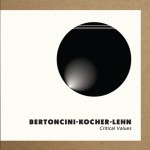
Artist: Bertoncini · Kocher · Lehn (http://www.thomaslehn.com) (@)
Title: Critical Values
Format: CD + Download
Label: Bruit Editions (@)
Rated:
Title: Critical Values
Format: CD + Download
Label: Bruit Editions (@)
Rated:
Improvised music sometimes gets described as though the musicians have simply agreed to remove the safety rails and see what happens. "Critical Values" suggests something more demanding: three experienced players meeting for the first time and discovering, in real time, which sounds can survive contact with one another. Tiziana Bertoncini’s violin, Jonas Kocher’s accordion and Thomas Lehn’s analogue synthesizer and processing do not form a conventional trio so much as a small laboratory in which acoustic identity is repeatedly placed under pressure. The laboratory happens to have microphones, and thankfully nobody is wearing a white coat.
The recording comes from a single encounter at La Voirie in Biel/Bienne on 17 September 2025, divided into just two pieces, “Complex Plane” and “Bifurcation Points”, lasting roughly twenty-three and twenty minutes respectively. Nothing has been edited or rearranged afterwards. That decision matters because the music depends on the gradual accumulation of microscopic reactions. It is not trying to give the impression of spontaneity. It actually preserves the consequences of spontaneity, including the moments when an idea has to be abandoned because another sound has unexpectedly changed the conditions around it.
Bertoncini and Lehn bring a particularly long history of musical conversation to the meeting. They have worked together since the early 2000s, developing a language in which her classically trained violin can become brittle, granular, skeletal or strangely vocal while Lehn’s analogue electronics respond not merely by accompanying it but by transforming its acoustic implications. Bertoncini’s background is unusually divided between music and visual art: after classical violin studies she also studied painting, and that visual dimension has remained part of her wider practice through installations and interdisciplinary projects. It is tempting to describe her playing in visual terms, therefore, but the more interesting thing is that she often seems to manipulate density and contour as though sound had physical edges.
Lehn has an equally distinctive history. Trained in piano and sound engineering, he has worked with analogue synthesizer systems since the late 1980s and has become one of the central figures in European live electronics, collaborating with musicians ranging from free improvisers to composers of rigorously notated experimental music. His electronics here are particularly effective because they rarely behave like an ornamental electronic layer placed underneath the violin and accordion. They alter the apparent material of the other instruments. A violin attack can become a residue; an accordion tone can acquire a metallic shadow; a tiny acoustic gesture can return with its dimensions quietly rearranged.
Kocher enters this established dyad as the destabilising third presence, although “destabilising” should not be mistaken for “chaotic”. The accordion is an instrument with an unfortunate public-relations problem: it arrives carrying decades of folk clichés, cabaret associations and the faint possibility of someone requesting a waltz. Kocher has spent years dismantling that baggage through improvisation, composition and interdisciplinary work, and here the instrument is treated primarily as a generator of pressure, friction, breath and resonance. Its familiar identity is still present, but it is increasingly difficult to locate.
“Complex Plane” develops through precisely this uncertainty. The opening does not announce a hierarchy. Instead, sounds seem to test their own boundaries, appearing as isolated events before gradually entering relationships with the others. Bertoncini can produce a narrow, almost threadlike violin presence, while Kocher introduces unstable pneumatic textures and Lehn expands or contaminates the acoustic information. The piece advances without conventional rhythmic propulsion, yet it is never static. Its movement occurs through changes in density, duration, register and response. One sound causes another to alter its behaviour, and suddenly what seemed like three independent streams has become a single unstable mechanism.
The title “Complex Plane” is particularly apt without requiring a mathematical lecture, for which everyone should be grateful. The music seems to operate through coordinates that are constantly being recalculated. A sound is not simply high or low, loud or quiet, acoustic or electronic. Its significance depends on what the other instruments are doing at that precise moment. A thin violin squeak can become substantial when surrounded by near-silence; an apparently massive electronic tone can become almost weightless when the violin cuts across it. Scale is therefore psychological rather than fixed.
“Bifurcation Points” is more restless. Its sounds appear to approach thresholds, hesitate and then split into different directions. The accordion becomes especially useful here because its physical mechanism already contains a peculiar contradiction: air produces sound, but the player can manipulate that airflow with almost absurdly fine control. Kocher exploits the instrument's capacity for pressure and interruption, while Bertoncini's violin supplies another kind of instability, moving between recognisable instrumental gestures and sounds that seem to have escaped from the instrument before anyone could identify them.
Lehn’s role is crucial in keeping this from becoming a mere catalogue of extended techniques. His processing creates relationships between sounds rather than simply making them more unusual. At times the electronics appear to enlarge microscopic details until they acquire their own environment; elsewhere they remain almost hidden, changing the listener’s perception without announcing their presence. The effect is less “electronic versus acoustic” than a continual uncertainty about where one ends and the other begins.
There is also something refreshingly physical about the recording. Despite the sophistication of the players, "Critical Values" never sounds like a demonstration of specialist knowledge. You can hear musicians listening, withholding, testing, retreating and returning. Silence becomes an active participant rather than a decorative pause, and individual gestures acquire importance because nobody rushes to fill the space after them. This is one of the reasons the uninterrupted nature of the performance works so well. The music retains its little hesitations and changes of direction, the places where thought can almost be heard happening.
The album's most compelling achievement is consequently not any particular unusual sound. It is the creation of a situation in which sounds are allowed to change their identity through proximity. The violin does not remain “the violin”, the accordion does not remain “the accordion”, and the synthesizer does not simply stand on the other side of an imaginary technological border. Each instrument becomes a set of possibilities that the others continually reshape.
That process also explains why "Critical Values" rewards attention without demanding reverence. It is austere in materials but surprisingly rich in incident. The music does not decorate its ideas, and it does not tell the listener where the important moment is supposed to occur. Instead, importance emerges retrospectively: a tiny noise heard several minutes earlier suddenly makes sense because the trio has moved somewhere else.
Perhaps that is the real meaning of the album's title. The critical value is not a particular point on a graph but the instant when a sound stops behaving as expected. A violin ceases to sound like a violin. An accordion becomes an acoustic machine. An electronic pulse acquires something almost tactile. Three musicians who have never previously made this exact conversation discover that the most interesting territory lies neither in agreement nor conflict, but in the unstable region where one sound forces another to reconsider what it is.
For forty-four minutes, "Critical Values" keeps returning to that region without settling it. No grand climax is required. The experiment works because nobody tries to prove that it has worked. The music simply keeps changing the conditions under which its own sounds can exist, which is perhaps the most convincing form of improvisational intelligence: not knowing what comes next, but being sufficiently attentive to recognise it when it arrives.
The recording comes from a single encounter at La Voirie in Biel/Bienne on 17 September 2025, divided into just two pieces, “Complex Plane” and “Bifurcation Points”, lasting roughly twenty-three and twenty minutes respectively. Nothing has been edited or rearranged afterwards. That decision matters because the music depends on the gradual accumulation of microscopic reactions. It is not trying to give the impression of spontaneity. It actually preserves the consequences of spontaneity, including the moments when an idea has to be abandoned because another sound has unexpectedly changed the conditions around it.
Bertoncini and Lehn bring a particularly long history of musical conversation to the meeting. They have worked together since the early 2000s, developing a language in which her classically trained violin can become brittle, granular, skeletal or strangely vocal while Lehn’s analogue electronics respond not merely by accompanying it but by transforming its acoustic implications. Bertoncini’s background is unusually divided between music and visual art: after classical violin studies she also studied painting, and that visual dimension has remained part of her wider practice through installations and interdisciplinary projects. It is tempting to describe her playing in visual terms, therefore, but the more interesting thing is that she often seems to manipulate density and contour as though sound had physical edges.
Lehn has an equally distinctive history. Trained in piano and sound engineering, he has worked with analogue synthesizer systems since the late 1980s and has become one of the central figures in European live electronics, collaborating with musicians ranging from free improvisers to composers of rigorously notated experimental music. His electronics here are particularly effective because they rarely behave like an ornamental electronic layer placed underneath the violin and accordion. They alter the apparent material of the other instruments. A violin attack can become a residue; an accordion tone can acquire a metallic shadow; a tiny acoustic gesture can return with its dimensions quietly rearranged.
Kocher enters this established dyad as the destabilising third presence, although “destabilising” should not be mistaken for “chaotic”. The accordion is an instrument with an unfortunate public-relations problem: it arrives carrying decades of folk clichés, cabaret associations and the faint possibility of someone requesting a waltz. Kocher has spent years dismantling that baggage through improvisation, composition and interdisciplinary work, and here the instrument is treated primarily as a generator of pressure, friction, breath and resonance. Its familiar identity is still present, but it is increasingly difficult to locate.
“Complex Plane” develops through precisely this uncertainty. The opening does not announce a hierarchy. Instead, sounds seem to test their own boundaries, appearing as isolated events before gradually entering relationships with the others. Bertoncini can produce a narrow, almost threadlike violin presence, while Kocher introduces unstable pneumatic textures and Lehn expands or contaminates the acoustic information. The piece advances without conventional rhythmic propulsion, yet it is never static. Its movement occurs through changes in density, duration, register and response. One sound causes another to alter its behaviour, and suddenly what seemed like three independent streams has become a single unstable mechanism.
The title “Complex Plane” is particularly apt without requiring a mathematical lecture, for which everyone should be grateful. The music seems to operate through coordinates that are constantly being recalculated. A sound is not simply high or low, loud or quiet, acoustic or electronic. Its significance depends on what the other instruments are doing at that precise moment. A thin violin squeak can become substantial when surrounded by near-silence; an apparently massive electronic tone can become almost weightless when the violin cuts across it. Scale is therefore psychological rather than fixed.
“Bifurcation Points” is more restless. Its sounds appear to approach thresholds, hesitate and then split into different directions. The accordion becomes especially useful here because its physical mechanism already contains a peculiar contradiction: air produces sound, but the player can manipulate that airflow with almost absurdly fine control. Kocher exploits the instrument's capacity for pressure and interruption, while Bertoncini's violin supplies another kind of instability, moving between recognisable instrumental gestures and sounds that seem to have escaped from the instrument before anyone could identify them.
Lehn’s role is crucial in keeping this from becoming a mere catalogue of extended techniques. His processing creates relationships between sounds rather than simply making them more unusual. At times the electronics appear to enlarge microscopic details until they acquire their own environment; elsewhere they remain almost hidden, changing the listener’s perception without announcing their presence. The effect is less “electronic versus acoustic” than a continual uncertainty about where one ends and the other begins.
There is also something refreshingly physical about the recording. Despite the sophistication of the players, "Critical Values" never sounds like a demonstration of specialist knowledge. You can hear musicians listening, withholding, testing, retreating and returning. Silence becomes an active participant rather than a decorative pause, and individual gestures acquire importance because nobody rushes to fill the space after them. This is one of the reasons the uninterrupted nature of the performance works so well. The music retains its little hesitations and changes of direction, the places where thought can almost be heard happening.
The album's most compelling achievement is consequently not any particular unusual sound. It is the creation of a situation in which sounds are allowed to change their identity through proximity. The violin does not remain “the violin”, the accordion does not remain “the accordion”, and the synthesizer does not simply stand on the other side of an imaginary technological border. Each instrument becomes a set of possibilities that the others continually reshape.
That process also explains why "Critical Values" rewards attention without demanding reverence. It is austere in materials but surprisingly rich in incident. The music does not decorate its ideas, and it does not tell the listener where the important moment is supposed to occur. Instead, importance emerges retrospectively: a tiny noise heard several minutes earlier suddenly makes sense because the trio has moved somewhere else.
Perhaps that is the real meaning of the album's title. The critical value is not a particular point on a graph but the instant when a sound stops behaving as expected. A violin ceases to sound like a violin. An accordion becomes an acoustic machine. An electronic pulse acquires something almost tactile. Three musicians who have never previously made this exact conversation discover that the most interesting territory lies neither in agreement nor conflict, but in the unstable region where one sound forces another to reconsider what it is.
For forty-four minutes, "Critical Values" keeps returning to that region without settling it. No grand climax is required. The experiment works because nobody tries to prove that it has worked. The music simply keeps changing the conditions under which its own sounds can exist, which is perhaps the most convincing form of improvisational intelligence: not knowing what comes next, but being sufficiently attentive to recognise it when it arrives.
Igor Ballereau: UMWeLT

The problem with the word “world” is that we tend to imagine everyone is looking at the same one. Igor Ballereau’s "UMWeLT" quietly objects to this arrangement. Borrowing its title from Jakob von Uexküll’s notion of the subjective environment inhabited by every living being, the album proposes something considerably more unsettling than an ambient record: four pieces in which perception itself seems to have become unstable, as though the walls of reality were made from a substance that could soften whenever nobody was paying attention.
Ballereau is an unusual figure in contemporary music because his earlier work was deeply connected to the voice, including compositions built around the letters and diaries of Lewis Carroll, Franz Kafka and Katherine Mansfield. His trajectory has nevertheless never been particularly interested in staying inside a single institutional definition of composition. After years of writing for ensembles and vocalists, a long silence eventually led to a new phase in which acoustic and electronic materials, darkness and enchantment, composition and the imagined cinema began to overlap. "ijkl" and the seventy-minute "Ptyx" opened that territory; "UMWeLT" goes further by making the territory itself increasingly difficult to locate.
The four pieces are long enough to resist the usual attention economy but not so long that duration becomes a test of moral character. “Umwelt - i” lasts twelve minutes, and its development feels less like a sequence of events than a gradual alteration of conditions. Sounds emerge without necessarily presenting themselves as objects. Something might resemble a voice, a room, a mechanical vibration, a distant environmental disturbance, but just when the ear thinks it has identified the source, the music changes the rules. Ballereau is not particularly interested in giving the listener a comfortable answer to the question of what exactly is being heard. This is less field recording than field hallucination.
That distinction matters because "UMWeLT" is full of traces. The album uses fragments of room ambience, playground sound and indistinct human voices, but their function is not documentary. They are evidence without a crime scene. A murmur may suggest another person; a familiar acoustic space may suddenly feel inaccessible; a human gesture can be reduced to texture and still retain some stubborn residue of intention. The result is strangely intimate without ever becoming confessional. We are not being told someone's story. We are hearing what might remain after the story has disappeared.
“Umwelt - ii” is especially effective in this respect. Its apparently porous environment continually allows sounds to enter and recede, while the piece maintains a remarkable sense of enclosure. There is no conventional melody to hold onto, yet neither is the music formless. Ballereau shapes density, distance, recurrence and disappearance with the precision of someone who knows that silence is not the absence of information. Sometimes it is the most suspicious information available.
This is where his earlier experience with voice becomes perceptible even though "UMWeLT" is not a vocal album in the conventional sense. Ballereau has spent much of his compositional life investigating language and the physical presence of voices, and here the human voice has been stripped of its semantic privileges. What remains is breath, grain, proximity, interruption. A voice no longer needs to tell us what somebody thinks in order to remind us that somebody was there. It is almost perversely effective: after centuries of teaching voices to speak, music discovers that they can be more mysterious when they stop cooperating.
“Umwelt - iii” deepens this sense of unstable recognition. The sonic material seems to circulate rather than progress, but repetition never quite produces reassurance. A sound returns altered by everything that happened around it, so that memory becomes less like retrieval than contamination. The piece has the peculiar sensation of listening to an event through a wall, then discovering that the wall is inside your head. This is not horror in any conventional cinematic sense. There are no monsters jumping out of cupboards, largely because Ballereau understands that cupboards are already quite psychologically complicated.
The final “Umwelt - iv”, stretching beyond thirteen minutes, gives the album its broadest temporal field. By this point, the listener has stopped expecting conventional development and begins noticing smaller shifts: changes in pressure, spectral colour, the distance between sounds, the appearance and disappearance of almost-recognisable presences. The music becomes compelling precisely because it refuses to convert these changes into obvious dramatic gestures. Its drama is perceptual. You notice that the room has changed before you can explain how.
There is a strong connection here with "Ptyx", which Ballereau described as music for imaginary films, but "UMWeLT" seems to remove even more of the cinema. There are fewer obvious postcards, fewer recognisable places, fewer clues about where the listener is supposed to stand. Instead, the album behaves like the soundtrack to a film whose camera has been left somewhere unattended while the world continues without it. The imagined narrative remains, but only as pressure.
Ballereau’s long-standing interest in literary documents is also transformed into something more abstract. Where letters and diaries once supplied words, personalities and histories, "UMWeLT" works with the remains of presence itself. Its sounds feel as though they have passed through an imperfect archival machine. Nothing is reproduced completely. Everything arrives slightly damaged, blurred at the edges, carrying an intensity that seems to belong to something no longer accessible.
That may be the album’s most affecting quality. It does not romanticise disappearance, nor does it attempt to reconstruct whatever has been lost. Instead, it pays attention to the peculiar life of the trace. A sound can survive its source without preserving its meaning. A voice can remain after the speaker has vanished. An environment can continue to exist while becoming completely different to the person who once inhabited it. The four pieces keep circling this paradox without resolving it, which is precisely why they feel alive.
"UMWeLT" is therefore not music that asks to be “understood” in the conventional sense. It asks the listener to surrender the assumption that perception is a neutral activity. Every sound arrives from somewhere, but the somewhere changes according to who is listening. Ballereau constructs that uncertainty with extraordinary restraint, allowing electronic tones, acoustic residues and human fragments to form a private ecology in which nothing quite stays where it was first encountered.
There is no grand revelation at the end, and thankfully so. The album leaves something more elusive behind: the suspicion that reality may consist less of stable objects than of temporary agreements between things, senses and memories. We hear a trace, decide what it might be, and for a moment inhabit the same world as it. Then the sound changes, and so does the world.
Ballereau is an unusual figure in contemporary music because his earlier work was deeply connected to the voice, including compositions built around the letters and diaries of Lewis Carroll, Franz Kafka and Katherine Mansfield. His trajectory has nevertheless never been particularly interested in staying inside a single institutional definition of composition. After years of writing for ensembles and vocalists, a long silence eventually led to a new phase in which acoustic and electronic materials, darkness and enchantment, composition and the imagined cinema began to overlap. "ijkl" and the seventy-minute "Ptyx" opened that territory; "UMWeLT" goes further by making the territory itself increasingly difficult to locate.
The four pieces are long enough to resist the usual attention economy but not so long that duration becomes a test of moral character. “Umwelt - i” lasts twelve minutes, and its development feels less like a sequence of events than a gradual alteration of conditions. Sounds emerge without necessarily presenting themselves as objects. Something might resemble a voice, a room, a mechanical vibration, a distant environmental disturbance, but just when the ear thinks it has identified the source, the music changes the rules. Ballereau is not particularly interested in giving the listener a comfortable answer to the question of what exactly is being heard. This is less field recording than field hallucination.
That distinction matters because "UMWeLT" is full of traces. The album uses fragments of room ambience, playground sound and indistinct human voices, but their function is not documentary. They are evidence without a crime scene. A murmur may suggest another person; a familiar acoustic space may suddenly feel inaccessible; a human gesture can be reduced to texture and still retain some stubborn residue of intention. The result is strangely intimate without ever becoming confessional. We are not being told someone's story. We are hearing what might remain after the story has disappeared.
“Umwelt - ii” is especially effective in this respect. Its apparently porous environment continually allows sounds to enter and recede, while the piece maintains a remarkable sense of enclosure. There is no conventional melody to hold onto, yet neither is the music formless. Ballereau shapes density, distance, recurrence and disappearance with the precision of someone who knows that silence is not the absence of information. Sometimes it is the most suspicious information available.
This is where his earlier experience with voice becomes perceptible even though "UMWeLT" is not a vocal album in the conventional sense. Ballereau has spent much of his compositional life investigating language and the physical presence of voices, and here the human voice has been stripped of its semantic privileges. What remains is breath, grain, proximity, interruption. A voice no longer needs to tell us what somebody thinks in order to remind us that somebody was there. It is almost perversely effective: after centuries of teaching voices to speak, music discovers that they can be more mysterious when they stop cooperating.
“Umwelt - iii” deepens this sense of unstable recognition. The sonic material seems to circulate rather than progress, but repetition never quite produces reassurance. A sound returns altered by everything that happened around it, so that memory becomes less like retrieval than contamination. The piece has the peculiar sensation of listening to an event through a wall, then discovering that the wall is inside your head. This is not horror in any conventional cinematic sense. There are no monsters jumping out of cupboards, largely because Ballereau understands that cupboards are already quite psychologically complicated.
The final “Umwelt - iv”, stretching beyond thirteen minutes, gives the album its broadest temporal field. By this point, the listener has stopped expecting conventional development and begins noticing smaller shifts: changes in pressure, spectral colour, the distance between sounds, the appearance and disappearance of almost-recognisable presences. The music becomes compelling precisely because it refuses to convert these changes into obvious dramatic gestures. Its drama is perceptual. You notice that the room has changed before you can explain how.
There is a strong connection here with "Ptyx", which Ballereau described as music for imaginary films, but "UMWeLT" seems to remove even more of the cinema. There are fewer obvious postcards, fewer recognisable places, fewer clues about where the listener is supposed to stand. Instead, the album behaves like the soundtrack to a film whose camera has been left somewhere unattended while the world continues without it. The imagined narrative remains, but only as pressure.
Ballereau’s long-standing interest in literary documents is also transformed into something more abstract. Where letters and diaries once supplied words, personalities and histories, "UMWeLT" works with the remains of presence itself. Its sounds feel as though they have passed through an imperfect archival machine. Nothing is reproduced completely. Everything arrives slightly damaged, blurred at the edges, carrying an intensity that seems to belong to something no longer accessible.
That may be the album’s most affecting quality. It does not romanticise disappearance, nor does it attempt to reconstruct whatever has been lost. Instead, it pays attention to the peculiar life of the trace. A sound can survive its source without preserving its meaning. A voice can remain after the speaker has vanished. An environment can continue to exist while becoming completely different to the person who once inhabited it. The four pieces keep circling this paradox without resolving it, which is precisely why they feel alive.
"UMWeLT" is therefore not music that asks to be “understood” in the conventional sense. It asks the listener to surrender the assumption that perception is a neutral activity. Every sound arrives from somewhere, but the somewhere changes according to who is listening. Ballereau constructs that uncertainty with extraordinary restraint, allowing electronic tones, acoustic residues and human fragments to form a private ecology in which nothing quite stays where it was first encountered.
There is no grand revelation at the end, and thankfully so. The album leaves something more elusive behind: the suspicion that reality may consist less of stable objects than of temporary agreements between things, senses and memories. We hear a trace, decide what it might be, and for a moment inhabit the same world as it. Then the sound changes, and so does the world.
Julien Gasc: Perles, coraux & requins

Artist: Julien Gasc
Title: Perles, coraux & requins
Format: CD + Download
Label: Prohibited Records (@)
Rated:
Title: Perles, coraux & requins
Format: CD + Download
Label: Prohibited Records (@)
Rated:
Julien Gasc has always seemed slightly suspicious of the idea that a song should behave itself. On "Perles, coraux & requins", his fifth solo album, he gives that suspicion an aquatic setting: beneath the turbulence of ordinary life, somewhere between romantic fantasy, private melancholy and mildly surreal observation, he goes diving. The result is an album that treats French chanson less as a tradition to be preserved than as a strange little animal that can still be taught some new tricks.
Gasc’s background makes the record’s peculiar balance easier to understand. A founding member of Aquaserge, he has also worked with Stereolab, while his solo catalogue has gradually moved between psychedelic pop, intimate songwriting, experimental arrangements and the more eccentric corners of French song. He is a multi-instrumentalist in the literal sense rather than the promotional sense: here he handles voice, guitar, bass, organ, synthesizers, Mellotron and drum machine, constructing a remarkably detailed environment around songs that often sound deceptively simple. His musical vocabulary draws on Brazilian songwriters such as João Gilberto and Chico Buarque, but also on the more elusive tradition of French pop in which melody, verbal absurdity and arrangement can coexist without asking permission from one another.
The Berlin circumstances add another layer of intrigue. Anton Newcombe recorded the album over three sessions between 2023 and 2024, contributing synthesizers, Mellotron and percussion, while Tim Gane adds guitar and Leo Blomov provides arrangements. It is an unusually convincing meeting because Newcombe’s psychedelic sensibility does not turn Gasc into another BJM satellite, nor does Gane merely arrive to provide an instantly recognisable Stereolab signature. Instead, the production gives the songs a slightly skewed depth, allowing apparently modest gestures to acquire strange afterimages. There is plenty of studio detail here, but very little of the modern obsession with polishing every surface until the music looks frightened of being touched.
“Rosen montag” immediately establishes Gasc’s peculiar relationship with rhythm and melody. His singing can sound languid without being passive, as though the words are arriving a fraction later than the music and have decided not to apologise. “Chez Martine” takes that quality further, with Tim Gane’s guitar adding a subtle foreign body to the chanson framework. The song seems simultaneously domestic and elsewhere, which is one of Gasc’s more useful tricks: he can make an ordinary name, place or gesture feel as though it has been lifted from a half-remembered film whose plot nobody bothered to explain.
The album becomes more bodily as it proceeds. “Le goût de tes lèvres” and “C’est dans le corps” bring desire closer to the skin, but Gasc avoids the usual vocabulary of grand romantic declaration. His sensuality is less polished than curious, interested in the awkwardness of inhabiting a body that keeps producing inconvenient emotions. “Plongeon de haut vol” pushes this further by shifting perspective beyond the solitary male narrator. The song’s emotional weight comes partly from this attempt to inhabit another person’s experience, turning the underwater metaphor into something more serious than an attractive bit of album decoration.
Then there is “16”, where the arrangements become especially important. Blomov’s contribution gives the piece a carefully constructed harmonic architecture, but Gasc never lets the arrangement become pompous. This is perhaps the central achievement of "Perles, coraux & requins": sophistication is everywhere, yet sophistication rarely announces itself wearing a name badge. Even the more elaborate passages retain the slightly crooked charm of someone making pop music while refusing to forget that pop music can be wonderfully strange.
“Patrick”, the album’s sole composition not written by Gasc, fits surprisingly well into this universe. Rather than functioning as an obvious detour, it becomes another piece in the album’s collection of romantic and absurdist fragments. “Je t’aime bel et bien” is more direct, but its brevity prevents the declaration from becoming monumental. Love is allowed to be sincere without being sentenced to orchestral grandeur. Livvy O’Hagan’s contribution to this and “Déguste” adds another vocal presence, and the contrast helps make the record’s interpersonal dimension more tangible.
The title track is where the underwater imagery finally becomes fully convincing. At more than five minutes, “Perles, coraux & requins” has room to let its colours accumulate: soft psychedelic electronics, melodic details, rhythmic insinuations and Gasc’s voice moving through the arrangement with an almost weightless authority. Yet the sharks are important. They prevent the album from becoming an entirely benevolent aquarium. Beauty here has teeth, desire has consequences, and introspection is not necessarily a peaceful activity. One can dive beneath the surface and still discover that the ocean contains predators. This is presumably why swimming pools have chlorine.
There is also a subtle tension between Gasc’s apparent nonchalance and the emotional material underneath it. The voice rarely sounds desperate even when the songs deal with longing, vulnerability, love or unease. That distance is not emotional coldness. It is closer to the French tradition of disguising intensity through elegance, allowing a phrase to smile while something considerably less comfortable happens underneath. The effect is particularly effective because the arrangements refuse to settle into a single mood: Mellotron haze can sit beside a drum machine, a guitar line can suddenly sharpen the texture, and the songs can drift from chanson intimacy toward psychedelic pop without announcing a change of government.
What makes "Perles, coraux & requins" ultimately more interesting than its aquatic imagery might suggest is that the sea is never really the subject. It is a way of thinking about consciousness. Above the surface there is noise, pressure, social machinery and all the ridiculous arrangements through which modern life keeps pretending to be rational. Beneath it, Gasc finds another kind of order: slower, stranger, more sensual, but certainly not free of danger. His songs inhabit that contradiction rather beautifully.
The final “Déguste” leaves the album with one last taste of its peculiar mixture of tenderness and mischief. By then, the pearls, corals and sharks have stopped functioning as symbols that need decoding. They have become inhabitants of Gasc’s private aquarium, swimming around the songs as naturally as guitars, Mellotrons and improbable French sentences.
"Perles, coraux & requins" is therefore not really an escape from the world. It is an alternative method of looking at it: from below, sideways, occasionally upside down. Gasc does not make the chaos disappear. He simply discovers that there is enough oxygen beneath it to sing.
Gasc’s background makes the record’s peculiar balance easier to understand. A founding member of Aquaserge, he has also worked with Stereolab, while his solo catalogue has gradually moved between psychedelic pop, intimate songwriting, experimental arrangements and the more eccentric corners of French song. He is a multi-instrumentalist in the literal sense rather than the promotional sense: here he handles voice, guitar, bass, organ, synthesizers, Mellotron and drum machine, constructing a remarkably detailed environment around songs that often sound deceptively simple. His musical vocabulary draws on Brazilian songwriters such as João Gilberto and Chico Buarque, but also on the more elusive tradition of French pop in which melody, verbal absurdity and arrangement can coexist without asking permission from one another.
The Berlin circumstances add another layer of intrigue. Anton Newcombe recorded the album over three sessions between 2023 and 2024, contributing synthesizers, Mellotron and percussion, while Tim Gane adds guitar and Leo Blomov provides arrangements. It is an unusually convincing meeting because Newcombe’s psychedelic sensibility does not turn Gasc into another BJM satellite, nor does Gane merely arrive to provide an instantly recognisable Stereolab signature. Instead, the production gives the songs a slightly skewed depth, allowing apparently modest gestures to acquire strange afterimages. There is plenty of studio detail here, but very little of the modern obsession with polishing every surface until the music looks frightened of being touched.
“Rosen montag” immediately establishes Gasc’s peculiar relationship with rhythm and melody. His singing can sound languid without being passive, as though the words are arriving a fraction later than the music and have decided not to apologise. “Chez Martine” takes that quality further, with Tim Gane’s guitar adding a subtle foreign body to the chanson framework. The song seems simultaneously domestic and elsewhere, which is one of Gasc’s more useful tricks: he can make an ordinary name, place or gesture feel as though it has been lifted from a half-remembered film whose plot nobody bothered to explain.
The album becomes more bodily as it proceeds. “Le goût de tes lèvres” and “C’est dans le corps” bring desire closer to the skin, but Gasc avoids the usual vocabulary of grand romantic declaration. His sensuality is less polished than curious, interested in the awkwardness of inhabiting a body that keeps producing inconvenient emotions. “Plongeon de haut vol” pushes this further by shifting perspective beyond the solitary male narrator. The song’s emotional weight comes partly from this attempt to inhabit another person’s experience, turning the underwater metaphor into something more serious than an attractive bit of album decoration.
Then there is “16”, where the arrangements become especially important. Blomov’s contribution gives the piece a carefully constructed harmonic architecture, but Gasc never lets the arrangement become pompous. This is perhaps the central achievement of "Perles, coraux & requins": sophistication is everywhere, yet sophistication rarely announces itself wearing a name badge. Even the more elaborate passages retain the slightly crooked charm of someone making pop music while refusing to forget that pop music can be wonderfully strange.
“Patrick”, the album’s sole composition not written by Gasc, fits surprisingly well into this universe. Rather than functioning as an obvious detour, it becomes another piece in the album’s collection of romantic and absurdist fragments. “Je t’aime bel et bien” is more direct, but its brevity prevents the declaration from becoming monumental. Love is allowed to be sincere without being sentenced to orchestral grandeur. Livvy O’Hagan’s contribution to this and “Déguste” adds another vocal presence, and the contrast helps make the record’s interpersonal dimension more tangible.
The title track is where the underwater imagery finally becomes fully convincing. At more than five minutes, “Perles, coraux & requins” has room to let its colours accumulate: soft psychedelic electronics, melodic details, rhythmic insinuations and Gasc’s voice moving through the arrangement with an almost weightless authority. Yet the sharks are important. They prevent the album from becoming an entirely benevolent aquarium. Beauty here has teeth, desire has consequences, and introspection is not necessarily a peaceful activity. One can dive beneath the surface and still discover that the ocean contains predators. This is presumably why swimming pools have chlorine.
There is also a subtle tension between Gasc’s apparent nonchalance and the emotional material underneath it. The voice rarely sounds desperate even when the songs deal with longing, vulnerability, love or unease. That distance is not emotional coldness. It is closer to the French tradition of disguising intensity through elegance, allowing a phrase to smile while something considerably less comfortable happens underneath. The effect is particularly effective because the arrangements refuse to settle into a single mood: Mellotron haze can sit beside a drum machine, a guitar line can suddenly sharpen the texture, and the songs can drift from chanson intimacy toward psychedelic pop without announcing a change of government.
What makes "Perles, coraux & requins" ultimately more interesting than its aquatic imagery might suggest is that the sea is never really the subject. It is a way of thinking about consciousness. Above the surface there is noise, pressure, social machinery and all the ridiculous arrangements through which modern life keeps pretending to be rational. Beneath it, Gasc finds another kind of order: slower, stranger, more sensual, but certainly not free of danger. His songs inhabit that contradiction rather beautifully.
The final “Déguste” leaves the album with one last taste of its peculiar mixture of tenderness and mischief. By then, the pearls, corals and sharks have stopped functioning as symbols that need decoding. They have become inhabitants of Gasc’s private aquarium, swimming around the songs as naturally as guitars, Mellotrons and improbable French sentences.
"Perles, coraux & requins" is therefore not really an escape from the world. It is an alternative method of looking at it: from below, sideways, occasionally upside down. Gasc does not make the chaos disappear. He simply discovers that there is enough oxygen beneath it to sing.