
Browse by Genre
Industrial Music / Industrial Metal / Aggro Industrial / Electro Metal
Industrial Noise / Power Noise / Harsh Noise
Synth Pop / Electro Pop / Synth-Electronica
Techno / Trance / Goa / Drum'n'Bass / Jungle / Tribal / Trip-Hop
Ambient / Electronica / Ethereal / Dub / Soundscapes / Abstract
Experimental / Avantgarde / Weird & Wired / Glitch / Noise / Field Recording
Dark / Gothic / Wave / New Wave / Dark Wave / Industrial Gothic
New Music / Downtown / Avantgarde Jazz / New Classical / World
Search Reviews
Music Reviews
Sound_00 + Lefterna: Collab 67

Artist: Sound_00 + Lefterna
Title: Collab 67
Format: Download Only (MP3 + Lossless)
Label: Inner Demons Records
Rated:

Title: Collab 67
Format: Download Only (MP3 + Lossless)
Label: Inner Demons Records
Rated:
Sound_00 is the work of Macedonian artist Toni Dimitrov, who also used to record under the name Every Kid On Speed. Lefterna is the work of musician, writer, and translator Boban Ristevski, who works mainly in ambient / drone and industrial / noise music. I was familiar with Dimitrov’s work as he had been on a few compilations that I put out, but this is my introduction to Lefterna’s work. I am always interested to see how collaborations leverage each other’s strengths, so let’s dive in and see what this one brings.
This is one 33 minute track of interesting drone. The base consists of a repetitive drone theme, but there is are other elements here to keep it interesting. Static that sounds like rain at times and heavily reverbed warbling sounds keep it from getting too repetitive. The overall effect is relaxing; this would be a good choice to put on and read a good book. This is well worth picking up, and name your price is about as good of a price as you can get, so it is completely worth the risk.
This is one 33 minute track of interesting drone. The base consists of a repetitive drone theme, but there is are other elements here to keep it interesting. Static that sounds like rain at times and heavily reverbed warbling sounds keep it from getting too repetitive. The overall effect is relaxing; this would be a good choice to put on and read a good book. This is well worth picking up, and name your price is about as good of a price as you can get, so it is completely worth the risk.
Moreine: Upon Thy Cattle

This is my introduction to Moreine, and the bandcamp bio simply states, "Behold, the hand of the Lord is upon thy cattle which is in the field, upon thy horses, upon thy donkeys, upon thy camels, upon thy oxen, and upon thy sheep: there shall be a very grievous moreine." For those who are not Biblical scholars, this comes from Exodus 9:3 (although the King James Version renders this as "murrain," as moreine is the Middle English spelling. And what is this, you may ask? Why a plague, of course. Other than that, I know nothing of the artist, so let's dive right in.
If you are looking for feel good music with what I just told you, you would be barking up the wrong tree. This is dark and oppressive, just the way a plague on all of your cattle should be. This plays out like a soundtrack for the events of Exodus 9, which is a catalog of the plagues that the Lord sent upon Egypt and Pharaoh to convince him to let the children of Israel leave. Heavy drone and animalistic noises play a major role in the compositions and the overall effect is cinematic. The compositions are carefully constructed and nothing seems to be left to chance. Like a vengeful deity, Moreine plays things for maximum impact. The overall effect is unsettling, while avoiding the cliches of horror music. If there is one word to describe this music, it would be "visceral." For example, "The Fifth Plague" almost sounds like a symphony that you are hearing from the inside of an animal's stomach and "Die Like a Pig" likewise sounds like swine feeding at the trough punctuated with heavily processed snippets of voice.
Overall, this is well done, and if you like your music to tell a story, even if (or especially if, for some of you) it is not a pleasant one, this will be right up your alley. This album weighs in at around 51 minutes and is limited to 42 copies.
If you are looking for feel good music with what I just told you, you would be barking up the wrong tree. This is dark and oppressive, just the way a plague on all of your cattle should be. This plays out like a soundtrack for the events of Exodus 9, which is a catalog of the plagues that the Lord sent upon Egypt and Pharaoh to convince him to let the children of Israel leave. Heavy drone and animalistic noises play a major role in the compositions and the overall effect is cinematic. The compositions are carefully constructed and nothing seems to be left to chance. Like a vengeful deity, Moreine plays things for maximum impact. The overall effect is unsettling, while avoiding the cliches of horror music. If there is one word to describe this music, it would be "visceral." For example, "The Fifth Plague" almost sounds like a symphony that you are hearing from the inside of an animal's stomach and "Die Like a Pig" likewise sounds like swine feeding at the trough punctuated with heavily processed snippets of voice.
Overall, this is well done, and if you like your music to tell a story, even if (or especially if, for some of you) it is not a pleasant one, this will be right up your alley. This album weighs in at around 51 minutes and is limited to 42 copies.
Substak: Consciousness

Artist: Substak (@)
Title: Consciousness
Format: Download Only (MP3 + Lossless)
Label: Inner Demons Records
Rated:

Title: Consciousness
Format: Download Only (MP3 + Lossless)
Label: Inner Demons Records
Rated:
Substak is the work of Kostas Staikos, who hails from Athens, Greece. I have reviewed several of his releases on Inner Demons, and they all have different feels, so it is interesting to see what he has each time. The liner notes state, “This music stands for itself. It's an escape where no rules are followed. That's Substak.” Well, let’s see what we have here.
We kick it off with “Consciousness,” which is grinding noises over warbling synth. This is like shaving with an electric razor in a wind tunnel. So far, so good. “Consciousness II” would be right at home in the soundtrack to a science fiction movie. Gritty synth with some analog noises and spacey sounds. “Brooding” is the best way to describe the feel of this track. “Consciousness III” closes it out with a much more complex piece, with pitch bent synth, crashing waves of sound, all floating on a sea of drone. If the other two were relatively peaceful and representative of a more level headed consciousness, this consciousness is manic, with wild shifts from one emotion to another.
Overall, this is an interesting set of drones with enough going on in them to keep it interesting. If you like your drone with a bit of grit to it, this is something to check out. This album weighs in at around 17 minutes.
We kick it off with “Consciousness,” which is grinding noises over warbling synth. This is like shaving with an electric razor in a wind tunnel. So far, so good. “Consciousness II” would be right at home in the soundtrack to a science fiction movie. Gritty synth with some analog noises and spacey sounds. “Brooding” is the best way to describe the feel of this track. “Consciousness III” closes it out with a much more complex piece, with pitch bent synth, crashing waves of sound, all floating on a sea of drone. If the other two were relatively peaceful and representative of a more level headed consciousness, this consciousness is manic, with wild shifts from one emotion to another.
Overall, this is an interesting set of drones with enough going on in them to keep it interesting. If you like your drone with a bit of grit to it, this is something to check out. This album weighs in at around 17 minutes.
The Grey Men: The Shape of Noise to Come

Artist: The Grey Men
Title: The Shape of Noise to Come
Format: CD
Label: Inner Demons Records
Rated:
Title: The Shape of Noise to Come
Format: CD
Label: Inner Demons Records
Rated:
I was unfamiliar with this group, but The Grey Men hail from Sydney, Australia, and the label describes them as so: “Inspired by early Earth, Sunn 0))) and Fennesz, The Grey Men combine slowly played distorted guitars and feedback with modular synthesizers, tape loops and obscure samples to achieve sounds both harsh and transcendent.” Their bandcamp bio reads “Volume as an instrument and strip nearly everything else away,” which sounds promising, so let’s dive in.
If you like really slow doom style distorted guitars, this album has it in spades. But this is really, really slow stuff. I mean glacially slow. “Canon 3 [Remove],” “Witness,” “Canon 5 [Asphalt],” and “Canon 6 [Vengeance]” all follow a similar recipe. Long sustained chords, with some feedback and eternities of sustain as a garnish.
There are some that go outside of this strategy, and for me the standout track here is “Coeur - feat. MxRF,” with ethereal vocals that are an interesting contrast to the crushing guitar. It is this juxtaposition of the gentle voice and heavy guitars that give this track its power. The guitars seem to be more of a composition in this track, which makes it a much better, much stronger track. Truly lovely. On the other end of the spectrum, we have “Void,” featuring guitar stabs with shrieking underneath, like standing outside of a mental institution with a guitar. Not really my cup of tea, but if you like the screams of the damned, this is where you will find it.
Guitar noise can be interesting (Fear Falls Burning, for example), but much of it began to sound too similar, with the exception of “Coeur,” which I found to be exquisite. That said, if you like your guitar noise extra sludgy, this would be up your alley. This album weighs in at around 66 minutes and is limited to 42 copies.
If you like really slow doom style distorted guitars, this album has it in spades. But this is really, really slow stuff. I mean glacially slow. “Canon 3 [Remove],” “Witness,” “Canon 5 [Asphalt],” and “Canon 6 [Vengeance]” all follow a similar recipe. Long sustained chords, with some feedback and eternities of sustain as a garnish.
There are some that go outside of this strategy, and for me the standout track here is “Coeur - feat. MxRF,” with ethereal vocals that are an interesting contrast to the crushing guitar. It is this juxtaposition of the gentle voice and heavy guitars that give this track its power. The guitars seem to be more of a composition in this track, which makes it a much better, much stronger track. Truly lovely. On the other end of the spectrum, we have “Void,” featuring guitar stabs with shrieking underneath, like standing outside of a mental institution with a guitar. Not really my cup of tea, but if you like the screams of the damned, this is where you will find it.
Guitar noise can be interesting (Fear Falls Burning, for example), but much of it began to sound too similar, with the exception of “Coeur,” which I found to be exquisite. That said, if you like your guitar noise extra sludgy, this would be up your alley. This album weighs in at around 66 minutes and is limited to 42 copies.
WIELORYB: Ritual
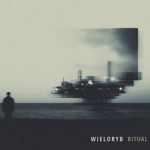
Some musicians treat rhythm like a polite suggestion. Others treat it like a hammer. On "Ritual", Pawe Kmiecik, operating under the long-standing moniker WIELORYB, clearly belongs to the second category. This is music that does not stroll into the room. It kicks the door open, drags in a stack of steel drums, and starts assembling a factory.
Originally released digitally in 2021 and now resurrected on CD by Zoharum with additional tracks and fresh artwork, "Ritual" stretches across more than seventy-eight minutes of dense rhythmic machinery. Fifteen tracks, most of them built around relentless industrial pulses, form something that feels less like a conventional album and more like a prolonged mechanical ceremony.
WIELORYB’s history runs deeper than casual listeners might assume. Founded in the mid-1990s, the project emerged during the formative years of Poland’s industrial and EBM underground, alongside acts like Agressiva 69. Back then the project functioned as a duo and occasionally a trio, navigating the raw electronic aesthetics that defined that era. Since 2010, however, the project has essentially become Kmiecik’s personal laboratory, a place where industrial structures slowly mutated into something closer to rhythmic noise: harsher, more physical, and considerably less concerned with traditional song forms.
"Ritual" embodies that evolution rather clearly. The opening track “Methods” wastes no time establishing the album’s grammar: pounding mechanical beats, layered textures that grind against one another like rusted gears, and an atmosphere thick enough to require ventilation. The sound design feels claustrophobic in a strangely deliberate way, as if the listener has been locked inside the basement of a particularly determined drum machine.
Yet beneath that oppressive density lies careful construction. Kmiecik’s approach to rhythm is surprisingly architectural. Patterns stack, fracture, and reform; percussion elements emerge briefly before dissolving back into the larger machine. “Many” and “Korangar” expand the palette with shifting layers of metallic percussion and subtle industrial drones, creating the sensation of wandering through a labyrinth of interconnected engines.
The title track “Ritual” itself appears almost like a compressed manifesto. Shorter than many of the surrounding pieces, it distills the project’s aesthetic into a concentrated burst of tribal-mechanical energy. The rhythm is hypnotic, almost ceremonial, as if ancient drum patterns had been translated into the language of malfunctioning circuitry.
That strange balance between archaic and mechanical impulses appears repeatedly throughout the record. “Tribal Order” and “Sacrifice” lean heavily into the idea of rhythm as communal invocation, although here the tribe in question might just be a gathering of malfunctioning robots chanting in a warehouse at three in the morning. The mood is dark but never static. Kmiecik frequently shifts the density of the arrangement, allowing brief moments of space before the percussion inevitably surges back.
Some tracks reveal unexpected nuance within the noise. “Las” introduces a slightly more atmospheric dimension, its textures suggesting distant environmental echoes rather than pure mechanical aggression. “Meadow”, intriguingly titled for such a harsh sonic environment, momentarily softens the album’s relentless momentum, as if someone briefly opened a door and allowed a gust of fresh air into the factory.
Still, subtlety is not the record’s primary mission. The sheer endurance test of listening through seventy-plus minutes of rhythmic noise is part of the experience. Albums like this operate less as background listening and more as immersive environments. One does not casually sip tea while "Ritual" plays. The music demands attention, physical engagement, perhaps even a mild tolerance for sonic blunt force.
The bonus tracks included in this new edition extend that atmosphere further rather than altering it. “Dragstore”, “Echoes in the Night”, and “Fly” function as additional corridors in the same industrial complex, each reinforcing the sense that the album’s universe is vast, echoing, and faintly menacing.
In a cultural landscape currently saturated with polite ambient drones and tasteful electronic minimalism, "Ritual" feels refreshingly stubborn. It refuses to be elegant. It refuses to be soothing. Instead it builds a massive rhythmic structure and invites the listener to stand inside it while the walls vibrate.
Not everyone will enjoy that experience. Some listeners prefer their music to behave nicely. "Ritual" does not. It marches, pounds, and reverberates like an underground ceremony conducted by machines that have developed their own theology.
And honestly, considering the current state of the world, a few industrial drums beating in the dark might be the most honest soundtrack available.
Originally released digitally in 2021 and now resurrected on CD by Zoharum with additional tracks and fresh artwork, "Ritual" stretches across more than seventy-eight minutes of dense rhythmic machinery. Fifteen tracks, most of them built around relentless industrial pulses, form something that feels less like a conventional album and more like a prolonged mechanical ceremony.
WIELORYB’s history runs deeper than casual listeners might assume. Founded in the mid-1990s, the project emerged during the formative years of Poland’s industrial and EBM underground, alongside acts like Agressiva 69. Back then the project functioned as a duo and occasionally a trio, navigating the raw electronic aesthetics that defined that era. Since 2010, however, the project has essentially become Kmiecik’s personal laboratory, a place where industrial structures slowly mutated into something closer to rhythmic noise: harsher, more physical, and considerably less concerned with traditional song forms.
"Ritual" embodies that evolution rather clearly. The opening track “Methods” wastes no time establishing the album’s grammar: pounding mechanical beats, layered textures that grind against one another like rusted gears, and an atmosphere thick enough to require ventilation. The sound design feels claustrophobic in a strangely deliberate way, as if the listener has been locked inside the basement of a particularly determined drum machine.
Yet beneath that oppressive density lies careful construction. Kmiecik’s approach to rhythm is surprisingly architectural. Patterns stack, fracture, and reform; percussion elements emerge briefly before dissolving back into the larger machine. “Many” and “Korangar” expand the palette with shifting layers of metallic percussion and subtle industrial drones, creating the sensation of wandering through a labyrinth of interconnected engines.
The title track “Ritual” itself appears almost like a compressed manifesto. Shorter than many of the surrounding pieces, it distills the project’s aesthetic into a concentrated burst of tribal-mechanical energy. The rhythm is hypnotic, almost ceremonial, as if ancient drum patterns had been translated into the language of malfunctioning circuitry.
That strange balance between archaic and mechanical impulses appears repeatedly throughout the record. “Tribal Order” and “Sacrifice” lean heavily into the idea of rhythm as communal invocation, although here the tribe in question might just be a gathering of malfunctioning robots chanting in a warehouse at three in the morning. The mood is dark but never static. Kmiecik frequently shifts the density of the arrangement, allowing brief moments of space before the percussion inevitably surges back.
Some tracks reveal unexpected nuance within the noise. “Las” introduces a slightly more atmospheric dimension, its textures suggesting distant environmental echoes rather than pure mechanical aggression. “Meadow”, intriguingly titled for such a harsh sonic environment, momentarily softens the album’s relentless momentum, as if someone briefly opened a door and allowed a gust of fresh air into the factory.
Still, subtlety is not the record’s primary mission. The sheer endurance test of listening through seventy-plus minutes of rhythmic noise is part of the experience. Albums like this operate less as background listening and more as immersive environments. One does not casually sip tea while "Ritual" plays. The music demands attention, physical engagement, perhaps even a mild tolerance for sonic blunt force.
The bonus tracks included in this new edition extend that atmosphere further rather than altering it. “Dragstore”, “Echoes in the Night”, and “Fly” function as additional corridors in the same industrial complex, each reinforcing the sense that the album’s universe is vast, echoing, and faintly menacing.
In a cultural landscape currently saturated with polite ambient drones and tasteful electronic minimalism, "Ritual" feels refreshingly stubborn. It refuses to be elegant. It refuses to be soothing. Instead it builds a massive rhythmic structure and invites the listener to stand inside it while the walls vibrate.
Not everyone will enjoy that experience. Some listeners prefer their music to behave nicely. "Ritual" does not. It marches, pounds, and reverberates like an underground ceremony conducted by machines that have developed their own theology.
And honestly, considering the current state of the world, a few industrial drums beating in the dark might be the most honest soundtrack available.