
Sunday, November 22, 2026
Browse by Genre
Industrial Music / Industrial Metal / Aggro Industrial / Electro Metal
Industrial Noise / Power Noise / Harsh Noise
Synth Pop / Electro Pop / Synth-Electronica
Techno / Trance / Goa / Drum'n'Bass / Jungle / Tribal / Trip-Hop
Ambient / Electronica / Ethereal / Dub / Soundscapes / Abstract
Experimental / Avantgarde / Weird & Wired / Glitch / Noise / Field Recording
Dark / Gothic / Wave / New Wave / Dark Wave / Industrial Gothic
New Music / Downtown / Avantgarde Jazz / New Classical / World
Search Reviews
Music Reviews
DunningWebsterUnderwood: Bleed

"Bleed" is the debut release from DunningWebsterUnderwood, an improv trio that staves off a so-called traditional treatment of their instruments (tuba, baritone saxophone, turnable) as much as possible. Throughout the album, tonality routinely functions merely as an agent to create spontaneous, discontinuous, noise-like sounds. To put it another way, during melodic and harmonic moments, the sounds are more akin to drone metal without any of the typically-associated instrumentation (distorted guitar/s and drums).
The soundstage throughout the LP is similar: Underwood's tuba is left, Webster's bari is right, and Dunning's turntable and effects down-the-middle. With only three players, there is great capacity for sonic exploration, and the spatial configuration allows for maximum definition. Lengthy album opener 'Dustbleedblip' is beautifully malicious with swelling simultaneous drones in both channels whilst the edginess stems from the turntable's static, vinyl-crackle-like roar, which almost acts as a distorted guitar of sorts. It's immediately followed by the terse 'Lavaeclustercore' complete with horse lip flap sax and turntable swells similar to that of ocean waves breaking. This is surely next-level unconventional use of instrumentation, and a fair amount of it is both intriguing and palatable.
It's no surprise that I gravitate toward the longer tracks on "Bleed". They sound perhaps a bit more thought-out, and also tinker with intonation and harmonic-minor movement. At nearly six minutes, 'Tarnlavadust' is probably my favorite. Along with sustained droning, Dunning's incorporation of what sounds like a field recording of many voices in a hall of sorts is perfect. The listener is unable to discern what is being uttered, the result of which is one of my favorite types of audible subterfuge: a sound that beckons the listener closer to decipher the message, but there is none.
James Freeman: Echoes of Nature III

Artist: James Freeman
Title: Echoes of Nature III
Format: CD
Label: Edgetone Records (@)
Distributor: The Orchard
Rated:

Title: Echoes of Nature III
Format: CD
Label: Edgetone Records (@)
Distributor: The Orchard
Rated:
The third installment of James Freeman's "Echoes of Nature" is generally interchangeable with the first two albums, though it is easily the most disjointed, and thus perhaps the most adventurous. Composer, conceptualist, and performer Freeman (synthesizer, bass, and guitar), once again marries his 'field recordings' (equally natural and unpredictable sounds of turkeys, birds, thunder, wolves, etc.) with authoritative soloing by live musicians. In addition to "Echoes" regulars Yehudit and Mad Tolling on violin/viola and Nika Rejto on flute/winds, Sheldon Brown returns on saxophone along with newcomer Lisa Wellhausen on flute.
The album begins rather ominously with fragmented low-end flourishes, which sets the tone for the first two tracks 'August Birds' and 'Wolves'. Both tracks, especially 'August Birds', can be surprisingly ominous-sounding. The pair had interesting moments, but more than once I felt like I needed a sonic breath to empty the mind space saturated by Freeman's conceptions.
'Canadian Geese' had more spaciousness and was a very interesting listen. Clean electric guitar comping coupled with the sounds of geese! I digress, but wonder if Canadian Geese sound different then geese of other nationalities? Proficient string improvisation by either Yehudit or Mad Tolling throughout leads to the subsequent 'Thunder Turkeys', which is similar in tonality and the longest track on the album (17:38). The comical, unpredictable sound of turkeys is highly amusing at times, and in this instance Freeman conjoins everything with an electric bass. Again, nearly ten minutes in, I found myself yearning for a long, deep breath as opposed to gasps.
I enjoyed the last three tracks the most, notably 'Amazon Dance', which was framed in the 'jazz idiom' and heavy on the winds and reeds. 'Tweety Birds' utilizes Rhodes piano-type sounds panned quickly back-and-forth to great effect. All in all, "Echoes of Nature III" was my least favorite of the bunch, but also the most audacious. It may fare better with a different track order. A remarkable sonic undertaking, regardless.
The math formula used to create the music, as defined in the press sheet:
1. Translate notes into numbers: C= 1, C#=2, etc.
2. Compose a theme, such as 1 3 4 6 2 9 11 3
3. Create derivative lines using the math formulas
4. Repeat this process to yield a matrix of numbers (notes) as a foundation for composing ideas
James Freeman: Echoes of Nature II

Artist: James Freeman
Title: Echoes of Nature II
Format: CD
Label: Edgetone Records (@)
Distributor: The Orchard
Rated:

Title: Echoes of Nature II
Format: CD
Label: Edgetone Records (@)
Distributor: The Orchard
Rated:
Wait..there's a sequel to James Freeman's "Echoes of Nature"? And - spoiler alert - there's also an "Echoes of Nature III"??!! Still coming to all five senses from listening to the first, along comes a sequel with equally juxtaposed synthetics, natural 'field recordings' (owls, streams, etc.), and acoustic instruments/live musicians improvising atop it all. The result is surprisingly intriguing yet pastoral.
I was impressed with Freeman's first "Echoes of Nature", and this is more of the same, albeit more synthetic-sounding and nimble than the prior. Twenty-minute opener 'Frog Pond' features dexterous synth arpeggios, a frog-like ascending motif that functions almost like a bassline, and animated interplay amongst the soloists ranging in instrumentation from reed to wind to string. Mad Tolling and Yehudit return on violin/viola, as does Nika Rejto on flute and piccolo.
In an almost disconcerting way, the inorganic drum that opens the final track 'Jungle Flute' was so synthetic that, for a moment, it took me away from what had been nearly 50 minutes of balanced auditory potpourri. I thought, "that is a very unnatural-sounding drum to imagine either being or hearing in the jungle". Like everything on both of Freeman's "Echoes of Nature" albums, however, it somehow finds its relative place in the atmosphere, merrily plodding along.
Recommended for first-thing AM/last-thing PM listening for maximum enjoyment.
James Freeman: Echoes of Nature
Artist: James Freeman
Title: Echoes of Nature
Format: CD
Label: Edgetone Records (@)
Distributor: The Orchard
Rated:
Title: Echoes of Nature
Format: CD
Label: Edgetone Records (@)
Distributor: The Orchard
Rated:
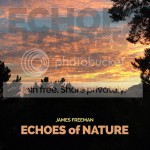
James Freeman's "Echoes of Nature" is a curious juxtaposition of synthesis and nature. Pre-listen, my thinking was that - though adventurous - the bulk of the material would be far too labored to have significant merit. The idea of 1s, 0s, and that which is inorganic blended with field recordings of nature (crickets, ocean waves, etc.) further coupled with organic/acoustic instrument improvisation seemed contrived. It still does. But somehow it works, literally filling either a room or your ears with echoes of natural musicality that still somehow derives itself from mathematically-shifting modality.
The extended violin and viola soloing of Mad Tolling and Yehudit are out-front but also well-integrated, as-is the flute and piccolo of Nika Rejto on the applicable 'Sunrise Birds'. All of the solos work contextually most of the time, and even when they sound like they might be getting in the way or otherwise too dominant, a temporary reprieve - but hardly a resolution - is almost breath-like as my brain gets ready for the next one.
Hard to pick a favorite, but I enjoyed the very long (39:48) 'Morning Waves' the most; it proved to be a dexterous workout for my headphones and my brain. Freeman's slow moving low-end synth swells married with high-end fast arpeggios and scale runs contrast the ocean waves in a spectacular way that is hypnotic. I had the pleasure of listening to "Echoes of Nature" first thing in the early AM, and it was quite rewarding. Musically fulfilling in-the-moment, and somehow continuing to be functional post-listen as I felt a sense of calmness afterward.