
Monday, October 26, 2026
Browse by Genre
Industrial Music / Industrial Metal / Aggro Industrial / Electro Metal
Industrial Noise / Power Noise / Harsh Noise
Synth Pop / Electro Pop / Synth-Electronica
Techno / Trance / Goa / Drum'n'Bass / Jungle / Tribal / Trip-Hop
Ambient / Electronica / Ethereal / Dub / Soundscapes / Abstract
Experimental / Avantgarde / Weird & Wired / Glitch / Noise / Field Recording
Dark / Gothic / Wave / New Wave / Dark Wave / Industrial Gothic
New Music / Downtown / Avantgarde Jazz / New Classical / World
Search Reviews
Music Reviews
Birch Book: Fortune & Folly

Artist: Birch Book
Title: Fortune & Folly
Format: CD
Label: Helmet Room Recordings (@)
Distributor: Massive Music
Rated:


Title: Fortune & Folly
Format: CD
Label: Helmet Room Recordings (@)
Distributor: Massive Music
Rated:
Melding with the neo-medieval-folk sensibilities that Dead Can Dance re-popularized, Birch Book's Michael B'eirth labors to resuscitate the troubadour tradition in this now out-of-print collection of psychedelia-tinged folk originals. Not since John Renbourne, Bert Jansch and the Dransfield brothers of the sixties have I heard such serious acoustic guitar-driven intent to praise the itinerant minstrel. An American to boot, the man is also an accomplished custom luthier (guitar maker) based somewhere in the Pacific Northwest.
Though not in as cerebral a mindset as Nick Drake, B'eirth rhymes and chooses his words well enough to make his ultra-lilting, whispery delivery bearable (for those who are not too into having some guy breathing in their ear). In other words, if you loved the movie Once, you may not be able to do without Fortune & Folly. A great moment comes from track six, the instrumental "Diaspora," a frightening take on Leonard Cohen with a beautifully mixed-in jet airplane sound, although some lyrics would have made it brilliant. The only complaints as far as technique is concerned are a few wobbly harmonies and strangely dubbed vocals on track four, "Young Souls."
A significant letdown, however, is that the lyrical themes largely center on the troubadour himself and little else, as in track 7, "Wandering Boy"; track nine, "The Trip Goes On" is a pernicious example of overindulgent repetition. There is little room left for the picaresque narratives and fables that should actually come from the bardic tradition from which B'eirth takes his cue. Where are they? Alas, the beasts with two backs and the jealous cuckolds are nowhere to be seen. Fortune & Folly is an otherwise promising folk outing that smolders with ambition, yet is hobbled by the crippling self-importance that helped scuttle the previous great folk movement. It could be that there is such a thing as too much transcendence.
Though not in as cerebral a mindset as Nick Drake, B'eirth rhymes and chooses his words well enough to make his ultra-lilting, whispery delivery bearable (for those who are not too into having some guy breathing in their ear). In other words, if you loved the movie Once, you may not be able to do without Fortune & Folly. A great moment comes from track six, the instrumental "Diaspora," a frightening take on Leonard Cohen with a beautifully mixed-in jet airplane sound, although some lyrics would have made it brilliant. The only complaints as far as technique is concerned are a few wobbly harmonies and strangely dubbed vocals on track four, "Young Souls."
A significant letdown, however, is that the lyrical themes largely center on the troubadour himself and little else, as in track 7, "Wandering Boy"; track nine, "The Trip Goes On" is a pernicious example of overindulgent repetition. There is little room left for the picaresque narratives and fables that should actually come from the bardic tradition from which B'eirth takes his cue. Where are they? Alas, the beasts with two backs and the jealous cuckolds are nowhere to be seen. Fortune & Folly is an otherwise promising folk outing that smolders with ambition, yet is hobbled by the crippling self-importance that helped scuttle the previous great folk movement. It could be that there is such a thing as too much transcendence.
Cranebuilders: Sometimes You Hear Through Someone Else

Artist: Cranebuilders
Title: Sometimes You Hear Through Someone Else
Format: CD
Label: Azra Records (@)
Distributor: Massive Music America
Rated:
Buy from
Title: Sometimes You Hear Through Someone Else
Format: CD
Label: Azra Records (@)
Distributor: Massive Music America
Rated:
Buy from
Liverpudlian proponents of gentle twee-rock sincerity, the Cranebuilders have apparently had a UK following before crossing the Atlantic via this stateside Azra/Massive Music release. This quintet features a frontman who favors singing near the very bottom of his register, much in the manner of an upbeat Lou Reed. The band display touches of Spacemen 3, early Sisters of Mercy and This Mortal Coil (in order of strength) throughout their sad odes to young love, lust, loss and awkwardness.
This 20-song CD (including 8 bonus tracks) overall is deceptively American-sounding, indeed even more so than anything recorded by the Red House Painters, whose glacial tempos and moods they affect with only a fraction of the brooding venom. It's all the more surprising that this band do not tap into their rich English tradition of liturgical vocal harmonies. Their female singer only seems capable of following along in unison, rendering the vocal deliveries as flat as cardboard cut-outs. This disappointing trait casts a pall over otherwise bright spots such as "So What Could I Do" and "Morning Cup" (the latter of which is just funky and driving enough to be saved from cringe-worthy descriptions of "sweet surrender"). She only manages to harmonize once, slightly, in track 9, "She Can't Find the Words." The best, most sublime and transcendent moment is track 11, "Advanced Directive," with its haunting, Spacemen-like 2-chord vamp.
I hate resorting to stereotypes, but with this CD the Cranebuilders fail to take more advantage of the wealth of native influence all around them, and have a lot more to answer to than they bother with. And so compared to most of their predecessors, who were much better at the English art of making dreary, drab, bleak existence sound cool, here they come up short.
This 20-song CD (including 8 bonus tracks) overall is deceptively American-sounding, indeed even more so than anything recorded by the Red House Painters, whose glacial tempos and moods they affect with only a fraction of the brooding venom. It's all the more surprising that this band do not tap into their rich English tradition of liturgical vocal harmonies. Their female singer only seems capable of following along in unison, rendering the vocal deliveries as flat as cardboard cut-outs. This disappointing trait casts a pall over otherwise bright spots such as "So What Could I Do" and "Morning Cup" (the latter of which is just funky and driving enough to be saved from cringe-worthy descriptions of "sweet surrender"). She only manages to harmonize once, slightly, in track 9, "She Can't Find the Words." The best, most sublime and transcendent moment is track 11, "Advanced Directive," with its haunting, Spacemen-like 2-chord vamp.
I hate resorting to stereotypes, but with this CD the Cranebuilders fail to take more advantage of the wealth of native influence all around them, and have a lot more to answer to than they bother with. And so compared to most of their predecessors, who were much better at the English art of making dreary, drab, bleak existence sound cool, here they come up short.
The Bad Hand: This Is No Time For Modesty
Artist: The Bad Hand
Title: This Is No Time For Modesty
Format: 12"
Label: Daly City Records (@)
Distributor: Massive Music America
Rated:
Title: This Is No Time For Modesty
Format: 12"
Label: Daly City Records (@)
Distributor: Massive Music America
Rated:
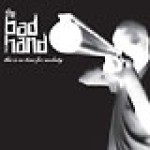
Pleasantly eclectic San Francisco band with jazz-alt-grunge-punk leanings give their utmost in this 11-song effort, yet have a ways to go to cement their overall feel. Most of this LP's instrumentals seem partially half-formed, as if still stuck at their "jam" phase of songwriting, and their incidental noise effects, farty kazoo and backwards-taped snippets of conversation do little more than add comic relief to the album's off-beat-ness. Nevertheless there is a certain charm about the shoegazerish, wispy female vocals on "Hell Bent" and "Grand Theft Bravo," and the way they work atypical instruments (Rhodes piano, Hammond organ, violin, mandolin, recorder) into the mix. But although they sound just the way a band like Guided By Voices might have sounded at one time, the Bad Hand's alchemy is not quite yet up to par.
If you are a local S. F. scenester, however, then you need to both own this album (on limited edition white vinyl, no less) and go to all of their shows ? because whether or not they become the next G.B.V., this is exactly the kind of unpretentious, non-commercial non-pop that every growing boy and girl of collegiate age should cut his/her canines on.
If you are a local S. F. scenester, however, then you need to both own this album (on limited edition white vinyl, no less) and go to all of their shows ? because whether or not they become the next G.B.V., this is exactly the kind of unpretentious, non-commercial non-pop that every growing boy and girl of collegiate age should cut his/her canines on.
Rena Jones: Driftwood
Artist: Rena Jones
Title: Driftwood
Format: CD
Label: Native State Records (@)
Distributor: Massive Music
Rated:
Buy from
Title: Driftwood
Format: CD
Label: Native State Records (@)
Distributor: Massive Music
Rated:
Buy from
San Francisco Bay Area-based violinist/cellist and audio engineer/composer Rena Jones has turned in an ambitious blend of gentle, lilting Ambient Electronica and New Age/Ethnic chamber music instrumentals that remain in search of their own definition. Given these musical parameters, a project such as Driftwood should be a walk in the park in the minds of most people, but here the accomplished and obviously talented Jones is caught in a typically thorny conundrum -- how to be experimental AND conventional at the same time. For example, second track "Photosynthesis" has some neat chord expressions, but they really deserve a better, much less sedate framework with which to set them off. The suggestively-titled "Open Me Slowly" has a muted violin melody line that recalls Chris Isaak's "Wicked Games," but instead of expanding on its erotic theme, the song feels close and claustrophobic.
Jones deserves points for her discriminating selection of sounds and textures, which she juxtaposes artfully and exquisitely. The programmed percussion contains the most "listenable" elements of the tracks, with varied kick-and-snare shots backwards-looped in places. All well and good, but in such mellow, regular song and chord structures, it's a bit like hanging Warhol prints inside the Notre Dame cathedral. Only track 12, the Slidecamp remix of "Photosynthesis," shows enough promise to transcend the album's general stasis. Unless taken in as strictly make-out music, Driftwood doesn't quite have what it takes to make it onto shore.
Jones deserves points for her discriminating selection of sounds and textures, which she juxtaposes artfully and exquisitely. The programmed percussion contains the most "listenable" elements of the tracks, with varied kick-and-snare shots backwards-looped in places. All well and good, but in such mellow, regular song and chord structures, it's a bit like hanging Warhol prints inside the Notre Dame cathedral. Only track 12, the Slidecamp remix of "Photosynthesis," shows enough promise to transcend the album's general stasis. Unless taken in as strictly make-out music, Driftwood doesn't quite have what it takes to make it onto shore.
Natural Frequencies: Ornamental Journey

Artist: Natural Frequencies
Title: Ornamental Journey
Format: CD
Label: Ozella Music (@)
Rated:
Buy from or Buy from 
Title: Ornamental Journey
Format: CD
Label: Ozella Music (@)
Rated:
Buy from
or Buy from
A single listening to Ornamental Journey gives the initial impression of yet one more tedious Nature/Space/Synth CD (at first seeing "New Age" pop up in the Genres category for this release in iTunes almost made me throw up a little inside my mouth), but in truth there is a lot more than meets the ear -- way more.
This masterwork, by Germany-based composer/producer and DJ Andreas Leifeld, is the mellowest of mellow listens, yet it somehow counters that with deft composition, nicely recorded acoustic textures, and appropriate, subtle programming. Leifeld manages to strike such a nearly impossible balance between minimal repetition and complex depth that it takes many listenings to pick up all the clues. Most of the pieces' titles take on an exotic, vaguely third-world "nature" theme, which unfortunately gives the tracks a false impression of innocuousness. Track two, the eight-minute-long "Snake," has the first hint of profound stillness that can settle over you and open up all your senses and personal remembrances, if you let it. On track four, "Hurikea," there is a recitation in Japanese by a low, droning female voice, which, because there is no accompanying translation, gives one a strong whiff of ethnic tourism. (This is entirely forgivable, however, since this is not musical colonialism on the egregious level of, say, a Paul Simon or a David Byrne.) In a similar sense, "Desert" blends chimy percussion, saxophone and synth artfully with only a hint of stereotype. "Mouse & Elephant" aims at weaving a beast fable through surreal accoustic guitar strums, and "Muted City" paints a sad urban landscape with some Chick Corea-esque piano for taste.
On the whole Ornamental Journey is a very "composerish" work, and a lot of mid-twentieth-century Classical Minimalism has gone into the chord changes and song structures, so this is by no means mere knob-twaddling fluff, easy as it is to listen to. That said, it pretty much skirts the soundtrack realm, but what a damn fine movie this would be to watch.
This masterwork, by Germany-based composer/producer and DJ Andreas Leifeld, is the mellowest of mellow listens, yet it somehow counters that with deft composition, nicely recorded acoustic textures, and appropriate, subtle programming. Leifeld manages to strike such a nearly impossible balance between minimal repetition and complex depth that it takes many listenings to pick up all the clues. Most of the pieces' titles take on an exotic, vaguely third-world "nature" theme, which unfortunately gives the tracks a false impression of innocuousness. Track two, the eight-minute-long "Snake," has the first hint of profound stillness that can settle over you and open up all your senses and personal remembrances, if you let it. On track four, "Hurikea," there is a recitation in Japanese by a low, droning female voice, which, because there is no accompanying translation, gives one a strong whiff of ethnic tourism. (This is entirely forgivable, however, since this is not musical colonialism on the egregious level of, say, a Paul Simon or a David Byrne.) In a similar sense, "Desert" blends chimy percussion, saxophone and synth artfully with only a hint of stereotype. "Mouse & Elephant" aims at weaving a beast fable through surreal accoustic guitar strums, and "Muted City" paints a sad urban landscape with some Chick Corea-esque piano for taste.
On the whole Ornamental Journey is a very "composerish" work, and a lot of mid-twentieth-century Classical Minimalism has gone into the chord changes and song structures, so this is by no means mere knob-twaddling fluff, easy as it is to listen to. That said, it pretty much skirts the soundtrack realm, but what a damn fine movie this would be to watch.