
Browse by Genre
Industrial Music / Industrial Metal / Aggro Industrial / Electro Metal
Industrial Noise / Power Noise / Harsh Noise
Synth Pop / Electro Pop / Synth-Electronica
Techno / Trance / Goa / Drum'n'Bass / Jungle / Tribal / Trip-Hop
Ambient / Electronica / Ethereal / Dub / Soundscapes / Abstract
Experimental / Avantgarde / Weird & Wired / Glitch / Noise / Field Recording
Dark / Gothic / Wave / New Wave / Dark Wave / Industrial Gothic
New Music / Downtown / Avantgarde Jazz / New Classical / World
Search Reviews
Music Reviews
Merzbow: Life Performance

Writing a critique of one of Masami Akita's work is not an easy task as the historical importance acts as a deforming mirror of the musical value. Life Performance is the reissue of a '85 cassette release and shows some of the characteristics for whom Merzbow symbolizes a genre. While in Europe, the first noise acts tied a shocking imaginary to the musical impact, Masami Akita tied it to an art form. Instead of conceiving noise as a symbol for pain, it's the direct result of the juxtaposition of sound sources, probably discarded as the material used by Kurt Schwitters, until the fulness of the sound spectrum. So, the collage of the artwork is a reference of the method used in the development of the "action", a term not used without a reference, whose result is recorded in this release.
"Nil Vagina Mail Action" is a single track in five part: the first one starts with a tape loop upon a background noise which gradually reveals itself as generated by electronic, probably noise generators and filters, with inserts of samples that could even be of pop music. The second part is characterized by the loop of the central part which unifies the other sound sources used. The third part is close to a white noise generated by components which reveal themselves at their time. The fourth part sounds generated by phone tones as a picture of the crowd which surround a person. The fifth part closes this release with a loop upon an evolving noise.
This release is so far from the usual representation of noise of a monolithic mass of sound without movement that remind of the motivations for whom this kind of music is even able to approach art galleries. A piece of history which cannot be rated.
"Nil Vagina Mail Action" is a single track in five part: the first one starts with a tape loop upon a background noise which gradually reveals itself as generated by electronic, probably noise generators and filters, with inserts of samples that could even be of pop music. The second part is characterized by the loop of the central part which unifies the other sound sources used. The third part is close to a white noise generated by components which reveal themselves at their time. The fourth part sounds generated by phone tones as a picture of the crowd which surround a person. The fifth part closes this release with a loop upon an evolving noise.
This release is so far from the usual representation of noise of a monolithic mass of sound without movement that remind of the motivations for whom this kind of music is even able to approach art galleries. A piece of history which cannot be rated.
Henrik Nordvargr Björkk / Margaux Renaudin: Anima Nostra

Artist: Henrik Nordvargr Björkk / Margaux Renaudin (@)
Title: Anima Nostra
Format: CD
Label: Cold Spring (@)
Rated:

Title: Anima Nostra
Format: CD
Label: Cold Spring (@)
Rated:
This release is a collaboration between Henrik Nordvargr Björkk, with his remarkable career as a solo artist but mostly as a member of MZ.412, and Margaux Renaudin, better known as a visual artist. As reasonably predictable, the musical style is based on the form already codified in the previous releases as Nordvargr where musical impact is stemmed by an evocative constructed soundscape and, so, the main contribution of Margaux Renaudin seems apparently a refined artwork focused on pseudo ermetic symbols printed on grey upon black.
The rhythmic structure of "Sunyata" opens this release as a container for the ritualistic part focused on the use of the vocals. "Spiritus Omni" is instead a dark ambient track developed upon the sound layers typical of Nordvargr's style. "Mourning Star" is a cover of a track from "Infernal Affairs" whose atmospheric element is exalted and so "Kmt" with the vocals of Nader Sadek is closer to the most industrial oriented output of this band. "Runik Hexagram II" returns to more subtle sonic construction while "Gjallarhornet ljuder" is based on thick layers of drone whose mass is overwhelming. "Lavenement Du Neant" is an evocative ritual track whose charm is related to the french spoken word. The depth of the reverb used in "Maladia Skandinavia" is crucial in the closing of this album with a sense of being immersed in a spiritual space.
Obviously Björkk's music hasn't any innovation but, for a so codified style, sometimes the music is able to match the remarkable beauty of the artwork and is a reminder on the importance of writing. Recommended for Nordvargr's fans.
The rhythmic structure of "Sunyata" opens this release as a container for the ritualistic part focused on the use of the vocals. "Spiritus Omni" is instead a dark ambient track developed upon the sound layers typical of Nordvargr's style. "Mourning Star" is a cover of a track from "Infernal Affairs" whose atmospheric element is exalted and so "Kmt" with the vocals of Nader Sadek is closer to the most industrial oriented output of this band. "Runik Hexagram II" returns to more subtle sonic construction while "Gjallarhornet ljuder" is based on thick layers of drone whose mass is overwhelming. "Lavenement Du Neant" is an evocative ritual track whose charm is related to the french spoken word. The depth of the reverb used in "Maladia Skandinavia" is crucial in the closing of this album with a sense of being immersed in a spiritual space.
Obviously Björkk's music hasn't any innovation but, for a so codified style, sometimes the music is able to match the remarkable beauty of the artwork and is a reminder on the importance of writing. Recommended for Nordvargr's fans.
Sonovo: a line has two sides

Coming back after seven years of silence by means of a couple of tracks on a strictly limited (just 30 copies for his imprint Klanggold) yellow tape, lasting approximately six minutes each, could be compared to the announce of the discovery of lifeforms on Pluto after an astrophysicist interpreted the noise of his fart as a radio signal from that far planet. Anyway Sonovo, moniker of the smart sound artist and performer Andreas Usenbetz, came back by two impressive studies in minimal electronic music where he mainly squeezed a Microkorg and looped some samples as well as a field recording that Mark Baker grabbed at Peace Park in Hiroshima on the title-track "a line has two sides" on Side A. Both the popping micropattern on this track and, even more, the more regular one on the other half of the tape, titled "Serious Colors" - in spite of its opening, that could sound like the looped noise of a gastroesophageal reflux or the one that could come from the squeezing of something slimy! -, features a minimal approach and a certain sense of balanced elegance that could vaguely resemble the stuff coming from German label ~scape by Stefan 'Pole' Betke (not working since 2010, in spite of the high quality of its outputs) such as Pole, Jan Jelinek, Kit Clayton or System. We could forgive Andreas 'Sonovo' Usenbetz, just if he's going to release more lengthy stuff as soon as possible after this delicious tidbit. The way you'll figure, forewarned is forearmed!
Gunnar Lettow & Korhan Erel: Bad Falling Bostel
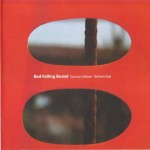
Artist: Gunnar Lettow & Korhan Erel
Title: Bad Falling Bostel
Format: CD
Label: Creative Sources (@)
Rated:

Title: Bad Falling Bostel
Format: CD
Label: Creative Sources (@)
Rated:
I got attracted by the name of this aged output within the huge pile of releases from Portuguese label Creative Sources before discovering the German guys behind its named it after the name of a small village between Hamburg and Hannover in Lower Saxony, Germany, they usually visit twice a year. What is more, Gunnar Lettow (prepared bass guitar, electronics, found objects) and Kohran Erel (computer, controllers) decided to title each of the twelve bizarre tracks they included in this output by likewise odd names of districts and almost unknown towns all over Germany - I could wonder in discovering the name of the inhabitants of cities/villages such as Dickfeitzen, Zacking, Grilling or Salderatzen! -. Their style, as you can easily guess, is experimental, as they mainly combine sets of microsounds, percussions, little electronic sounds and hits on many different objects that could easily tickle your imagination. For instance, I finally found a possible soundtrack for those educational posters I saw in many studios of dentists to explain the importance of brushing teeth every day, where grinning microbes set their building site to demolish molars while listening to tracks like "Heirengen" or "Urschalling". I could even match stuff like "Zacking" or Middefeitz" to the amplified noises of the digestive system of a woodworm after a bleeding bellyful of furniture! Check these funny experiments out to understand what I mean!
UN ensemble: s/t

Juliette Lacroix (cello), Thomas Lachaise (saxophones), Guillaume Ladain (analog synth), Frédéric Roumagne (electric guitar), Jean-Marc Reilla (analog synth, electronics), Didier Laserre (snare drum & cymbals), Julien Sellam (violin), Laurie Batista (vocals), Yann Saboya (electric guitar), Johann Mazé (drums), Eric Camara (bass), Jean Rougier (bass), Tanguy Bernard (tuba), Delphine Lafon (vocals), Bruno Laurent (bass), Claude Saubole (acoustic guitar), David Chiesa (piano frame), Johann Loiseau (flute, small percussions), Thomas Dubois (trumpet), Mathias Pontevia (horizontal drums), Christophe Ratier (bass clarinet), Guylaine Cosseron (vocals), Guillaume Flamen (tuba)...these are the overlapped names (and the instruments they respectively play) on the cover artwork of this enormous ensemble. It includes just six (more or less long-lasting) improvisational sessions, but both the quality of the recording and the almost theatrical vividness they collectively reached is astonishing. Before now, I only knew the name of David Chiesa, who signed a couple of sessions: an amalgamation of dynamics, timbres, resounding matters and musical quotations that he tried to organize over a time line in the exciting piece "Masses" and "The Blue Yonder", the longest session of the whole release, named after and inspired by an half-fake documentary about Werner Herzog, where a set of images taken from the archives of NASA and an Antarctic submarine exploration station go along with the interview of a fake alien, telling the story of its journey to reach out planet from his ocean-covered one and explaining its project of a giant shopping centre between two railways. The overlapping cartographies over three levels (stars, earth, and seabed) provided the instructions (including temporalities and heights) to the playing orchestra! Even its subject could be somehow demeaning, one of the most impressive session is "L'Acceptation d'Elisabeth", the opening one, which refers to the five stages of grief (denial, anger, bargaining, depression and acceptance), described and detected by Swiss-American psychiatrist Elisabeth Kübler-Ross in self-named model: the way by which they musically translated each stage is just astonishing and so vividly that it seems they managed to bridge that gap of verbal incommunicability of a person who sadly experiences them. In between the last mentioned sessions, there's a tribute to the memory of the French brilliant bass player Bernard "Beb" Guerin, where its director, Didier Lassere, tried to turn his orchestra into a sort of "humanly heated synthesizer" - as described in the inlay -, by playing on overlaying, appearing and disappearing orchestral sonic blocks. Such a sonic organization reminded to me the one adopted by Urban Sax, another conceptual orchestra led by Gilbert Artman, who involved Beb Guerin in some of its spectacular sessions. The rule of the game in Bruno Laurent's "HEIN!!!", the shortest output by UN, is likewise bizarre. The orchestra got divided into smaller groups of six players, each of them only knew the game mode and each player had to find a strategy to go from a mode to another on each instrument in a relevant manner...you could vaguely imagine how unpredictable are this interchanges. Another crazy idea is the one behind the final suite "Tenir par là: 174,6 Hz et ses multiples", where everything orbits around the frequency quoted in its title - the first of the 7 major solfeggio frequencies and, according to music therapists, the frequency that could activate DNA, muscles and organs in general by inducing them to operate at optimal performance! -, resulting in a fantastic piece where musicians turns into listeners as well and seems to contribute to the maintenance of this beneficial frequency using their breath and muscles as well.