
Saturday, August 29, 2026
Moljebka Pvlse: The Distant Past Resounds
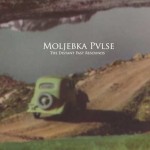


Nowadays brevity is often king and the ephemeral reigns almost supreme. Within the narrow fences of such unfavorable historical conjunction, "The Distant Past Resounds" stands as a monument to patience, depth, and the art of true immersion. This record, with its sprawling three-part odyssey, invites listeners to abandon the triviality of the now and to delve into the echoes of a time long forgotten. Ironically, it is within this vast expanse of sound that one finds the most poignant reflections on the present.
The journey begins with "I" a 25-minute exploration that unfolds like an ancient manuscript, each note a carefully inscribed rune. It’s as if Moljebka Pvlse have tapped into the very soul of the earth, pulling forth vibrations that have lain dormant for eons. The piece is a masterclass in subtlety and restraint, its layers revealing themselves slowly, like the gradual erosion of stone by water. The irony is not lost on the listener: in a world obsessed with speed, it is in this prolonged reverie that one truly begins to feel the weight and beauty of time.
"I" bleeds into "II" with a seamlessness that is both hypnotic and jarring. At 26 minutes, "II" is the album’s heart—a pulsating, resonant core that beats with the primordial rhythm of life itself. Here, the textures are richer, the layers more intricate. It is a soundscape that conjures images of vast, desolate landscapes, ancient ruins, and forgotten civilizations. The track breathes with an eerie vitality, each swell and decay a testament to the cyclic nature of existence. The past, it seems, is not so distant after all; it resounds within us, shaping our present and hinting at our future.
The final movement, "III", at nearly 26 minutes, is a cathartic resolution, a slow exhalation of breath held for too long. It is here that the album’s themes coalesce into a profound meditation on memory and impermanence. The music is both mournful and celebratory, a requiem for what has been lost and a hymn to what endures. The layers of sound are both dense and spacious, a paradox that mirrors the duality of human experience. The irony here is exquisite: in an album so concerned with the past, it is the listener’s present emotions that are most vividly stirred. The mentioned tripartition applies only to the digital edition, as the physical version contains a single track (or I'd rather call it a proper drone!) lasting approximately 1 hour and 15 minutes.
"The Distant Past Resounds" is not an album for the casual listener. It demands time, attention, and a willingness to engage with its depths. But for those who accept its challenge, it offers a richly rewarding experience. Moljebka Pvlse have crafted a work that is both timeless and timely, a sonic tapestry that resonates with the profound truths of our existence.
In this era of distraction and disposability, "The Distant Past Resounds" stands as a defiant testament to the power of slow, deliberate artistry, where besides the electronic mantle by Mathias Josefson, the other “voices” - the one by Hara Alonso on piano, the icy touch by Isabel Fogelklou on the harp and the piercing double bass by Kris Kuldkepp - sounds like wisely sharpened to dig into listener's consciousness. It is a reminder that sometimes, to understand the present, we must listen to the echoes of the past. And in doing so, we might just hear the faint, resounding pulse of eternity.
The journey begins with "I" a 25-minute exploration that unfolds like an ancient manuscript, each note a carefully inscribed rune. It’s as if Moljebka Pvlse have tapped into the very soul of the earth, pulling forth vibrations that have lain dormant for eons. The piece is a masterclass in subtlety and restraint, its layers revealing themselves slowly, like the gradual erosion of stone by water. The irony is not lost on the listener: in a world obsessed with speed, it is in this prolonged reverie that one truly begins to feel the weight and beauty of time.
"I" bleeds into "II" with a seamlessness that is both hypnotic and jarring. At 26 minutes, "II" is the album’s heart—a pulsating, resonant core that beats with the primordial rhythm of life itself. Here, the textures are richer, the layers more intricate. It is a soundscape that conjures images of vast, desolate landscapes, ancient ruins, and forgotten civilizations. The track breathes with an eerie vitality, each swell and decay a testament to the cyclic nature of existence. The past, it seems, is not so distant after all; it resounds within us, shaping our present and hinting at our future.
The final movement, "III", at nearly 26 minutes, is a cathartic resolution, a slow exhalation of breath held for too long. It is here that the album’s themes coalesce into a profound meditation on memory and impermanence. The music is both mournful and celebratory, a requiem for what has been lost and a hymn to what endures. The layers of sound are both dense and spacious, a paradox that mirrors the duality of human experience. The irony here is exquisite: in an album so concerned with the past, it is the listener’s present emotions that are most vividly stirred. The mentioned tripartition applies only to the digital edition, as the physical version contains a single track (or I'd rather call it a proper drone!) lasting approximately 1 hour and 15 minutes.
"The Distant Past Resounds" is not an album for the casual listener. It demands time, attention, and a willingness to engage with its depths. But for those who accept its challenge, it offers a richly rewarding experience. Moljebka Pvlse have crafted a work that is both timeless and timely, a sonic tapestry that resonates with the profound truths of our existence.
In this era of distraction and disposability, "The Distant Past Resounds" stands as a defiant testament to the power of slow, deliberate artistry, where besides the electronic mantle by Mathias Josefson, the other “voices” - the one by Hara Alonso on piano, the icy touch by Isabel Fogelklou on the harp and the piercing double bass by Kris Kuldkepp - sounds like wisely sharpened to dig into listener's consciousness. It is a reminder that sometimes, to understand the present, we must listen to the echoes of the past. And in doing so, we might just hear the faint, resounding pulse of eternity.
Comments
Stream
Browse by Genre
Industrial Music / Industrial Metal / Aggro Industrial / Electro Metal
Industrial Noise / Power Noise / Harsh Noise
Synth Pop / Electro Pop / Synth-Electronica
Techno / Trance / Goa / Drum'n'Bass / Jungle / Tribal / Trip-Hop
Ambient / Electronica / Ethereal / Dub / Soundscapes / Abstract
Experimental / Avantgarde / Weird & Wired / Glitch / Noise / Field Recording
Dark / Gothic / Wave / New Wave / Dark Wave / Industrial Gothic
New Music / Downtown / Avantgarde Jazz / New Classical / World