
Crossland Frangenheim: Basic Tracks (Baltimore New York)
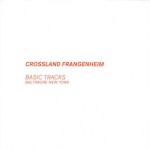


"Basic Tracks: Baltimore / New York" is an exercise in avant-garde audacity, that manages to be both exhilarating and confounding in equal measure. Patrick Crossland on trombone and Alexander Frangenheim on double bass present a collaboration that feels like a deep dive into the subconscious, where every note is a revelation and every pause a moment of introspective reflection.
The album opens with "UMBC 1st Set Part 1", recorded live at the University of Maryland, Baltimore County during the LiveWire 12 Festival. This 17-minute opus is a sprawling, almost meandering exploration of sound. Crossland’s trombone, with its guttural growls and sudden bursts of energy, contrasts sharply with Frangenheim’s double bass, which anchors the piece with a dark, brooding presence. The two musicians exhibit a telepathic level of interaction, creating a dynamic where the music feels less like a performance and more like a conversation — albeit one filled with abstract thoughts and unspoken tension.
Günter Christmann, the venerable pioneer of improvised music, praises this work, and it's easy to see why. The album captures the raw essence of live performance, where spontaneity reigns supreme and the boundaries of conventional music are gleefully ignored. The recording quality, handled by Alan Wonneberger, deserves a nod as well; it captures the spatial expanse of the concert hall, allowing the sound to breathe and unfold naturally.
The transition to the second half of the album, recorded at The Record Shop in Brooklyn, marks a shift in atmosphere. Here, the close-mic'd recording brings an intimacy that the expansive UMBC recordings lack. "Record Shop NY #1" plunges the listener into a denser, more immediate sound world. The dynamic shifts are abrupt, the interplay between Crossland and Frangenheim even more visceral. It's as if the constraints of the smaller venue force the music to confront its own intensity head-on.
Frangenheim’s double bass work throughout the album is nothing short of remarkable. His ability to coax a wide range of textures and tones from his instrument, from percussive thumps to melodic arco passages, adds layers of complexity to the music. Crossland’s trombone, meanwhile, alternates between being a provocateur and a mediator, pushing the music forward one moment and offering a soothing balm the next.
The final track, "Record Shop NY #3", clocks in at a succinct 4:30, but it packs a punch. It’s a condensed burst of energy that serves as a fitting conclusion to the album’s journey. The piece encapsulates the album's essence: raw, unfiltered, and brimming with the kind of musical tension that only true improvisation can produce.
Comparing Crossland and Frangenheim to other artists in the field of free improvisation, one might draw parallels to the likes of Peter Brötzmann or Evan Parker, but with a unique twist. Crossland’s background, studying under luminaries like Pierre Boulez and performing with ensembles such as MusikFabrik, brings a certain rigor and precision to his improvisations. Frangenheim’s extensive experience in the international improvisation scene, collaborating with the likes of Cecil Taylor and John Butcher, imbues his playing with a depth and maturity that is palpable.
For those willing to take the plunge, this record offers a journey into the unknown, guided by two masters of their craft. And for that, it is nothing short of extraordinary.
The album opens with "UMBC 1st Set Part 1", recorded live at the University of Maryland, Baltimore County during the LiveWire 12 Festival. This 17-minute opus is a sprawling, almost meandering exploration of sound. Crossland’s trombone, with its guttural growls and sudden bursts of energy, contrasts sharply with Frangenheim’s double bass, which anchors the piece with a dark, brooding presence. The two musicians exhibit a telepathic level of interaction, creating a dynamic where the music feels less like a performance and more like a conversation — albeit one filled with abstract thoughts and unspoken tension.
Günter Christmann, the venerable pioneer of improvised music, praises this work, and it's easy to see why. The album captures the raw essence of live performance, where spontaneity reigns supreme and the boundaries of conventional music are gleefully ignored. The recording quality, handled by Alan Wonneberger, deserves a nod as well; it captures the spatial expanse of the concert hall, allowing the sound to breathe and unfold naturally.
The transition to the second half of the album, recorded at The Record Shop in Brooklyn, marks a shift in atmosphere. Here, the close-mic'd recording brings an intimacy that the expansive UMBC recordings lack. "Record Shop NY #1" plunges the listener into a denser, more immediate sound world. The dynamic shifts are abrupt, the interplay between Crossland and Frangenheim even more visceral. It's as if the constraints of the smaller venue force the music to confront its own intensity head-on.
Frangenheim’s double bass work throughout the album is nothing short of remarkable. His ability to coax a wide range of textures and tones from his instrument, from percussive thumps to melodic arco passages, adds layers of complexity to the music. Crossland’s trombone, meanwhile, alternates between being a provocateur and a mediator, pushing the music forward one moment and offering a soothing balm the next.
The final track, "Record Shop NY #3", clocks in at a succinct 4:30, but it packs a punch. It’s a condensed burst of energy that serves as a fitting conclusion to the album’s journey. The piece encapsulates the album's essence: raw, unfiltered, and brimming with the kind of musical tension that only true improvisation can produce.
Comparing Crossland and Frangenheim to other artists in the field of free improvisation, one might draw parallels to the likes of Peter Brötzmann or Evan Parker, but with a unique twist. Crossland’s background, studying under luminaries like Pierre Boulez and performing with ensembles such as MusikFabrik, brings a certain rigor and precision to his improvisations. Frangenheim’s extensive experience in the international improvisation scene, collaborating with the likes of Cecil Taylor and John Butcher, imbues his playing with a depth and maturity that is palpable.
For those willing to take the plunge, this record offers a journey into the unknown, guided by two masters of their craft. And for that, it is nothing short of extraordinary.
Comments
Browse by Genre
Industrial Music / Industrial Metal / Aggro Industrial / Electro Metal
Industrial Noise / Power Noise / Harsh Noise
Synth Pop / Electro Pop / Synth-Electronica
Techno / Trance / Goa / Drum'n'Bass / Jungle / Tribal / Trip-Hop
Ambient / Electronica / Ethereal / Dub / Soundscapes / Abstract
Experimental / Avantgarde / Weird & Wired / Glitch / Noise / Field Recording
Dark / Gothic / Wave / New Wave / Dark Wave / Industrial Gothic
New Music / Downtown / Avantgarde Jazz / New Classical / World