
Chamber 4: Dawn To Dusk
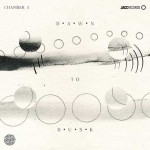


"Dawn to Dusk" by Chamber 4 is a record that will undoubtedly polarize listeners, and perhaps that’s the point. Recorded live at the Jazz ao Centro Festival in an ancient church, the Antiga Igreja do Convento S. Francisco, this album carries the weight of both its historical setting and the audacious spirit of modern improvisational jazz. One can almost feel the centuries-old walls absorbing the sound, lending an air of solemnity and gravitas to the music.
The quartet, consisting of Théo Ceccaldi on violin, Luís Vicente on trumpet, Valentin Ceccaldi on cello, and Marcelo dos Reis on acoustic guitar, presents an intriguing blend of instruments and personalities. From the outset, it’s clear that this isn't an album for those seeking the comfort of traditional jazz structures. Instead, it’s an exploration — sometimes meandering, sometimes electrifying — of some possible boundaries between sound and silence.
The album opens with the 24-minute epic "Dawn", an epic track that might be more accurately titled "The Slow Birth of Sound". It begins with an almost painful deliberation, each musician seemingly unsure whether they want to play or just listen to the church’s echoes. The result is a tension-filled atmosphere, punctuated by tentative notes and hesitant rhythms. It's like watching a sunrise that’s unsure if it wants to commit to rising at all. If patience is a virtue, then "Dawn" is practically a spiritual exercise with many awesome moments.
The second track, "To", is a brief, five-minute interlude that feels like the musicians collectively decided to stretch their legs, their fingers and their strings after the endurance test of "Dawn". It’s lighter, more playful, and offers a glimpse of what this ensemble can do when they’re not engaged in an existential sound quest. However, just as you start to settle into its sketched grooves (to call them so), it abruptly ends by a flatty moment (starting after less than 3 minutes), leaving you craving more of this more accessible side of Chamber 4 on the first half, as the energy that was ready to explode get gradually extiguished by impacts with the light and the awareness on things that it can often carry.
Finally, we arrive at "Dusk", an 11-minute piece that sounds like an attempt to tie the album’s themes together. It’s here that the quartet truly shines. The interplay between Théo's violin and Luís's trumpet is particularly noteworthy, weaving a complex tapestry of sound that’s both haunting and beautiful. Valentin’s cello and Marcelo’s guitar provide a grounding, though still experimental, backdrop that allows the other instruments to soar.
It's not easy to find some terms of comparison, but maybe Chamber 4 can be likened to a modern-day AMM or Art Ensemble of Chicago, with their focus on free improvisation and the deconstruction of musical norms. Yet, there’s a distinctly European flavor to their sound, perhaps influenced by the Ceccaldi brothers’ French roots and the Iberian connection through Vicente and dos Reis.
However, not all is perfect in this avant-garde paradise. The album’s length (sometimes sounding like a form of purposeful long-windedness, even if a certain prolixity in soem crescendo could belong to the performing strategy of live recordings) and the sprawling nature of its compositions may test the limits of even the most dedicated jazz aficionado. The live recording adds an authentic, raw quality but also means that some moments feel more like a rehearsal than a polished performance, particularly in some occasional moments when the sound (maybe deliberately) appear a bit dirty.
I would say that Chamber 4's music here is for those who enjoy the journey as much as, if not more than, the destination. It demands active listening, patience, and a willingness to embrace the unknown. In a world of instant gratification, Chamber 4 offers a challenging, yet ultimately rewarding, alternative. If you're willing to put in the time, you’ll find "Dawn to Dusk" to be a fascinating, albeit occasionally frustrating, exploration of contemporary jazz improvisation.
The quartet, consisting of Théo Ceccaldi on violin, Luís Vicente on trumpet, Valentin Ceccaldi on cello, and Marcelo dos Reis on acoustic guitar, presents an intriguing blend of instruments and personalities. From the outset, it’s clear that this isn't an album for those seeking the comfort of traditional jazz structures. Instead, it’s an exploration — sometimes meandering, sometimes electrifying — of some possible boundaries between sound and silence.
The album opens with the 24-minute epic "Dawn", an epic track that might be more accurately titled "The Slow Birth of Sound". It begins with an almost painful deliberation, each musician seemingly unsure whether they want to play or just listen to the church’s echoes. The result is a tension-filled atmosphere, punctuated by tentative notes and hesitant rhythms. It's like watching a sunrise that’s unsure if it wants to commit to rising at all. If patience is a virtue, then "Dawn" is practically a spiritual exercise with many awesome moments.
The second track, "To", is a brief, five-minute interlude that feels like the musicians collectively decided to stretch their legs, their fingers and their strings after the endurance test of "Dawn". It’s lighter, more playful, and offers a glimpse of what this ensemble can do when they’re not engaged in an existential sound quest. However, just as you start to settle into its sketched grooves (to call them so), it abruptly ends by a flatty moment (starting after less than 3 minutes), leaving you craving more of this more accessible side of Chamber 4 on the first half, as the energy that was ready to explode get gradually extiguished by impacts with the light and the awareness on things that it can often carry.
Finally, we arrive at "Dusk", an 11-minute piece that sounds like an attempt to tie the album’s themes together. It’s here that the quartet truly shines. The interplay between Théo's violin and Luís's trumpet is particularly noteworthy, weaving a complex tapestry of sound that’s both haunting and beautiful. Valentin’s cello and Marcelo’s guitar provide a grounding, though still experimental, backdrop that allows the other instruments to soar.
It's not easy to find some terms of comparison, but maybe Chamber 4 can be likened to a modern-day AMM or Art Ensemble of Chicago, with their focus on free improvisation and the deconstruction of musical norms. Yet, there’s a distinctly European flavor to their sound, perhaps influenced by the Ceccaldi brothers’ French roots and the Iberian connection through Vicente and dos Reis.
However, not all is perfect in this avant-garde paradise. The album’s length (sometimes sounding like a form of purposeful long-windedness, even if a certain prolixity in soem crescendo could belong to the performing strategy of live recordings) and the sprawling nature of its compositions may test the limits of even the most dedicated jazz aficionado. The live recording adds an authentic, raw quality but also means that some moments feel more like a rehearsal than a polished performance, particularly in some occasional moments when the sound (maybe deliberately) appear a bit dirty.
I would say that Chamber 4's music here is for those who enjoy the journey as much as, if not more than, the destination. It demands active listening, patience, and a willingness to embrace the unknown. In a world of instant gratification, Chamber 4 offers a challenging, yet ultimately rewarding, alternative. If you're willing to put in the time, you’ll find "Dawn to Dusk" to be a fascinating, albeit occasionally frustrating, exploration of contemporary jazz improvisation.
Comments
Stream
Browse by Genre
Industrial Music / Industrial Metal / Aggro Industrial / Electro Metal
Industrial Noise / Power Noise / Harsh Noise
Synth Pop / Electro Pop / Synth-Electronica
Techno / Trance / Goa / Drum'n'Bass / Jungle / Tribal / Trip-Hop
Ambient / Electronica / Ethereal / Dub / Soundscapes / Abstract
Experimental / Avantgarde / Weird & Wired / Glitch / Noise / Field Recording
Dark / Gothic / Wave / New Wave / Dark Wave / Industrial Gothic
New Music / Downtown / Avantgarde Jazz / New Classical / World