
Saturday, October 17, 2026
Egil Kalman: Forest of Tines: Egil Kalman Plays the Buchla 200
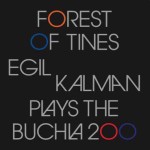
Artist: Egil Kalman (@)
Title: Forest of Tines: Egil Kalman Plays the Buchla 200
Format: 12" x 2
Label: iDEAL
Rated:

Title: Forest of Tines: Egil Kalman Plays the Buchla 200
Format: 12" x 2
Label: iDEAL
Rated:
Egil Kalman’s "Forest of Tines" - one of releases that I missed, after getting buried by a plenty of promo releases - isn’t so much an album as it is a sonic séance, a chance to commune with the spirit of Don Buchla and the ghostly echoes of the EMS studios in Stockholm. If you're looking for something that will gently accompany your morning coffee, this isn't it. Kalman’s follow-up to his "Kingdom of Bells" feels more like the soundtrack to a David Lynch fever dream, conjured from the depths of a modular labyrinth where time and space seem to fold in on themselves.
Let’s start with the Buchla 200, the storied beast of an instrument that dominates this album. For the uninitiated, the Buchla 200 is not your everyday synth — it’s an analog behemoth with a will of its own, and Kalman, rather than taming it, seems content to let it run wild. You can almost hear the Buchla’s circuits sighing with relief as they’re finally given the freedom to stretch out after years of being cooped up in EMS's vaults. The result is a collection of tracks that oscillate between the hypnotic and the unsettling, with Kalman’s skillful touch guiding the machine through its paces without ever fully imposing his will on it.
“Diffused”, the album’s opener, eases you in gently, like stepping into a warm bath of just-tuned drones. But before you can get too comfortable, “Glint” follows with a flurry of pointillistic improvisations, each note like a sudden glimmer of light in a dark forest. Kalman’s approach here is meticulous, yet there’s an underlying spontaneity that keeps you on your toes. It’s as if he’s coaxing the Buchla into revealing its secrets one by one, but only when it’s good and ready.
And then there’s “Blageten”, a traditional Scandinavian folk tune that Kalman somehow manages to fit into this digital dystopia without it feeling out of place. It’s a brief but poignant reminder of Kalman’s roots, a glimpse of the past that’s quickly swallowed up by the towering trees of the "Forest of Tines". The title track, “Forest of Tines”, feels like the album’s dark heart — its oscillating tones and eerie reverb suggesting something ancient and untamable lurking just beneath the surface.
But the album isn’t all gloom and doom. There are moments of genuine beauty, like the shimmering “Autumn Leaves”, where the Buchla’s tones seem to hang in the air like the last rays of sunlight on a crisp fall evening. And then there’s “Dub One”, a track that nods to Kalman’s love of hypnotic ostinatos, its repetitive patterns slowly building into a kind of meditative trance.
Yet for all its sonic variety, "Forest of Tines" is a remarkably cohesive album, each track flowing into the next like chapters in a strange, otherworldly novel. Even the shorter pieces, like the minute-long “Electric Music Box pt. 1”, feel essential to the album’s narrative arc. Kalman’s decision to record everything live, without any overdubs, only adds to the album’s sense of immediacy. You can hear the Buchla in all its raw, untamed glory — no post-production tricks, no glossy veneer, just pure, unfiltered sound.
Comparisons could be drawn to the work of Morton Subotnick or Suzanne Ciani, both of whom have explored the Buchla’s unique sound world, but Kalman’s approach feels distinctly his own. There’s a deep reverence for the instrument’s history here, but also a willingness to push it into new and uncharted territories. Where Subotnick’s "Silver Apples of the Moon" was all about controlled chaos, Kalman seems more interested in the spaces between the notes, in the textures and tones that linger in the air like smoke after a fire.
But for all its technical prowess and avant-garde posturing, "Forest of Tines" is also an intensely emotional record. There’s a melancholic undertone that runs through the album, a sense of longing for something just out of reach. Tracks like “7th” and “From Stone” feel almost elegiac, their sparse melodies evoking a kind of deep, existential sadness that’s hard to shake.
And then there’s the final track, “Ocquet”, which closes the album on a note of quiet resignation. It’s a fitting end to a record that feels like a journey through a forest of sound, each track a different path leading deeper into the unknown. By the time the last notes fade away, you’re left with the sense that you’ve been somewhere strange and beautiful, a place that exists just on the edge of reality. Kalman has created something truly special here—a record that honors the legacy of the Buchla 200 while also forging its own path.
Let’s start with the Buchla 200, the storied beast of an instrument that dominates this album. For the uninitiated, the Buchla 200 is not your everyday synth — it’s an analog behemoth with a will of its own, and Kalman, rather than taming it, seems content to let it run wild. You can almost hear the Buchla’s circuits sighing with relief as they’re finally given the freedom to stretch out after years of being cooped up in EMS's vaults. The result is a collection of tracks that oscillate between the hypnotic and the unsettling, with Kalman’s skillful touch guiding the machine through its paces without ever fully imposing his will on it.
“Diffused”, the album’s opener, eases you in gently, like stepping into a warm bath of just-tuned drones. But before you can get too comfortable, “Glint” follows with a flurry of pointillistic improvisations, each note like a sudden glimmer of light in a dark forest. Kalman’s approach here is meticulous, yet there’s an underlying spontaneity that keeps you on your toes. It’s as if he’s coaxing the Buchla into revealing its secrets one by one, but only when it’s good and ready.
And then there’s “Blageten”, a traditional Scandinavian folk tune that Kalman somehow manages to fit into this digital dystopia without it feeling out of place. It’s a brief but poignant reminder of Kalman’s roots, a glimpse of the past that’s quickly swallowed up by the towering trees of the "Forest of Tines". The title track, “Forest of Tines”, feels like the album’s dark heart — its oscillating tones and eerie reverb suggesting something ancient and untamable lurking just beneath the surface.
But the album isn’t all gloom and doom. There are moments of genuine beauty, like the shimmering “Autumn Leaves”, where the Buchla’s tones seem to hang in the air like the last rays of sunlight on a crisp fall evening. And then there’s “Dub One”, a track that nods to Kalman’s love of hypnotic ostinatos, its repetitive patterns slowly building into a kind of meditative trance.
Yet for all its sonic variety, "Forest of Tines" is a remarkably cohesive album, each track flowing into the next like chapters in a strange, otherworldly novel. Even the shorter pieces, like the minute-long “Electric Music Box pt. 1”, feel essential to the album’s narrative arc. Kalman’s decision to record everything live, without any overdubs, only adds to the album’s sense of immediacy. You can hear the Buchla in all its raw, untamed glory — no post-production tricks, no glossy veneer, just pure, unfiltered sound.
Comparisons could be drawn to the work of Morton Subotnick or Suzanne Ciani, both of whom have explored the Buchla’s unique sound world, but Kalman’s approach feels distinctly his own. There’s a deep reverence for the instrument’s history here, but also a willingness to push it into new and uncharted territories. Where Subotnick’s "Silver Apples of the Moon" was all about controlled chaos, Kalman seems more interested in the spaces between the notes, in the textures and tones that linger in the air like smoke after a fire.
But for all its technical prowess and avant-garde posturing, "Forest of Tines" is also an intensely emotional record. There’s a melancholic undertone that runs through the album, a sense of longing for something just out of reach. Tracks like “7th” and “From Stone” feel almost elegiac, their sparse melodies evoking a kind of deep, existential sadness that’s hard to shake.
And then there’s the final track, “Ocquet”, which closes the album on a note of quiet resignation. It’s a fitting end to a record that feels like a journey through a forest of sound, each track a different path leading deeper into the unknown. By the time the last notes fade away, you’re left with the sense that you’ve been somewhere strange and beautiful, a place that exists just on the edge of reality. Kalman has created something truly special here—a record that honors the legacy of the Buchla 200 while also forging its own path.
Comments
Stream
Browse by Genre
Industrial Music / Industrial Metal / Aggro Industrial / Electro Metal
Industrial Noise / Power Noise / Harsh Noise
Synth Pop / Electro Pop / Synth-Electronica
Techno / Trance / Goa / Drum'n'Bass / Jungle / Tribal / Trip-Hop
Ambient / Electronica / Ethereal / Dub / Soundscapes / Abstract
Experimental / Avantgarde / Weird & Wired / Glitch / Noise / Field Recording
Dark / Gothic / Wave / New Wave / Dark Wave / Industrial Gothic
New Music / Downtown / Avantgarde Jazz / New Classical / World