
Saturday, August 29, 2026
"Blue" Gene Tyranny: Real Life and The Movies: Vol.1
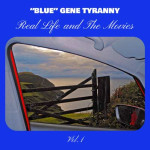
Artist: "Blue" Gene Tyranny
Title: Real Life and The Movies: Vol.1
Format: Download Only (MP3 + Lossless)
Label: Unseen Worlds (@)
Rated:

Title: Real Life and The Movies: Vol.1
Format: Download Only (MP3 + Lossless)
Label: Unseen Worlds (@)
Rated:
"Blue" Gene Tyranny's "Real Life and The Movies: Volume 1" is a kaleidoscope of sound that exists somewhere between a fever dream and a found-footage documentary. It's as if you stumbled into a dusty archive of forgotten experimental films and just pressed play on everything at once. The result is a bewildering, occasionally brilliant, and wholly unpredictable journey through a mind that never met a boundary it couldn't at least poke a hole through.
To call Tyranny's work eclectic is like calling the Grand Canyon a crack in the ground. "Real Life and The Movies" doesn’t just cross genres; it crossbreeds them into something that barely resembles any known musical species. The album is a patchwork of styles, ideas, and experiments that span decades and contexts. The fact that it’s all stitched together with the kind of DIY ethos that predates lo-fi hipsters by a good three decades only adds to its scrappy charm.
Take the opening track, "Theme for Sally Kellman's 'I Was a Teenage Assassin for the C.I.A.'" (a title as gloriously absurd as the music itself). Clocking in at a brief 71 seconds, it’s a blink-and-you’ll-miss-it detour into a ‘60s Motown groove, but one that’s been twisted through a funhouse mirror. Tyranny’s keys dance around the edges of what could have been a chart-topping hit in some alternate universe where the CIA recruits assassins at sock hops. It’s catchy, but in the way a tune gets stuck in your head after you’ve accidentally wandered into the surreal part of a museum.
Then there’s "The Bust", a 1967 recording from Megan Terry’s "Viet Rock", where Bo Diddley meets Lyndon B. Johnson in a back-alley jazz club under an icehouse in Texas. The music is frantic, yet strangely composed — a boozy late-night jam session where the saxes, trumpets, and Tyranny’s own Wurlitzer seem to be playing chicken with the ghost of bebop. And somewhere in the middle of it all, a police officer threatens to haul you off, only to vanish into the smoky ether. It’s music that feels like it’s unraveling at the edges, barely holding together, much like the country at that time.
The pièce de résistance, though, might just be "The White Night Riot", a sonic document of the 1979 San Francisco riots following Dan White’s scandalously lenient verdict for the murders of Harvey Milk and George Moscone. It’s a sound collage that captures the chaos, anger, and disillusionment of the night with a rawness that’s both uncomfortable and utterly captivating. Tyranny doesn’t just recreate the events—he distills them into an abstract, visceral experience. The piece shifts between found sounds, electronic manipulation, and Tyranny’s own grim observations on a society that seems to cultivate its own tragedies. It's not easy listening, but it’s essential.
Interspersed among these more narrative-driven tracks are pieces like "Three Begins" and "Pals / Touch and Action-at-a-Distance", where Tyranny indulges his penchant for pure sonic exploration. These are studies in texture and form, where the music feels less like a performance and more like an excavation—digging through layers of sound to reveal something deeply buried and vaguely unsettling. It’s in these moments that Tyranny’s genius shines brightest, even if it’s not the kind of genius that everyone will appreciate.
And perhaps that’s the crux of this album. "Real Life and The Movies" is not designed for mass appeal. It’s idiosyncratic to the point of being inscrutable, a treasure trove for those willing to sift through its strange, sometimes bewildering offerings. For every moment of transcendence, there’s a stretch of sonic detritus that could easily be mistaken for the ramblings of someone who forgot to take their meds.
To call Tyranny's work eclectic is like calling the Grand Canyon a crack in the ground. "Real Life and The Movies" doesn’t just cross genres; it crossbreeds them into something that barely resembles any known musical species. The album is a patchwork of styles, ideas, and experiments that span decades and contexts. The fact that it’s all stitched together with the kind of DIY ethos that predates lo-fi hipsters by a good three decades only adds to its scrappy charm.
Take the opening track, "Theme for Sally Kellman's 'I Was a Teenage Assassin for the C.I.A.'" (a title as gloriously absurd as the music itself). Clocking in at a brief 71 seconds, it’s a blink-and-you’ll-miss-it detour into a ‘60s Motown groove, but one that’s been twisted through a funhouse mirror. Tyranny’s keys dance around the edges of what could have been a chart-topping hit in some alternate universe where the CIA recruits assassins at sock hops. It’s catchy, but in the way a tune gets stuck in your head after you’ve accidentally wandered into the surreal part of a museum.
Then there’s "The Bust", a 1967 recording from Megan Terry’s "Viet Rock", where Bo Diddley meets Lyndon B. Johnson in a back-alley jazz club under an icehouse in Texas. The music is frantic, yet strangely composed — a boozy late-night jam session where the saxes, trumpets, and Tyranny’s own Wurlitzer seem to be playing chicken with the ghost of bebop. And somewhere in the middle of it all, a police officer threatens to haul you off, only to vanish into the smoky ether. It’s music that feels like it’s unraveling at the edges, barely holding together, much like the country at that time.
The pièce de résistance, though, might just be "The White Night Riot", a sonic document of the 1979 San Francisco riots following Dan White’s scandalously lenient verdict for the murders of Harvey Milk and George Moscone. It’s a sound collage that captures the chaos, anger, and disillusionment of the night with a rawness that’s both uncomfortable and utterly captivating. Tyranny doesn’t just recreate the events—he distills them into an abstract, visceral experience. The piece shifts between found sounds, electronic manipulation, and Tyranny’s own grim observations on a society that seems to cultivate its own tragedies. It's not easy listening, but it’s essential.
Interspersed among these more narrative-driven tracks are pieces like "Three Begins" and "Pals / Touch and Action-at-a-Distance", where Tyranny indulges his penchant for pure sonic exploration. These are studies in texture and form, where the music feels less like a performance and more like an excavation—digging through layers of sound to reveal something deeply buried and vaguely unsettling. It’s in these moments that Tyranny’s genius shines brightest, even if it’s not the kind of genius that everyone will appreciate.
And perhaps that’s the crux of this album. "Real Life and The Movies" is not designed for mass appeal. It’s idiosyncratic to the point of being inscrutable, a treasure trove for those willing to sift through its strange, sometimes bewildering offerings. For every moment of transcendence, there’s a stretch of sonic detritus that could easily be mistaken for the ramblings of someone who forgot to take their meds.
Comments
Stream
Browse by Genre
Industrial Music / Industrial Metal / Aggro Industrial / Electro Metal
Industrial Noise / Power Noise / Harsh Noise
Synth Pop / Electro Pop / Synth-Electronica
Techno / Trance / Goa / Drum'n'Bass / Jungle / Tribal / Trip-Hop
Ambient / Electronica / Ethereal / Dub / Soundscapes / Abstract
Experimental / Avantgarde / Weird & Wired / Glitch / Noise / Field Recording
Dark / Gothic / Wave / New Wave / Dark Wave / Industrial Gothic
New Music / Downtown / Avantgarde Jazz / New Classical / World