
Keith Rowe & Kjell Bj?rgeengen: A Thought for Two
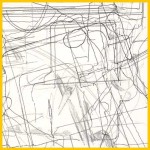
Artist: Keith Rowe & Kjell Bj?rgeengen (@)
Title: A Thought for Two
Format: CD
Label: True Blanking (@)
Rated:


Title: A Thought for Two
Format: CD
Label: True Blanking (@)
Rated:
This 42-minute single track is, in many ways, an endurance test. It’s an uncompromising slab of sound art that dares you to find melody, harmony, or even rhythm in a sea of meticulously curated static, errant electronic hums, and the ghostly echoes of a guitar that Keith Rowe seems to have half-forgotten is in his hands. Here, Rowe and Bjørgeengen revel in the abstract, a sonic experiment where instruments are merely tools for invoking what feels like a magnetic séance. The result? A record that is both challenging and deeply hypnotic, if you’re willing to let go of conventional ideas of music and simply let it wash over you.
Recorded at NYC’s Experimental Intermedia, "A Thought for Two" feels like the kind of thing you’d stumble upon late at night in a cavernous room filled with avant-garde stalwarts pretending they’re not impressed by the sound of a broken CRT monitor feeding back into its own magnetic field. It’s more of a meditation than an album, but one laced with a quiet intensity that rewards patience - and a willingness to embrace noise as the sound of the void thinking out loud.
Keith Rowe, for those unfamiliar with his work, is a founding member of the legendary AMM, a collective that helped pioneer the practice of electroacoustic improvisation. Rowe is not interested in playing guitar in any traditional sense; instead, he manipulates it as a kind of sound object, plucking at the fabric of reality itself with every dissonant note. On "A Thought for Two", Rowe’s guitar is a creature of texture, almost as if it’s performing a slow, whispered conversation with the electronics swirling around it - courtesy of Kjell Bjørgeengen’s Dave Jones Synthesizer. But don’t expect flashy solos or even anything that resembles a chord progression. Here, the guitar is reduced, or perhaps elevated, to its purest essence: a generator of raw, elemental sound.
The story behind the "Flood Coil" - a piece of tech wizardry built out of the remains of old analog components - adds another layer of intrigue. The fact that this jerry-rigged device, born out of a flood-stricken New York town, is a key player in the sonic landscape feels poetic. The "Flood Coil" picks up the debris of magnetic fields, transforming the invisible into the audible, and in doing so, it becomes a perfect metaphor for the entire project. This is music about what’s "left behind", the invisible remnants of things - ideas, cultures, technologies - caught in the crosshairs of time and decay.
Bjørgeengen’s contribution, primarily through his manipulation of video oscillators and the Dave Jones Synthesizer, is equally integral. There’s something wonderfully perverse about the idea of turning video signals into sound. It’s like these two artists got bored of the usual senses and decided to swap them out for fun. The result is a landscape of quiet, occasionally terrifying disturbances - a buzz here, a hum there - like a telepathic conversation with a machine that doesn’t know it’s alive.
As for the dedication to Phill Niblock, the long-time minimalist composer and sound artist who recently passed, it’s both fitting and touching. Niblock’s own work often blurred the line between sound and drone, much like "A Thought for Two". His spirit looms large over the record, as if his life's dedication to transforming sound into a physical experience found a kindred moment here, in this austere, 42-minute dialogue between guitar, electronics, and the residual hum of forgotten technologies.
But let’s not romanticize too much: "A Thought for Two" is a tough listen. For the uninitiated, it could come across as monotonous, even maddening. It's the kind of thing that might prompt your less avant-garde-inclined friends to ask, "Are you seriously listening to this?" And the answer, dear reader, is, "Yes, and it's brilliant." But it’s also one of those experiences where your mood - your willingness to surrender to the static, the drone, the cold, mechanical pulses - dictates whether it feels like transcendence or torture.
For fans of Rowe’s prior work, particularly his collaborations with AMM or other experimental artists like Christian Marclay or Otomo Yoshihide, "A Thought for Two" will feel familiar in its steadfast rejection of conventional musical structures. It’s in line with Rowe’s lifelong pursuit of reducing music to its most elemental forms - sound, space, silence, and texture. In some ways, it feels like the logical continuation of his journey from musician to sound sculptor.
Bjørgeengen’s role, though less immediately apparent to the casual listener, is no less important. The interplay between the audio and the conceptual video piece adds a layer of intellectual rigor that may be more appreciated by those with a deep interest in experimental visual art.
All in all, "A Thought for Two" is for those who relish the challenge, who find comfort in discomfort, and who are ready to dive into the unknown with only the hum of a cathode-ray tube as their guide, this album is a quietly radical piece of art.
Recorded at NYC’s Experimental Intermedia, "A Thought for Two" feels like the kind of thing you’d stumble upon late at night in a cavernous room filled with avant-garde stalwarts pretending they’re not impressed by the sound of a broken CRT monitor feeding back into its own magnetic field. It’s more of a meditation than an album, but one laced with a quiet intensity that rewards patience - and a willingness to embrace noise as the sound of the void thinking out loud.
Keith Rowe, for those unfamiliar with his work, is a founding member of the legendary AMM, a collective that helped pioneer the practice of electroacoustic improvisation. Rowe is not interested in playing guitar in any traditional sense; instead, he manipulates it as a kind of sound object, plucking at the fabric of reality itself with every dissonant note. On "A Thought for Two", Rowe’s guitar is a creature of texture, almost as if it’s performing a slow, whispered conversation with the electronics swirling around it - courtesy of Kjell Bjørgeengen’s Dave Jones Synthesizer. But don’t expect flashy solos or even anything that resembles a chord progression. Here, the guitar is reduced, or perhaps elevated, to its purest essence: a generator of raw, elemental sound.
The story behind the "Flood Coil" - a piece of tech wizardry built out of the remains of old analog components - adds another layer of intrigue. The fact that this jerry-rigged device, born out of a flood-stricken New York town, is a key player in the sonic landscape feels poetic. The "Flood Coil" picks up the debris of magnetic fields, transforming the invisible into the audible, and in doing so, it becomes a perfect metaphor for the entire project. This is music about what’s "left behind", the invisible remnants of things - ideas, cultures, technologies - caught in the crosshairs of time and decay.
Bjørgeengen’s contribution, primarily through his manipulation of video oscillators and the Dave Jones Synthesizer, is equally integral. There’s something wonderfully perverse about the idea of turning video signals into sound. It’s like these two artists got bored of the usual senses and decided to swap them out for fun. The result is a landscape of quiet, occasionally terrifying disturbances - a buzz here, a hum there - like a telepathic conversation with a machine that doesn’t know it’s alive.
As for the dedication to Phill Niblock, the long-time minimalist composer and sound artist who recently passed, it’s both fitting and touching. Niblock’s own work often blurred the line between sound and drone, much like "A Thought for Two". His spirit looms large over the record, as if his life's dedication to transforming sound into a physical experience found a kindred moment here, in this austere, 42-minute dialogue between guitar, electronics, and the residual hum of forgotten technologies.
But let’s not romanticize too much: "A Thought for Two" is a tough listen. For the uninitiated, it could come across as monotonous, even maddening. It's the kind of thing that might prompt your less avant-garde-inclined friends to ask, "Are you seriously listening to this?" And the answer, dear reader, is, "Yes, and it's brilliant." But it’s also one of those experiences where your mood - your willingness to surrender to the static, the drone, the cold, mechanical pulses - dictates whether it feels like transcendence or torture.
For fans of Rowe’s prior work, particularly his collaborations with AMM or other experimental artists like Christian Marclay or Otomo Yoshihide, "A Thought for Two" will feel familiar in its steadfast rejection of conventional musical structures. It’s in line with Rowe’s lifelong pursuit of reducing music to its most elemental forms - sound, space, silence, and texture. In some ways, it feels like the logical continuation of his journey from musician to sound sculptor.
Bjørgeengen’s role, though less immediately apparent to the casual listener, is no less important. The interplay between the audio and the conceptual video piece adds a layer of intellectual rigor that may be more appreciated by those with a deep interest in experimental visual art.
All in all, "A Thought for Two" is for those who relish the challenge, who find comfort in discomfort, and who are ready to dive into the unknown with only the hum of a cathode-ray tube as their guide, this album is a quietly radical piece of art.
Comments
Stream
Browse by Genre
Industrial Music / Industrial Metal / Aggro Industrial / Electro Metal
Industrial Noise / Power Noise / Harsh Noise
Synth Pop / Electro Pop / Synth-Electronica
Techno / Trance / Goa / Drum'n'Bass / Jungle / Tribal / Trip-Hop
Ambient / Electronica / Ethereal / Dub / Soundscapes / Abstract
Experimental / Avantgarde / Weird & Wired / Glitch / Noise / Field Recording
Dark / Gothic / Wave / New Wave / Dark Wave / Industrial Gothic
New Music / Downtown / Avantgarde Jazz / New Classical / World