
Saturday, August 29, 2026
Peter Herbert & Wolfgang Mitterer: Quiet Riots
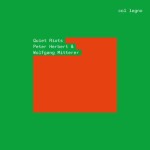
Artist: Peter Herbert & Wolfgang Mitterer (@)
Title: Quiet Riots
Format: CD + Download
Label: col legno (@)
Rated:


Title: Quiet Riots
Format: CD + Download
Label: col legno (@)
Rated:
Once in a blue moon, two musical explorers meet not at a crossroads but at a tangled sonic forest of their own making. "Quiet Riots", the “debut” of Peter Herbert and Wolfgang Mitterer, feels like the result of a long trek through these woods - an album 40 years in the making, rooted in friendship and fertilized by mutual admiration. And oh, what strange and exquisite foliage grows here.
Peter Herbert, a bassist whose passport likely has more stamps than your average diplomat’s, brings to the table a profound grounding in jazz and classical sensibilities, honed by decades of collaboration from New York to Vienna. Wolfgang Mitterer, on the other hand, is a sonic mad scientist. Whether conjuring dramatic operatic overtures or deconstructing music into jagged shards of electronics, Mitterer’s work lives on the border between the tangible and the utterly chaotic. Together, they’ve brewed a potion that shimmers with tension, wit, and a touch of riotous mischief.
The album opens with “Nardis”, an acoustic bass and prepared piano duet that dances on the edge of recognizable jazz standards before dissolving into abstract phrases - like a memory that fades just as you try to grasp it. From there, the titular “Quiet Riot” suite unfolds in six parts, each a miniature sonic rebellion. The bass moans, mutters, and occasionally erupts, while the piano groans and shivers under Mitterer’s inventive preparations and bursts of electronics. It's jazz, yes, but also a journey through the uncanny, where notes seem to arrive late to their own party only to find they've brought the perfect gift.
The duo's reinterpretation of “Someday My Prince Will Come” is a wry wink to tradition - a lullaby for a world that never quite calms down. And “Emily” is the perfect closer: tender, fragmented, and haunting, as if the album itself breathes a soft, contemplative sigh before slipping into the ether.
But this isn’t just an album for jazz aficionados or electronica adventurers. "Quiet Riots" is an exercise in contrast and chemistry, a testament to the beauty that emerges when acoustic and electronic worlds collide, not in battle, but in an elegant, friction-filled dance. Herbert’s deep, resonant bass serves as the album’s heartbeat, while Mitterer’s prepared piano and electronics inject sparks and shadow.
It’s playful yet profound, chaotic yet contemplative. And while the “quiet” may be relative - the album is full of noisy bursts of brilliance - there’s an undeniable intimacy here, the kind born of years of shared stages, ideas, and trust.
Peter Herbert, a bassist whose passport likely has more stamps than your average diplomat’s, brings to the table a profound grounding in jazz and classical sensibilities, honed by decades of collaboration from New York to Vienna. Wolfgang Mitterer, on the other hand, is a sonic mad scientist. Whether conjuring dramatic operatic overtures or deconstructing music into jagged shards of electronics, Mitterer’s work lives on the border between the tangible and the utterly chaotic. Together, they’ve brewed a potion that shimmers with tension, wit, and a touch of riotous mischief.
The album opens with “Nardis”, an acoustic bass and prepared piano duet that dances on the edge of recognizable jazz standards before dissolving into abstract phrases - like a memory that fades just as you try to grasp it. From there, the titular “Quiet Riot” suite unfolds in six parts, each a miniature sonic rebellion. The bass moans, mutters, and occasionally erupts, while the piano groans and shivers under Mitterer’s inventive preparations and bursts of electronics. It's jazz, yes, but also a journey through the uncanny, where notes seem to arrive late to their own party only to find they've brought the perfect gift.
The duo's reinterpretation of “Someday My Prince Will Come” is a wry wink to tradition - a lullaby for a world that never quite calms down. And “Emily” is the perfect closer: tender, fragmented, and haunting, as if the album itself breathes a soft, contemplative sigh before slipping into the ether.
But this isn’t just an album for jazz aficionados or electronica adventurers. "Quiet Riots" is an exercise in contrast and chemistry, a testament to the beauty that emerges when acoustic and electronic worlds collide, not in battle, but in an elegant, friction-filled dance. Herbert’s deep, resonant bass serves as the album’s heartbeat, while Mitterer’s prepared piano and electronics inject sparks and shadow.
It’s playful yet profound, chaotic yet contemplative. And while the “quiet” may be relative - the album is full of noisy bursts of brilliance - there’s an undeniable intimacy here, the kind born of years of shared stages, ideas, and trust.
Comments
Stream
Browse by Genre
Industrial Music / Industrial Metal / Aggro Industrial / Electro Metal
Industrial Noise / Power Noise / Harsh Noise
Synth Pop / Electro Pop / Synth-Electronica
Techno / Trance / Goa / Drum'n'Bass / Jungle / Tribal / Trip-Hop
Ambient / Electronica / Ethereal / Dub / Soundscapes / Abstract
Experimental / Avantgarde / Weird & Wired / Glitch / Noise / Field Recording
Dark / Gothic / Wave / New Wave / Dark Wave / Industrial Gothic
New Music / Downtown / Avantgarde Jazz / New Classical / World