
Monday, October 19, 2026
Gabriel Paiuk: Degrees of Transparency
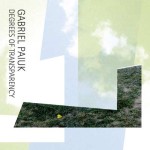
Artist: Gabriel Paiuk
Title: Degrees of Transparency
Format: CD + Download
Label: Unsounds (@)
Rated:


Title: Degrees of Transparency
Format: CD + Download
Label: Unsounds (@)
Rated:
Some music speaks. Some music whispers. "Degrees of Transparency" does something else entirely - it hovers, shifting just beyond the limits of articulation, like light bending through frosted glass. Gabriel Paiuk, Argentine-born composer and sound artist, has spent years exploring the blurred edges of sound and perception, and this album is an exquisite distillation of that ongoing inquiry.
Paiuk isn’t interested in the piano as a mere instrument; he treats it as a resonant body, a site of mediation, a vessel for the way sound is shaped by space. His collaborator, pianist Reinier van Houdt, is no stranger to such delicate negotiations - his work with David Tibet’s Current 93 and experimental composer Michael Pisaro proves his sensitivity to the nuances of sound as a living entity. Here, alongside the Maurice String Quartet and Paiuk himself, van Houdt navigates a world where music dissolves into atmosphere and re-emerges as something newly ambiguous, its boundaries redrawn.
The album’s two long-form pieces - "Degrees of Transparency" and "Rhythm, Presence, Voice" - feel less like compositions and more like environments. The first, a nearly 20-minute meditation, unfolds in a hushed, almost forensic manner. Fragments of field recordings, stretched and layered, seep into van Houdt’s piano, which never quite "plays" in a conventional sense but instead murmurs, reverberates, and hovers on the edge of disappearance. It’s an eerie, intimate study in sonic archaeology - an excavation of the moment where sound and space become indistinguishable.
The second piece, "Rhythm, Presence, Voice", takes this concept further, interrogating the intersection of language and music. Prosody - the way rhythm and intonation shape speech - is at the heart of the work. But instead of presenting language as meaning-laden, Paiuk breaks it down into texture, rhythm, the raw material of human presence. It’s a slow-burning study in auditory perception, where the voice itself becomes an instrument of destabilization.
If "Degrees of Transparency" has an agenda, it’s to unmoor the listener from certainty. The experience is akin to watching ripples distort a reflection: just when you think you recognize something - a chord, a breath, a memory - it shifts, its shape altered by the medium through which it passes. The result is not just music but a listening condition, one that forces you to confront the act of hearing itself.
Paiuk’s work has always been about mediation - the space between things, the artifacts of transmission. This album continues that trajectory with unsettling grace, proving that in the right hands, sound is never just sound. It is space. It is memory. It is something almost, but not quite, graspable.
Paiuk isn’t interested in the piano as a mere instrument; he treats it as a resonant body, a site of mediation, a vessel for the way sound is shaped by space. His collaborator, pianist Reinier van Houdt, is no stranger to such delicate negotiations - his work with David Tibet’s Current 93 and experimental composer Michael Pisaro proves his sensitivity to the nuances of sound as a living entity. Here, alongside the Maurice String Quartet and Paiuk himself, van Houdt navigates a world where music dissolves into atmosphere and re-emerges as something newly ambiguous, its boundaries redrawn.
The album’s two long-form pieces - "Degrees of Transparency" and "Rhythm, Presence, Voice" - feel less like compositions and more like environments. The first, a nearly 20-minute meditation, unfolds in a hushed, almost forensic manner. Fragments of field recordings, stretched and layered, seep into van Houdt’s piano, which never quite "plays" in a conventional sense but instead murmurs, reverberates, and hovers on the edge of disappearance. It’s an eerie, intimate study in sonic archaeology - an excavation of the moment where sound and space become indistinguishable.
The second piece, "Rhythm, Presence, Voice", takes this concept further, interrogating the intersection of language and music. Prosody - the way rhythm and intonation shape speech - is at the heart of the work. But instead of presenting language as meaning-laden, Paiuk breaks it down into texture, rhythm, the raw material of human presence. It’s a slow-burning study in auditory perception, where the voice itself becomes an instrument of destabilization.
If "Degrees of Transparency" has an agenda, it’s to unmoor the listener from certainty. The experience is akin to watching ripples distort a reflection: just when you think you recognize something - a chord, a breath, a memory - it shifts, its shape altered by the medium through which it passes. The result is not just music but a listening condition, one that forces you to confront the act of hearing itself.
Paiuk’s work has always been about mediation - the space between things, the artifacts of transmission. This album continues that trajectory with unsettling grace, proving that in the right hands, sound is never just sound. It is space. It is memory. It is something almost, but not quite, graspable.
Comments
Stream
Browse by Genre
Industrial Music / Industrial Metal / Aggro Industrial / Electro Metal
Industrial Noise / Power Noise / Harsh Noise
Synth Pop / Electro Pop / Synth-Electronica
Techno / Trance / Goa / Drum'n'Bass / Jungle / Tribal / Trip-Hop
Ambient / Electronica / Ethereal / Dub / Soundscapes / Abstract
Experimental / Avantgarde / Weird & Wired / Glitch / Noise / Field Recording
Dark / Gothic / Wave / New Wave / Dark Wave / Industrial Gothic
New Music / Downtown / Avantgarde Jazz / New Classical / World