
Saturday, August 29, 2026
Jo David Meyer Lysne: For renstemt klaver
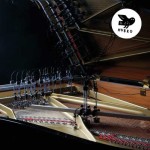
Artist: Jo David Meyer Lysne (@)
Title: For renstemt klaver
Format: CD + Download
Label: Hubro (@)
Rated:

Title: For renstemt klaver
Format: CD + Download
Label: Hubro (@)
Rated:
The piano is alone. Or so it seems.
At first glance, Jo David Meyer Lysne’s "For renstemt klaver" ("For justly-tuned piano") might look like a ghost recital - a grand piano taking deep, resonant breaths, singing without fingers pressing its keys. But behind this illusion of autonomy lies a tangle of wires, electronic magnets, and an obsessive devotion to resonance. Lysne, a Norwegian composer, instrument builder, and sonic experimenter, has not simply modified a piano - he has reimagined it as a living, breathing organism.
Lysne’s work sits at the intersection of music, engineering, and philosophy. His background in improvised music and composition (studied at the Norwegian Academy of Music) has led him to create self-playing instruments that exist in the liminal space between the mechanical and the organic. His previous collaborations - with cellist Amalie Stalheim, ensembles like Aksiom, and tubist/composer Peder Simonsen - have often questioned the relationship between human touch and sound production. But here, on "For renstemt klaver", the human hand is largely absent.
Instead, Lysne and his team (including programmer Thom Johansen and piano tuner Jacob Solheim) have devised a system where magnets excite the piano strings at their own resonant frequencies, bypassing the hammer mechanism entirely. The result? A spectral, shimmering landscape where notes bloom and dissolve like ink in water. The piano becomes something between a harp, an organ, and a ghostly choir - otherworldly yet deeply tactile.
Each piece on the album explores a different sonic phenomenon. The opening track, "I", unfurls with tense, suspended chords, as if the piano is inhaling, holding its breath. "II & III" descend into partials, peeling back the overtone series like an X-ray of sound itself. "IV" introduces Lysne’s “instrumentation” method, where treble and copper-wound bass strings take on distinct sonic identities - one sounding eerily like a bowed cello, the other evoking brass.
Then, in "V", a tiny, one-minute interlude, we hear something unexpected: the whirring of the magnets themselves. It’s a rare moment where the machine shows its seams, a mechanical heartbeat within the music’s otherwise floating, disembodied nature. "VI" briefly hints at folk traditions, albeit refracted through Lysne’s just-intonation prism, before "VII" brings the album to a close, returning to his signature tuning palette - an ending that feels less like a resolution and more like a question dissolving into silence.
There’s something both deeply futuristic and eerily archaic about "For renstemt klaver". While it employs cutting-edge technology, it also recalls the ghosts of early keyboard experiments - the just-intonation investigations of Harry Partch, the prepared pianos of John Cage, the autonomous fantasies of Conlon Nancarrow’s player pianos. And yet, this is not a nostalgic work; Lysne’s approach is uniquely contemporary, concerned less with virtuosity and more with what happens when instruments are left to their own devices.
Is this a self-playing piano, or is the piano simply playing itself? The distinction is subtle but crucial. Unlike the pianolas of the early 20th century - designed to mimic human performance - Lysne’s instrument does not replicate; it reveals. By eliminating the hammer’s percussive attack, he allows us to hear what’s usually hidden: the long, trembling life of the strings, the microtonal inflections that standard tuning would erase. It’s less about performance and more about "presence".
To listen to "For renstemt klaver" is to eavesdrop on an instrument in conversation with itself. It is music of pure sound, free from the weight of human intervention, existing in its own resonant universe. At times, it feels almost sacred - like an organ droning in an empty cathedral - yet it remains deeply material, a physical interaction of metal, wood, and electromagnetic force.
Lysne has not just built a machine that plays music. He has built a machine that "listens". And in doing so, he invites us to listen differently too.
Score: 9/8 (in just intonation, of course).
At first glance, Jo David Meyer Lysne’s "For renstemt klaver" ("For justly-tuned piano") might look like a ghost recital - a grand piano taking deep, resonant breaths, singing without fingers pressing its keys. But behind this illusion of autonomy lies a tangle of wires, electronic magnets, and an obsessive devotion to resonance. Lysne, a Norwegian composer, instrument builder, and sonic experimenter, has not simply modified a piano - he has reimagined it as a living, breathing organism.
Lysne’s work sits at the intersection of music, engineering, and philosophy. His background in improvised music and composition (studied at the Norwegian Academy of Music) has led him to create self-playing instruments that exist in the liminal space between the mechanical and the organic. His previous collaborations - with cellist Amalie Stalheim, ensembles like Aksiom, and tubist/composer Peder Simonsen - have often questioned the relationship between human touch and sound production. But here, on "For renstemt klaver", the human hand is largely absent.
Instead, Lysne and his team (including programmer Thom Johansen and piano tuner Jacob Solheim) have devised a system where magnets excite the piano strings at their own resonant frequencies, bypassing the hammer mechanism entirely. The result? A spectral, shimmering landscape where notes bloom and dissolve like ink in water. The piano becomes something between a harp, an organ, and a ghostly choir - otherworldly yet deeply tactile.
Each piece on the album explores a different sonic phenomenon. The opening track, "I", unfurls with tense, suspended chords, as if the piano is inhaling, holding its breath. "II & III" descend into partials, peeling back the overtone series like an X-ray of sound itself. "IV" introduces Lysne’s “instrumentation” method, where treble and copper-wound bass strings take on distinct sonic identities - one sounding eerily like a bowed cello, the other evoking brass.
Then, in "V", a tiny, one-minute interlude, we hear something unexpected: the whirring of the magnets themselves. It’s a rare moment where the machine shows its seams, a mechanical heartbeat within the music’s otherwise floating, disembodied nature. "VI" briefly hints at folk traditions, albeit refracted through Lysne’s just-intonation prism, before "VII" brings the album to a close, returning to his signature tuning palette - an ending that feels less like a resolution and more like a question dissolving into silence.
There’s something both deeply futuristic and eerily archaic about "For renstemt klaver". While it employs cutting-edge technology, it also recalls the ghosts of early keyboard experiments - the just-intonation investigations of Harry Partch, the prepared pianos of John Cage, the autonomous fantasies of Conlon Nancarrow’s player pianos. And yet, this is not a nostalgic work; Lysne’s approach is uniquely contemporary, concerned less with virtuosity and more with what happens when instruments are left to their own devices.
Is this a self-playing piano, or is the piano simply playing itself? The distinction is subtle but crucial. Unlike the pianolas of the early 20th century - designed to mimic human performance - Lysne’s instrument does not replicate; it reveals. By eliminating the hammer’s percussive attack, he allows us to hear what’s usually hidden: the long, trembling life of the strings, the microtonal inflections that standard tuning would erase. It’s less about performance and more about "presence".
To listen to "For renstemt klaver" is to eavesdrop on an instrument in conversation with itself. It is music of pure sound, free from the weight of human intervention, existing in its own resonant universe. At times, it feels almost sacred - like an organ droning in an empty cathedral - yet it remains deeply material, a physical interaction of metal, wood, and electromagnetic force.
Lysne has not just built a machine that plays music. He has built a machine that "listens". And in doing so, he invites us to listen differently too.
Score: 9/8 (in just intonation, of course).
Comments
Stream
Browse by Genre
Industrial Music / Industrial Metal / Aggro Industrial / Electro Metal
Industrial Noise / Power Noise / Harsh Noise
Synth Pop / Electro Pop / Synth-Electronica
Techno / Trance / Goa / Drum'n'Bass / Jungle / Tribal / Trip-Hop
Ambient / Electronica / Ethereal / Dub / Soundscapes / Abstract
Experimental / Avantgarde / Weird & Wired / Glitch / Noise / Field Recording
Dark / Gothic / Wave / New Wave / Dark Wave / Industrial Gothic
New Music / Downtown / Avantgarde Jazz / New Classical / World