
Wednesday, November 11, 2026
Gabriele Mitelli Three Tsuru Origami: Colapesce
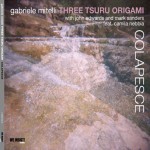
Artist: Gabriele Mitelli Three Tsuru Origami (@)
Title: Colapesce
Format: CD
Label: We Insist! (@)
Rated:

Title: Colapesce
Format: CD
Label: We Insist! (@)
Rated:
What happens when a legend drowns not in the sea, but in sound?
On Colapesce, Gabriele Mitelli conjures a mythic Mediterranean Atlantis, one that bubbles up from the depths of Sicilian folklore and then promptly explodes into shards of improvisational ferocity, electronic abstraction, and ritualized noise. This isn’t jazz, at least not the kind that wears a hat indoors and sips whiskey. It’s jazz as metamorphosis - gills sprouting mid-solo, a trumpet becoming sonar, a double bass mutating into tectonic rumbles.
Mitelli has long swum in deep waters - his piccolo trumpet has flirted with the mystic and the absurd, with electronics always close at hand like an emergency oxygen tank. But here, accompanied by the titanic rhythmic instincts of John Edwards (double bass) and Mark Sanders (drums), and with the volcanic force of Camila Nebbia’s tenor sax (equal parts kraken and liturgy), he crafts something far more narrative than usual. There’s an arc, a pulse, a fall, a sacrifice. In fact, Colapesce is a concept album that slyly pretends not to be.
Each track is a fragment of the Colapesce legend, but fragmented like sea glass - polished by motion, sharp in implication. “The King and the Challenge” doesn’t swing so much as it lurches, pulsing with pressure like something hunted. “Three Stones, Three Pillars” is a stuttering invocation, a Morse code sent from Poseidon to your nervous system. And “The Abyss”? It sounds like what the Titanic must have heard on its way down - slow-motion turbulence, a creaking hull of melody half-consumed by feedback.
Yet this isn’t just mythology for mythology’s sake. At its heart, the album is haunted by one very real figure: Lelio Giannetto, the beloved Sicilian artist and founder of Curva Minore, to whom the final track is dedicated. “The Eternal Guardian (Hymn for Lelio Giannetto)” is the closest this album comes to stillness - though even here, there's a restless ache in the phrasing, like someone trying to play a memory before it fades. Mitelli’s reverence is palpable, but never sentimental. This is mourning rendered as ceremony, not elegy.
Musically, the quartet swerves between structured chaos and ghostly restraint, guided by Mitelli’s minimal graphic scores that function more like treasure maps than sheet music. Camila Nebbia, a polymath saxophonist and memory-sculptor from Buenos Aires now based in Berlin, brings a distinct lyrical weight to the affair. Her tone can be brash or breathless, but it’s never inert. She plays like she’s rewriting personal archives with every note. And when her voice merges with Mitelli’s electronics, the resulting textures are neither acoustic nor digital - they're liminal. A phrase here, a flicker of drone there, like coral growing on sheet metal.
There are also moments of mischievous grace: “Songs of Sea and Land” flutters by in just over a minute, like a drunken sea shanty whispered by ghosts. “The Dance of the Waves” could almost be a B-side from an Ornette Coleman submarine session. These micro-movements stitch together like tide patterns, cyclical yet unpredictable. The whole album feels wet - not damp, but immersed, as if recorded inside a conch shell that doubles as a memory vault.
Colapesce is a meditation on depths - oceanic, emotional, mythic. It's an album that invites you to drown, not tragically, but ecstatically. You descend track by track until pressure becomes beauty and disorientation turns into clarity. It’s a long way down, but the view is unforgettable.
Like the legend it channels, Colapesce doesn’t offer conclusions. It offers echoes. Sacrifice becomes music. Music becomes myth. And the myth? It swims on.
Comments
Stream
Browse by Genre
Industrial Music / Industrial Metal / Aggro Industrial / Electro Metal
Industrial Noise / Power Noise / Harsh Noise
Synth Pop / Electro Pop / Synth-Electronica
Techno / Trance / Goa / Drum'n'Bass / Jungle / Tribal / Trip-Hop
Ambient / Electronica / Ethereal / Dub / Soundscapes / Abstract
Experimental / Avantgarde / Weird & Wired / Glitch / Noise / Field Recording
Dark / Gothic / Wave / New Wave / Dark Wave / Industrial Gothic
New Music / Downtown / Avantgarde Jazz / New Classical / World