
Son of Chi: We Carry Eden feat.Omar Ka
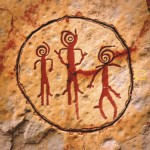


Some albums seek to impress. "We Carry Eden" seeks to disappear - into the soil, into the stars, into the silence between footfall and breath.
Emerging from the spectral traces of the Chi Factory, Son Of Chi is not so much a rebirth as a spiritual continuation - like a ripple travelling far beyond its original stone. Hanyo van Oosterom, ambient elder and sonic cartographer of Rotterdam, closes one circle to open another. This time, with Fulani storyteller Omar Ka at his side, he doesn't just build soundscapes. He invites you into a place where stories hum, winds whisper in dialects lost to modernity, and Eden - carried quietly in the chest like a seedpod - slowly unfurls.
The record is split into two 21-minute parts, which feels like a numerological wink rather than a practical choice. Why 21 minutes? Why not. Time here is gently mocked, stretched, ignored. We are listening in tree time, in desert time. The pulse is slow but alert, like something ancient watching from the underbrush.
The first part eases open with a voice - that of poet-mystic Robert Lax - delivered not as a quote but a benediction. His whisper feels like wind through monastic ruins. From there, it flows: dubby basslines emerging like roots seeking water, drones like tectonic sighs, field recordings that place you both everywhere and nowhere. Jazz teases its head in occasionally, but it never grabs the mic - it knows its place in the dream.
Then Omar Ka enters. His voice doesn’t narrate in any traditional sense. Instead, it responds: to birds, to memory, to the tremble of plucked strings. Ka brings the weight of a Fulani oral tradition that predates most European maps, folding a human soul into this hazy ecology of loops and lulls. You might not understand the words. That’s fine. Understanding is for spreadsheets. This is about resonance.
The second part continues the drift - but by now, you’re acclimated. Your inner ear has tuned to Eden’s frequency. What once sounded like distant weather now feels like intention. You begin to hear the architecture in the mist. Van Oosterom's sonic collages don’t just evoke Jon Hassell’s "fourth world" ideal; they renovate it, sweep the floors, and light the incense. Yet there’s nothing reverent or academic about this music. It’s just… deep. Rooted. Kind. With dub rhythms bubbling up like laughter in a monastery kitchen.
Of course, there’s a risk when musicians reach for spiritual or mythic registers - they can tip into bathrobe wisdom or worse, musical wallpaper. But "We Carry Eden" avoids these traps. It is sincere without being sentimental, spacious without becoming inert. There's play here, and subtle wit. After all, it takes a certain slyness to make an album this rich feel so weightless.
It’s also a beautiful subversion of “ambient” as background music. Try doing your emails to this, and you’ll end up writing poems to your boss. This is not ambient-as-furniture. This is ambient as fungus: slow, complex, secretly transformative.
Like its title suggests, "We Carry Eden" isn’t a place you go - it’s a memory you’re invited to recover. Or maybe it’s a rumor. A half-heard story from the next room. You lean in to catch more, but it’s already faded back into the loam.
And there, finally, lies the beauty: in its refusal to resolve. Eden isn’t found. It’s carried. Quietly. Carefully. Like a seed we might one day remember how to plant.
For fans of: Jon Hassell, Pauline Oliveros, African Head Charge, Roberto Musci, the idea of moss having consciousness.
Ideal setting: Post-meditation, pre-reincarnation.
Recommended pairing: A clay bowl of rainwater, and something slow-burning.
Emerging from the spectral traces of the Chi Factory, Son Of Chi is not so much a rebirth as a spiritual continuation - like a ripple travelling far beyond its original stone. Hanyo van Oosterom, ambient elder and sonic cartographer of Rotterdam, closes one circle to open another. This time, with Fulani storyteller Omar Ka at his side, he doesn't just build soundscapes. He invites you into a place where stories hum, winds whisper in dialects lost to modernity, and Eden - carried quietly in the chest like a seedpod - slowly unfurls.
The record is split into two 21-minute parts, which feels like a numerological wink rather than a practical choice. Why 21 minutes? Why not. Time here is gently mocked, stretched, ignored. We are listening in tree time, in desert time. The pulse is slow but alert, like something ancient watching from the underbrush.
The first part eases open with a voice - that of poet-mystic Robert Lax - delivered not as a quote but a benediction. His whisper feels like wind through monastic ruins. From there, it flows: dubby basslines emerging like roots seeking water, drones like tectonic sighs, field recordings that place you both everywhere and nowhere. Jazz teases its head in occasionally, but it never grabs the mic - it knows its place in the dream.
Then Omar Ka enters. His voice doesn’t narrate in any traditional sense. Instead, it responds: to birds, to memory, to the tremble of plucked strings. Ka brings the weight of a Fulani oral tradition that predates most European maps, folding a human soul into this hazy ecology of loops and lulls. You might not understand the words. That’s fine. Understanding is for spreadsheets. This is about resonance.
The second part continues the drift - but by now, you’re acclimated. Your inner ear has tuned to Eden’s frequency. What once sounded like distant weather now feels like intention. You begin to hear the architecture in the mist. Van Oosterom's sonic collages don’t just evoke Jon Hassell’s "fourth world" ideal; they renovate it, sweep the floors, and light the incense. Yet there’s nothing reverent or academic about this music. It’s just… deep. Rooted. Kind. With dub rhythms bubbling up like laughter in a monastery kitchen.
Of course, there’s a risk when musicians reach for spiritual or mythic registers - they can tip into bathrobe wisdom or worse, musical wallpaper. But "We Carry Eden" avoids these traps. It is sincere without being sentimental, spacious without becoming inert. There's play here, and subtle wit. After all, it takes a certain slyness to make an album this rich feel so weightless.
It’s also a beautiful subversion of “ambient” as background music. Try doing your emails to this, and you’ll end up writing poems to your boss. This is not ambient-as-furniture. This is ambient as fungus: slow, complex, secretly transformative.
Like its title suggests, "We Carry Eden" isn’t a place you go - it’s a memory you’re invited to recover. Or maybe it’s a rumor. A half-heard story from the next room. You lean in to catch more, but it’s already faded back into the loam.
And there, finally, lies the beauty: in its refusal to resolve. Eden isn’t found. It’s carried. Quietly. Carefully. Like a seed we might one day remember how to plant.
For fans of: Jon Hassell, Pauline Oliveros, African Head Charge, Roberto Musci, the idea of moss having consciousness.
Ideal setting: Post-meditation, pre-reincarnation.
Recommended pairing: A clay bowl of rainwater, and something slow-burning.
Comments
Stream
Browse by Genre
Industrial Music / Industrial Metal / Aggro Industrial / Electro Metal
Industrial Noise / Power Noise / Harsh Noise
Synth Pop / Electro Pop / Synth-Electronica
Techno / Trance / Goa / Drum'n'Bass / Jungle / Tribal / Trip-Hop
Ambient / Electronica / Ethereal / Dub / Soundscapes / Abstract
Experimental / Avantgarde / Weird & Wired / Glitch / Noise / Field Recording
Dark / Gothic / Wave / New Wave / Dark Wave / Industrial Gothic
New Music / Downtown / Avantgarde Jazz / New Classical / World