
The Crippled Flower: Forming Haze
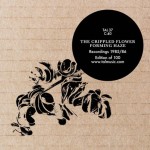


Somewhere in the twilight of West Germany, just as the synthetic gloss of the '80s began to peel, The Crippled Flower bloomed. And wilted. And now - through the slow magic of cassette hiss and careful archiving - it blooms again. "Forming Haze" isn’t a collection of songs so much as a scrapbook of stubborn beauty: 14 fragments (plus one digital whisper) of a band that arrived too late for the revolution, but too early for the nostalgia.
Emerging from Düsseldorf - specifically, the wonderfully obscure record shop "Heartbeat" - The Crippled Flower never quite sounded like a band in the traditional sense. These are sketches, test signals, clandestine communiqués from a group of kindred spirits with diverging astrological charts. And yet, there’s an unexpected cohesion in the chaos: a static electricity that never fully discharges, like a neon sign half-lit in the fog.
The sonic palette is a blurred mural of cold-wave pulses, skeletal funk, analog synths with chipped teeth, and guitars that shimmer like forgotten loves. Fans of Wire, Felt, or early Scritti Politti might find familiar terrain here - but don’t get too comfortable. Singer Phil Elston doesn’t sing so much as narrate from another timeline, observing human absurdities with a disillusioned tenderness. His Sprechgesang threads the shifting aesthetics together, holding the cracked mirror in place.
There’s something profoundly touching about this release - not just for the music itself, but for what it represents: a testimony to failure, to detours, to alternate futures that almost were. These songs weren’t designed to conquer stages or airwaves. They were moments of clarity captured on 4-track in the liminal hours between art school, fox-hunt sabotage, and broken-down synths.
Tracks like "Timetunnel Vision" and "Walking Away" feel like pages from a post-punk diary abandoned in a train station. "Animals", recorded live at ZAKK in Düsseldorf, hums with awkward urgency, as if the band knew it was their swan song. And "Now", the digital-only closer, lasts less than a minute - but it encapsulates the whole ethos: ephemeral, enigmatic, utterly sincere.
And what became of these dreamers? Krausen drifted into the proto-Kreidler avant-galaxy. Ahlers pursued art in Paris (as one does). Schneider remained a sonic explorer. Elston seems to have vanished into a Kraftwerkian ether, unreachable and unbothered by hashtags or timelines.
So why does "Forming Haze" matter now? Because in an era drowning in data and polished pastiche, it reminds us of a time when being in a band meant not having answers. When experimentation was messy, personal, and unrewarded. When a cassette could be a manifesto.
It's not nostalgia. It's archaeology. And The Crippled Flower, for all their ephemerality, left behind a time capsule that still radiates. Lopsided, luminous, and utterly human.
Emerging from Düsseldorf - specifically, the wonderfully obscure record shop "Heartbeat" - The Crippled Flower never quite sounded like a band in the traditional sense. These are sketches, test signals, clandestine communiqués from a group of kindred spirits with diverging astrological charts. And yet, there’s an unexpected cohesion in the chaos: a static electricity that never fully discharges, like a neon sign half-lit in the fog.
The sonic palette is a blurred mural of cold-wave pulses, skeletal funk, analog synths with chipped teeth, and guitars that shimmer like forgotten loves. Fans of Wire, Felt, or early Scritti Politti might find familiar terrain here - but don’t get too comfortable. Singer Phil Elston doesn’t sing so much as narrate from another timeline, observing human absurdities with a disillusioned tenderness. His Sprechgesang threads the shifting aesthetics together, holding the cracked mirror in place.
There’s something profoundly touching about this release - not just for the music itself, but for what it represents: a testimony to failure, to detours, to alternate futures that almost were. These songs weren’t designed to conquer stages or airwaves. They were moments of clarity captured on 4-track in the liminal hours between art school, fox-hunt sabotage, and broken-down synths.
Tracks like "Timetunnel Vision" and "Walking Away" feel like pages from a post-punk diary abandoned in a train station. "Animals", recorded live at ZAKK in Düsseldorf, hums with awkward urgency, as if the band knew it was their swan song. And "Now", the digital-only closer, lasts less than a minute - but it encapsulates the whole ethos: ephemeral, enigmatic, utterly sincere.
And what became of these dreamers? Krausen drifted into the proto-Kreidler avant-galaxy. Ahlers pursued art in Paris (as one does). Schneider remained a sonic explorer. Elston seems to have vanished into a Kraftwerkian ether, unreachable and unbothered by hashtags or timelines.
So why does "Forming Haze" matter now? Because in an era drowning in data and polished pastiche, it reminds us of a time when being in a band meant not having answers. When experimentation was messy, personal, and unrewarded. When a cassette could be a manifesto.
It's not nostalgia. It's archaeology. And The Crippled Flower, for all their ephemerality, left behind a time capsule that still radiates. Lopsided, luminous, and utterly human.
Comments
Stream
Browse by Genre
Industrial Music / Industrial Metal / Aggro Industrial / Electro Metal
Industrial Noise / Power Noise / Harsh Noise
Synth Pop / Electro Pop / Synth-Electronica
Techno / Trance / Goa / Drum'n'Bass / Jungle / Tribal / Trip-Hop
Ambient / Electronica / Ethereal / Dub / Soundscapes / Abstract
Experimental / Avantgarde / Weird & Wired / Glitch / Noise / Field Recording
Dark / Gothic / Wave / New Wave / Dark Wave / Industrial Gothic
New Music / Downtown / Avantgarde Jazz / New Classical / World