
Saturday, August 29, 2026
Zane Trow: Ibis
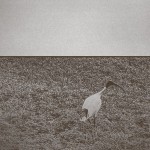


There’s a peculiar kind of serenity that comes from watching a bird ignore the collapse of civilization. That, in a sense, is what "Ibis" sounds like - a quiet electronic vigil held on the edge of ecological and moral decay. Zane Trow, one of Australia’s under-sung sound artisans, has always worked in that liminal space between installation art and ambient music, crafting tones that feel more observed than composed. With "Ibis", he turns his ear toward a fragile wetland near his home, and by extension, toward the world’s fraying conscience.
This isn’t ambient as wallpaper - it’s ambient as protest, whispered through reverb. Field recordings of birds, wind, and an ice cream truck bell (a touch of tragicomic Australiana) drift among electronic sighs and rustling frequencies. It’s the sort of soundscape that feels like it might disintegrate if you breathe too loudly. “Channel” opens the album with restrained beauty, an unstable signal from a world half-drowned. The title track, “Ibis”, follows with gliding drones and avian punctuation - not imitations but presences, as if the birds themselves were collaborators.
Across the nine pieces, Trow traces the fading boundaries between natural and synthetic sound. “Eonganj” unfurls like a slow pulse through humid air, its synth textures both organic and anxious. “Rotunda” and “Stalune” add a sense of flickering geometry, tones folding back on themselves like memory loops. By the time “Xenvonlv” and “Waterwyattin” arrive, the electronics seem to breathe of their own accord - feedbacks, echoes, and pulses forming an unsteady ecosystem of tones. “909” closes with a faint rhythmic nod, a mechanical ghost haunting the wetlands.
The conceptual underpinning of "Ibis" is as political as it is sonic. Trow’s note accompanying the release references rising fascism, the erosion of empathy, and the normalisation of cruelty. Yet the music never sermonizes. Instead, it embodies resistance through tenderness - a radical act in itself. To listen to "Ibis" attentively is to remember that attention is a form of care, and that care, these days, borders on rebellion.
Technically, Trow’s touch is that of a craftsman who understands decay as a musical element. His use of delay units, analogue echo, and digital detritus suggests a fascination with entropy - sounds that bloom and wither, tones that refuse to resolve. There’s a kinship here with the textural poetics of Lawrence English (who mastered the record), but also with artists like David Toop or Asmus Tietchens - composers who treat silence and instability as compositional materials.
"Ibis" feels like an act of mourning disguised as listening. Yet there’s humor in its restraint, a quiet smirk in the inclusion of that ice cream truck bell - a reminder that absurdity survives even in decline. Maybe that’s the album’s secret: amid environmental ruin and political rot, the ibis still watches, the bell still rings, and Trow still records.
It’s not a requiem. It’s a witness statement - fragile, weary, and beautifully alive.
This isn’t ambient as wallpaper - it’s ambient as protest, whispered through reverb. Field recordings of birds, wind, and an ice cream truck bell (a touch of tragicomic Australiana) drift among electronic sighs and rustling frequencies. It’s the sort of soundscape that feels like it might disintegrate if you breathe too loudly. “Channel” opens the album with restrained beauty, an unstable signal from a world half-drowned. The title track, “Ibis”, follows with gliding drones and avian punctuation - not imitations but presences, as if the birds themselves were collaborators.
Across the nine pieces, Trow traces the fading boundaries between natural and synthetic sound. “Eonganj” unfurls like a slow pulse through humid air, its synth textures both organic and anxious. “Rotunda” and “Stalune” add a sense of flickering geometry, tones folding back on themselves like memory loops. By the time “Xenvonlv” and “Waterwyattin” arrive, the electronics seem to breathe of their own accord - feedbacks, echoes, and pulses forming an unsteady ecosystem of tones. “909” closes with a faint rhythmic nod, a mechanical ghost haunting the wetlands.
The conceptual underpinning of "Ibis" is as political as it is sonic. Trow’s note accompanying the release references rising fascism, the erosion of empathy, and the normalisation of cruelty. Yet the music never sermonizes. Instead, it embodies resistance through tenderness - a radical act in itself. To listen to "Ibis" attentively is to remember that attention is a form of care, and that care, these days, borders on rebellion.
Technically, Trow’s touch is that of a craftsman who understands decay as a musical element. His use of delay units, analogue echo, and digital detritus suggests a fascination with entropy - sounds that bloom and wither, tones that refuse to resolve. There’s a kinship here with the textural poetics of Lawrence English (who mastered the record), but also with artists like David Toop or Asmus Tietchens - composers who treat silence and instability as compositional materials.
"Ibis" feels like an act of mourning disguised as listening. Yet there’s humor in its restraint, a quiet smirk in the inclusion of that ice cream truck bell - a reminder that absurdity survives even in decline. Maybe that’s the album’s secret: amid environmental ruin and political rot, the ibis still watches, the bell still rings, and Trow still records.
It’s not a requiem. It’s a witness statement - fragile, weary, and beautifully alive.
Comments
Stream
Browse by Genre
Industrial Music / Industrial Metal / Aggro Industrial / Electro Metal
Industrial Noise / Power Noise / Harsh Noise
Synth Pop / Electro Pop / Synth-Electronica
Techno / Trance / Goa / Drum'n'Bass / Jungle / Tribal / Trip-Hop
Ambient / Electronica / Ethereal / Dub / Soundscapes / Abstract
Experimental / Avantgarde / Weird & Wired / Glitch / Noise / Field Recording
Dark / Gothic / Wave / New Wave / Dark Wave / Industrial Gothic
New Music / Downtown / Avantgarde Jazz / New Classical / World