
Friday, October 23, 2026
Tristan Honsinger and Riuichi Daijo: We Met Tomorrow
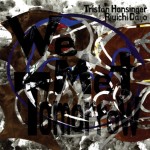
Artist: Tristan Honsinger and Riuichi Daijo
Title: We Met Tomorrow
Format: 12" + Download
Label: DPS Recordings
Rated:

Title: We Met Tomorrow
Format: 12" + Download
Label: DPS Recordings
Rated:
There is something quietly devastating about We Met Tomorrow - as if the music itself knew it was saying goodbye, but decided to do so by laughing softly instead of crying. Recorded in June 2023 at Permian, Riuichi Daijo’s intimate space for improvised music in Tokyo, the album captures two final dialogues between Daijo and the late Tristan Honsinger: one private, one public; one whisper, one open hand. It’s a document of friendship disguised as sound, of absurdity and grace braided through strings and silences.
Honsinger, who passed away later that year, was a performer of contradictions - a clown-philosopher with a cello, a man who could make dissonance sound like empathy. Here, he’s both lucid and disintegrating, his playing as spontaneous as speech and his speech as fractured as melody. Daijo, ever the patient listener, doesn’t accompany so much as inhabit the cello’s mood, letting his guitar become a mirror, a second mouth, or sometimes just a rustle of time.
Side A - Juxtaposition I through III - feels like two painters working on the same canvas without discussing what it should be. Notes overlap, cancel, blur; meaning emerges from proximity rather than structure. There are moments when Honsinger mutters or breathes, and one realizes that improvisation here isn’t “free” in the casual sense - it’s the desperate honesty of two people trusting the next sound more than any plan.
Side B, the live half, opens its throat wider. Daijo’s electric guitar hums with quiet voltage, while Honsinger - amplified, almost spectral - alternates between playing and murmuring strange aphorisms: “Stupidity is the right when you’re wrong”. It’s both a koan and a confession, and it lands like a flicked match in the dark. The closing piece, “We Met Tomorrow”, circles back on itself linguistically and emotionally. The phrase feels absurd, yes, but also oddly truthful - perfect for a musician whose entire career treated time not as a line but as a fold.
Listening feels like overhearing eternity thinking out loud. Honsinger’s cello doesn’t resolve; it lingers, trembles, loops like a Möbius strip of resonance. Daijo’s contribution is equally essential: he shapes silence with intent, giving space for Honsinger’s farewell without embalming it in reverence.
We Met Tomorrow isn’t just a posthumous record - it’s a séance that never ends. Honsinger’s laughter, sighs, and glissandi slip between irony and tenderness, turning the improvised moment into something strangely enduring. You leave the album with the unsettling conviction that he’s still there, bow in hand, waiting for the next note that doesn’t exist yet.
If this truly is his swan song, then it’s one sung backwards through time - a meeting that hasn’t yet happened, but always will.
Honsinger, who passed away later that year, was a performer of contradictions - a clown-philosopher with a cello, a man who could make dissonance sound like empathy. Here, he’s both lucid and disintegrating, his playing as spontaneous as speech and his speech as fractured as melody. Daijo, ever the patient listener, doesn’t accompany so much as inhabit the cello’s mood, letting his guitar become a mirror, a second mouth, or sometimes just a rustle of time.
Side A - Juxtaposition I through III - feels like two painters working on the same canvas without discussing what it should be. Notes overlap, cancel, blur; meaning emerges from proximity rather than structure. There are moments when Honsinger mutters or breathes, and one realizes that improvisation here isn’t “free” in the casual sense - it’s the desperate honesty of two people trusting the next sound more than any plan.
Side B, the live half, opens its throat wider. Daijo’s electric guitar hums with quiet voltage, while Honsinger - amplified, almost spectral - alternates between playing and murmuring strange aphorisms: “Stupidity is the right when you’re wrong”. It’s both a koan and a confession, and it lands like a flicked match in the dark. The closing piece, “We Met Tomorrow”, circles back on itself linguistically and emotionally. The phrase feels absurd, yes, but also oddly truthful - perfect for a musician whose entire career treated time not as a line but as a fold.
Listening feels like overhearing eternity thinking out loud. Honsinger’s cello doesn’t resolve; it lingers, trembles, loops like a Möbius strip of resonance. Daijo’s contribution is equally essential: he shapes silence with intent, giving space for Honsinger’s farewell without embalming it in reverence.
We Met Tomorrow isn’t just a posthumous record - it’s a séance that never ends. Honsinger’s laughter, sighs, and glissandi slip between irony and tenderness, turning the improvised moment into something strangely enduring. You leave the album with the unsettling conviction that he’s still there, bow in hand, waiting for the next note that doesn’t exist yet.
If this truly is his swan song, then it’s one sung backwards through time - a meeting that hasn’t yet happened, but always will.
Comments
Stream
Browse by Genre
Industrial Music / Industrial Metal / Aggro Industrial / Electro Metal
Industrial Noise / Power Noise / Harsh Noise
Synth Pop / Electro Pop / Synth-Electronica
Techno / Trance / Goa / Drum'n'Bass / Jungle / Tribal / Trip-Hop
Ambient / Electronica / Ethereal / Dub / Soundscapes / Abstract
Experimental / Avantgarde / Weird & Wired / Glitch / Noise / Field Recording
Dark / Gothic / Wave / New Wave / Dark Wave / Industrial Gothic
New Music / Downtown / Avantgarde Jazz / New Classical / World