
Aphelion Psalm: Portal to Cassiopea
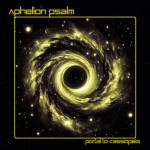
Artist: Aphelion Psalm (@)
Title: Portal to Cassiopea
Format: Download Only (MP3 + Lossless)
Label: self-released
Rated:


Title: Portal to Cassiopea
Format: Download Only (MP3 + Lossless)
Label: self-released
Rated:
There’s a particular kind of ambient musician who works like an amateur astronomer: alone, at night, with cheap tools, immeasurable patience, and the certainty that the universe whispers back if you just tilt the antenna right.
Carlos Martin Cuevas - under the astral moniker "Aphelion Psalm" - is clearly one of them. He’s based in Nerja (lovely small town on the less fashionable side of Costa del Sol), staring past the Mediterranean haze toward constellations whose names sound older than history. And for his debut EP he doesn’t try to impress; he simply opens a window to the infinite and invites you to lean out, hair blown by a solar wind that smells suspiciously like late-night soldering fumes and 1970s voltage drift.
Portal to Cassiopeia is a single 17-minute slab of space ambient, kept uncut to preserve narrative flow - a wise choice, because it breathes like a deep-space organism: slow, patient, occasionally ominous, occasionally tender in the way only the void can be. Cuevas claims it contains four chapters, but they feel less like movements and more like gravitational states: moments where your pulse lines up with the hum of machinery older than your species.
The portal opens with a shimmer that could be cosmic dust or a synth waking from hibernation; both options feel plausible. Soon you’re inside the cryosleep section, where time loses its manners and stretches into a soft metallic twilight. The "Antimatter Void Abyss" (a phrase that sounds like it should require a hazard suit) brings the album’s heaviest mass - a cavernous drone that evokes Lustmord’s subterranean cathedrals, but with a gentler cosmic melancholy swirling through it. And by the time you reach the "Gates of Alpha Cassiopeia", there’s a sense that you’ve crossed a boundary you weren’t meant to name aloud.
Cuevas openly worships at the altars of Tangerine Dream, Klaus Schulze, Neptune Towers and the more cosmic side of Blood Incantation - and yes, you can hear those echoes. But there's also a refreshing lack of pretension: this is DIY in its purest form, built with modest gear and a sincere desire to share a small fragment of celestial wonder. No cinematic universe, no overdesigned mythology - just the hum of a bedroom spacecraft plotting a slow, steady escape from gravity.
In the end, Portal to Cassiopeia doesn’t try to redefine dark ambient, or reinvent the Berlin School, or transcend cosmic drone history. It simply invites you to drift, to stop being a responsible terrestrial for seventeen minutes, and to let the cold dust of distant suns settle onto your skin.
And sometimes, that’s all the cosmos really asks of us.
Carlos Martin Cuevas - under the astral moniker "Aphelion Psalm" - is clearly one of them. He’s based in Nerja (lovely small town on the less fashionable side of Costa del Sol), staring past the Mediterranean haze toward constellations whose names sound older than history. And for his debut EP he doesn’t try to impress; he simply opens a window to the infinite and invites you to lean out, hair blown by a solar wind that smells suspiciously like late-night soldering fumes and 1970s voltage drift.
Portal to Cassiopeia is a single 17-minute slab of space ambient, kept uncut to preserve narrative flow - a wise choice, because it breathes like a deep-space organism: slow, patient, occasionally ominous, occasionally tender in the way only the void can be. Cuevas claims it contains four chapters, but they feel less like movements and more like gravitational states: moments where your pulse lines up with the hum of machinery older than your species.
The portal opens with a shimmer that could be cosmic dust or a synth waking from hibernation; both options feel plausible. Soon you’re inside the cryosleep section, where time loses its manners and stretches into a soft metallic twilight. The "Antimatter Void Abyss" (a phrase that sounds like it should require a hazard suit) brings the album’s heaviest mass - a cavernous drone that evokes Lustmord’s subterranean cathedrals, but with a gentler cosmic melancholy swirling through it. And by the time you reach the "Gates of Alpha Cassiopeia", there’s a sense that you’ve crossed a boundary you weren’t meant to name aloud.
Cuevas openly worships at the altars of Tangerine Dream, Klaus Schulze, Neptune Towers and the more cosmic side of Blood Incantation - and yes, you can hear those echoes. But there's also a refreshing lack of pretension: this is DIY in its purest form, built with modest gear and a sincere desire to share a small fragment of celestial wonder. No cinematic universe, no overdesigned mythology - just the hum of a bedroom spacecraft plotting a slow, steady escape from gravity.
In the end, Portal to Cassiopeia doesn’t try to redefine dark ambient, or reinvent the Berlin School, or transcend cosmic drone history. It simply invites you to drift, to stop being a responsible terrestrial for seventeen minutes, and to let the cold dust of distant suns settle onto your skin.
And sometimes, that’s all the cosmos really asks of us.
Comments
Stream
Browse by Genre
Industrial Music / Industrial Metal / Aggro Industrial / Electro Metal
Industrial Noise / Power Noise / Harsh Noise
Synth Pop / Electro Pop / Synth-Electronica
Techno / Trance / Goa / Drum'n'Bass / Jungle / Tribal / Trip-Hop
Ambient / Electronica / Ethereal / Dub / Soundscapes / Abstract
Experimental / Avantgarde / Weird & Wired / Glitch / Noise / Field Recording
Dark / Gothic / Wave / New Wave / Dark Wave / Industrial Gothic
New Music / Downtown / Avantgarde Jazz / New Classical / World