
Thursday, October 22, 2026
Nicholas Remondino / Natalia Rogantini: Orassion
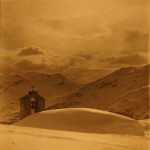
Artist: Nicholas Remondino / Natalia Rogantini
Title: Orassion
Format: CD + Download
Label: Torto Editions/Tour de Bras/Nunc. (@)
Rated:

Title: Orassion
Format: CD + Download
Label: Torto Editions/Tour de Bras/Nunc. (@)
Rated:
There are records that want to impress you, and there are records that simply happen to you - like a change in the weather, or the slow turning of a liturgical page. "Orassion" belongs firmly to the second category. Conceived and recorded in the Evangelical Reformed Church of St. Martin in Bondo, the album feels less like a studio document and more like a visitation: a moment when sound, space, and intention quietly agreed to coexist.
The pairing at its center is unusual yet strangely inevitable. Rogantini sits at a small positive organ, coaxing out timbres that bloom with the delicate stubbornness of alpine flowers. Remondino, notoriously suspicious of labels (“not” this, “not” that), divides his attention between tube bells, bass drum, and piano - an inventory that reads modest but behaves expansive. Together they approach the church not as a backdrop but as a collaborator: its air a resonant instrument, its walls a patient accomplice.
What emerges from these sessions is a series of miniature devotions, each one suspended between improvisation and composition. The tracks move with a kind of slow, luminous inevitability - sometimes as bare as a single harmonic exhalation, sometimes warm with overlapping overtones. You can hear both musicians listening intently, as though waiting for the room itself to decide the next step.
And if that sounds mystical, well… it is. But not in the incense-and-mystery sense. More in the “two people living in a mountain valley discovering that old organs still have secrets” sense. Because that’s the origin story here: Rogantini and Remondino live together in Valchiavenna, surrounded by small churches with instruments that are rarely touched and even more rarely explored. Their shared research has led them to approach these spaces as porous vessels, storing centuries of resonance. "Orassion" feels like an attempt to activate those traces - gently, respectfully, with the right kind of curiosity.
Musically, the album is full of chiaroscuro. Bright harmonics linger in the rafters; low percussive murmurs shift like distant snowfall. Some pieces arrive almost shyly (“in un cielo immenso”), while others seem carved from thicker stone (“oscuro”, indeed). There’s a sense of narrative throughout, but it’s the kind that unfolds in breath rather than plot. One moment the organ glitters like dust suspended in direct sunlight; the next, the bass drum tugs the floor downward, reminding you of gravity, of earth, of body.
The duo’s backgrounds enrich this palette. Rogantini’s work in voice, jazz, and radical improvisation gives her lines a human core even when she’s seated at the keys of a centuries-old mechanism. Remondino, with his sprawling constellation of collaborations - from lo-fi minimalism to contemporary ensembles to electronic dérives - brings an unstable, searching energy. Yet here he resists ornamentation, choosing instead to place sounds like stones in a stream: deliberate, sparse, quietly meaningful.
There’s a gentle humour in how solemn the record could have been and yet refuses to be. It’s earnest without being precious. Spiritual without wearing robes. More candle flame than cathedral. Even the shortest pieces feel complete, like haiku passed through wooden pipes and metal tongues.
"Orassion" ultimately functions as both a document and an invitation. It captures two artists tuned finely to place, to one another, and to the fragile shimmer that occurs when sound becomes a form of noticing - of catching light on a surface just long enough to understand something wordless.
It’s a small record, in the best sense: intimate, attentive, carved with care. You don’t listen to it so much as let it settle around you. And once it does, it feels a little like standing inside a prayer that hasn’t quite decided if it’s meant for you, or for the room that holds it.
The pairing at its center is unusual yet strangely inevitable. Rogantini sits at a small positive organ, coaxing out timbres that bloom with the delicate stubbornness of alpine flowers. Remondino, notoriously suspicious of labels (“not” this, “not” that), divides his attention between tube bells, bass drum, and piano - an inventory that reads modest but behaves expansive. Together they approach the church not as a backdrop but as a collaborator: its air a resonant instrument, its walls a patient accomplice.
What emerges from these sessions is a series of miniature devotions, each one suspended between improvisation and composition. The tracks move with a kind of slow, luminous inevitability - sometimes as bare as a single harmonic exhalation, sometimes warm with overlapping overtones. You can hear both musicians listening intently, as though waiting for the room itself to decide the next step.
And if that sounds mystical, well… it is. But not in the incense-and-mystery sense. More in the “two people living in a mountain valley discovering that old organs still have secrets” sense. Because that’s the origin story here: Rogantini and Remondino live together in Valchiavenna, surrounded by small churches with instruments that are rarely touched and even more rarely explored. Their shared research has led them to approach these spaces as porous vessels, storing centuries of resonance. "Orassion" feels like an attempt to activate those traces - gently, respectfully, with the right kind of curiosity.
Musically, the album is full of chiaroscuro. Bright harmonics linger in the rafters; low percussive murmurs shift like distant snowfall. Some pieces arrive almost shyly (“in un cielo immenso”), while others seem carved from thicker stone (“oscuro”, indeed). There’s a sense of narrative throughout, but it’s the kind that unfolds in breath rather than plot. One moment the organ glitters like dust suspended in direct sunlight; the next, the bass drum tugs the floor downward, reminding you of gravity, of earth, of body.
The duo’s backgrounds enrich this palette. Rogantini’s work in voice, jazz, and radical improvisation gives her lines a human core even when she’s seated at the keys of a centuries-old mechanism. Remondino, with his sprawling constellation of collaborations - from lo-fi minimalism to contemporary ensembles to electronic dérives - brings an unstable, searching energy. Yet here he resists ornamentation, choosing instead to place sounds like stones in a stream: deliberate, sparse, quietly meaningful.
There’s a gentle humour in how solemn the record could have been and yet refuses to be. It’s earnest without being precious. Spiritual without wearing robes. More candle flame than cathedral. Even the shortest pieces feel complete, like haiku passed through wooden pipes and metal tongues.
"Orassion" ultimately functions as both a document and an invitation. It captures two artists tuned finely to place, to one another, and to the fragile shimmer that occurs when sound becomes a form of noticing - of catching light on a surface just long enough to understand something wordless.
It’s a small record, in the best sense: intimate, attentive, carved with care. You don’t listen to it so much as let it settle around you. And once it does, it feels a little like standing inside a prayer that hasn’t quite decided if it’s meant for you, or for the room that holds it.
Comments
Stream
Browse by Genre
Industrial Music / Industrial Metal / Aggro Industrial / Electro Metal
Industrial Noise / Power Noise / Harsh Noise
Synth Pop / Electro Pop / Synth-Electronica
Techno / Trance / Goa / Drum'n'Bass / Jungle / Tribal / Trip-Hop
Ambient / Electronica / Ethereal / Dub / Soundscapes / Abstract
Experimental / Avantgarde / Weird & Wired / Glitch / Noise / Field Recording
Dark / Gothic / Wave / New Wave / Dark Wave / Industrial Gothic
New Music / Downtown / Avantgarde Jazz / New Classical / World