
Wednesday, November 18, 2026
Bewider: Ships That Pass in the Night
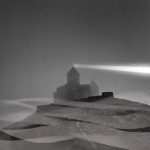


There is something stubbornly nocturnal about "Ships That Pass in the Night". Not just “best enjoyed in the dark” nocturnal, but the kind that insists you dim the room, lower your expectations of clarity, and accept that whatever is about to happen will only half-explain itself. Bewider - alias Piernicola Di Muro, a figure more accustomed to shaping emotions for the cinema than stepping into the spotlight - builds an album that behaves like a series of near-misses: patterns align, glances are exchanged, then everything politely drifts apart again. No climax, no reunion, just the echo of what might have been.
Di Muro’s background as a film composer and mix engineer is evident, but not in a bombastic, cinematic way. This isn’t soundtrack music begging for images; it’s more like the negative space between scenes, the part where the camera lingers too long on an empty street. The electronic sequences are angular, restrained, often slightly aloof, intersecting briefly before choosing solitude over commitment. Melodies don’t so much develop as they hesitate, circle, and then think better of it. It’s music that understands the poetry of restraint - and also knows when to quietly disappear before overstaying its welcome.
There’s a particular elegance in how "Ships That Pass in the Night" handles loneliness. It’s not tragic, and certainly not melodramatic. This is loneliness with good posture. The tracks feel like conversations overheard through walls: recognizable human warmth filtered through circuitry, softened by distance. The electronic textures are clean but never sterile, shaped with the precision of someone who knows exactly how much space a sound needs to breathe - and when it’s better left alone. If this album were a drive, it wouldn’t be a dramatic escape down an endless highway, but a calm, late-night journey where the headlights briefly illuminate other drivers before everyone continues on their separate routes.
What makes the record quietly compelling is its refusal to force meaning. Di Muro doesn’t insist on narrative resolution; instead, he trusts the listener to sit with ambiguity. The Longfellow reference in the title isn’t decorative - it’s structural. Each track behaves like one of those passing ships, exchanging signals just long enough to acknowledge mutual existence. In an era obsessed with constant connection, "Ships That Pass in the Night" gently suggests that fleeting encounters can be enough, and that not every trajectory needs to converge.
Ultimately, this is a record about motion without destination, connection without possession. Bewider doesn’t shout, doesn’t dazzle, doesn’t beg for attention. He lets the music move at its own pace, confident that those who are listening closely will catch the glow as it slips past. It’s a quiet album, yes - but it’s the kind of quiet that stays with you, like headlights in the rearview mirror, fading slowly, stubbornly memorable.
Comments
Stream
Browse by Genre
Industrial Music / Industrial Metal / Aggro Industrial / Electro Metal
Industrial Noise / Power Noise / Harsh Noise
Synth Pop / Electro Pop / Synth-Electronica
Techno / Trance / Goa / Drum'n'Bass / Jungle / Tribal / Trip-Hop
Ambient / Electronica / Ethereal / Dub / Soundscapes / Abstract
Experimental / Avantgarde / Weird & Wired / Glitch / Noise / Field Recording
Dark / Gothic / Wave / New Wave / Dark Wave / Industrial Gothic
New Music / Downtown / Avantgarde Jazz / New Classical / World