
Wednesday, October 14, 2026
Christian Marien Quartet: Beyond the Fingertips
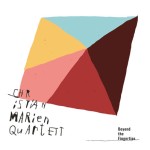
Artist: Christian Marien Quartet (http://www.christianmarien.de/) (@)
Title: Beyond the Fingertips
Format: LP
Label: MarMade
Title: Beyond the Fingertips
Format: LP
Label: MarMade
There is something beautifully cruel about the direct-to-disc process: the red light turns on, time tightens its grip, and whatever happens will happen. No edits, no safety net, no polite undo button. "Beyond the Fingertips" lives exactly there, on that thin wire stretched between intention and accident, where jazz either learns to fly or falls with style.
Christian Marien has always been a drummer with a quiet appetite for risk, and here he curates a quartet that treats danger not as an aesthetic choice but as a working condition. Tobias Delius (tenor saxophone, clarinet), Jasper Stadhouders (guitar), and Antonio Borghini (double bass) are not guests so much as co-conspirators: musicians seasoned enough to know when to push and, more importantly, when not to flinch. Years of shared concerts have fused them into a single organism - four nervous systems, one bloodstream.
The format dictates the music’s behavior. Each LP side is a continuous suite, unfolding like a long exhale you’re not entirely sure you can sustain. Themes surface, dissolve, reappear wearing different clothes. Melodies flirt, retreat, trip over a rhythmic corner, then recover with a grin. Mistakes - if we want to call them that - aren’t patched over; they’re acknowledged, metabolized, turned into momentum. This is jazz that doesn’t polish its fingerprints off the glass.
Marien’s drumming is the album’s gravitational field: alert, elastic, quietly insistent. He doesn’t dominate the conversation; he makes sure it keeps happening. Delius moves between lyricism and abstraction with the ease of someone who knows that clarity and confusion are siblings. Stadhouders’ guitar darts and fractures, sometimes slicing the air, sometimes whispering from the margins. Borghini anchors everything with a bass sound that feels less like a foundation and more like a living terrain - solid, uneven, human.
The title is not poetic decoration. "Beyond the Fingertips" suggests a place where control ends and trust begins. You can hear the moment when the musicians stop "playing" the music and start "following" it, as if the sound itself has taken over navigation. It’s exhilarating, slightly terrifying, and deeply intimate - like standing too close to a truth you didn’t plan to reveal.
This is not a record for passive listening or background comfort. It asks for attention, patience, and a tolerance for imperfection - qualities increasingly rare, and therefore precious. In return, it offers something honest: music as an irreversible act, carved into lacquer and time, reminding us that the most alive moments are often the ones we can’t quite hold onto.
Miss it once, and it’s gone. Which, of course, is the point.
Christian Marien has always been a drummer with a quiet appetite for risk, and here he curates a quartet that treats danger not as an aesthetic choice but as a working condition. Tobias Delius (tenor saxophone, clarinet), Jasper Stadhouders (guitar), and Antonio Borghini (double bass) are not guests so much as co-conspirators: musicians seasoned enough to know when to push and, more importantly, when not to flinch. Years of shared concerts have fused them into a single organism - four nervous systems, one bloodstream.
The format dictates the music’s behavior. Each LP side is a continuous suite, unfolding like a long exhale you’re not entirely sure you can sustain. Themes surface, dissolve, reappear wearing different clothes. Melodies flirt, retreat, trip over a rhythmic corner, then recover with a grin. Mistakes - if we want to call them that - aren’t patched over; they’re acknowledged, metabolized, turned into momentum. This is jazz that doesn’t polish its fingerprints off the glass.
Marien’s drumming is the album’s gravitational field: alert, elastic, quietly insistent. He doesn’t dominate the conversation; he makes sure it keeps happening. Delius moves between lyricism and abstraction with the ease of someone who knows that clarity and confusion are siblings. Stadhouders’ guitar darts and fractures, sometimes slicing the air, sometimes whispering from the margins. Borghini anchors everything with a bass sound that feels less like a foundation and more like a living terrain - solid, uneven, human.
The title is not poetic decoration. "Beyond the Fingertips" suggests a place where control ends and trust begins. You can hear the moment when the musicians stop "playing" the music and start "following" it, as if the sound itself has taken over navigation. It’s exhilarating, slightly terrifying, and deeply intimate - like standing too close to a truth you didn’t plan to reveal.
This is not a record for passive listening or background comfort. It asks for attention, patience, and a tolerance for imperfection - qualities increasingly rare, and therefore precious. In return, it offers something honest: music as an irreversible act, carved into lacquer and time, reminding us that the most alive moments are often the ones we can’t quite hold onto.
Miss it once, and it’s gone. Which, of course, is the point.
Comments
Stream
Browse by Genre
Industrial Music / Industrial Metal / Aggro Industrial / Electro Metal
Industrial Noise / Power Noise / Harsh Noise
Synth Pop / Electro Pop / Synth-Electronica
Techno / Trance / Goa / Drum'n'Bass / Jungle / Tribal / Trip-Hop
Ambient / Electronica / Ethereal / Dub / Soundscapes / Abstract
Experimental / Avantgarde / Weird & Wired / Glitch / Noise / Field Recording
Dark / Gothic / Wave / New Wave / Dark Wave / Industrial Gothic
New Music / Downtown / Avantgarde Jazz / New Classical / World