
Monday, October 26, 2026
Ov Pain: Free Time
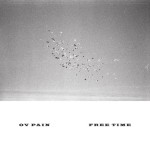


There’s a quiet provocation baked into "Free Time", and it’s not hidden in the track titles or the circuitry. It’s right there in the premise: two people, a handful of synthesizers, a salvaged computer, and the radical act of taking time that isn’t immediately monetised, optimised, or justified. Ov Pain - a project that has always preferred friction over polish - turn “free time” into both method and critique. Not leisure as lifestyle branding, but time briefly wrestled away from the machinery.
Tim (and collaborator) frame the record as improvised songwriting, which is a deceptively modest phrase. What’s actually happening is closer to political economy by other means. These tracks weren’t laboured over, weren’t reverse-engineered for relevance, weren’t subjected to the endless anxious revisions that contemporary productivity culture treats as virtue. They happened. Quickly. Cheaply. Intentionally. In an era where everything must prove its worth before it exists, "Free Time" insists on the opposite order.
Sonically, the album feels lived-in rather than constructed. Synthesizers breathe, stall, circle themselves. Patterns emerge not because they were designed to, but because hands kept moving. There’s a pleasant refusal of spectacle here: no big drops, no virtuosic posturing, no cinematic overstatement. Instead, long-form pieces like “Fascia” or “Slouching Toward Erehwon” unfold with a stubborn, almost domestic logic - the sound of attention sustained without urgency. If this is ambient-adjacent music, it’s the kind that notices the room it’s in.
The political charge isn’t shouted; it’s embedded. Titles like “Comparative Advantage” and “Pusillanimous” quietly smuggle economic and moral language into what otherwise sounds like patient electronic drift. It’s hard not to read this as a sideways glance at systems that reward speed, clarity, and dominance. Ov Pain seem more interested in what happens when you let things remain partially unresolved - musically and ethically. The music doesn’t rush to persuade you; it waits to see if you’re still listening.
There’s also a philosophical modesty at work. Improvisation here isn’t framed as transcendence or risk-taking heroism, but as a practical response to limited means. Low-rent studios, recycled tech, short windows of availability - these aren’t obstacles to overcome, they’re the conditions of possibility. The immediacy and economy Tim mentions don’t just describe how the album was made; they are the album. Form follows circumstance, and circumstance refuses to apologise.
Humour creeps in through understatement. “Well Defined Utter Oblivion” is a title that feels like a shrug directed at managerial language, while the music beneath it quietly unravels any notion of definition at all. Nothing here sounds sarcastic, but there’s a dry awareness that naming things doesn’t necessarily tame them - a useful reminder in times obsessed with labels, metrics, and outcomes.
The land acknowledgment at the end of the attached notes (explaining that "Ov Pain acknowledges the Wurundjeri Woi-wurrung & Bunurong Boon Wurrung peoples of the Kulin Eastern Nation as the owners and traditional custodians of the land on which this album was conceived and recorded") isn’t decorative, either. It reframes the idea of “free time” against histories where time, land, and sovereignty were anything but freely given. That tension lingers uncomfortably, as it should. "Free Time" isn’t escapist; it’s reflective. It recognises that even moments of creative freedom are situated, contingent, and politically charged.
In the end, Ov Pain offer a record that doesn’t argue so much as demonstrate. This is what happens, they seem to say, when you stop asking what something is for and start asking whether it needs to be. "Free Time" doesn’t promise liberation. It sketches a small, stubborn pause - and suggests that, under the right conditions, that might already be enough.
Tim (and collaborator) frame the record as improvised songwriting, which is a deceptively modest phrase. What’s actually happening is closer to political economy by other means. These tracks weren’t laboured over, weren’t reverse-engineered for relevance, weren’t subjected to the endless anxious revisions that contemporary productivity culture treats as virtue. They happened. Quickly. Cheaply. Intentionally. In an era where everything must prove its worth before it exists, "Free Time" insists on the opposite order.
Sonically, the album feels lived-in rather than constructed. Synthesizers breathe, stall, circle themselves. Patterns emerge not because they were designed to, but because hands kept moving. There’s a pleasant refusal of spectacle here: no big drops, no virtuosic posturing, no cinematic overstatement. Instead, long-form pieces like “Fascia” or “Slouching Toward Erehwon” unfold with a stubborn, almost domestic logic - the sound of attention sustained without urgency. If this is ambient-adjacent music, it’s the kind that notices the room it’s in.
The political charge isn’t shouted; it’s embedded. Titles like “Comparative Advantage” and “Pusillanimous” quietly smuggle economic and moral language into what otherwise sounds like patient electronic drift. It’s hard not to read this as a sideways glance at systems that reward speed, clarity, and dominance. Ov Pain seem more interested in what happens when you let things remain partially unresolved - musically and ethically. The music doesn’t rush to persuade you; it waits to see if you’re still listening.
There’s also a philosophical modesty at work. Improvisation here isn’t framed as transcendence or risk-taking heroism, but as a practical response to limited means. Low-rent studios, recycled tech, short windows of availability - these aren’t obstacles to overcome, they’re the conditions of possibility. The immediacy and economy Tim mentions don’t just describe how the album was made; they are the album. Form follows circumstance, and circumstance refuses to apologise.
Humour creeps in through understatement. “Well Defined Utter Oblivion” is a title that feels like a shrug directed at managerial language, while the music beneath it quietly unravels any notion of definition at all. Nothing here sounds sarcastic, but there’s a dry awareness that naming things doesn’t necessarily tame them - a useful reminder in times obsessed with labels, metrics, and outcomes.
The land acknowledgment at the end of the attached notes (explaining that "Ov Pain acknowledges the Wurundjeri Woi-wurrung & Bunurong Boon Wurrung peoples of the Kulin Eastern Nation as the owners and traditional custodians of the land on which this album was conceived and recorded") isn’t decorative, either. It reframes the idea of “free time” against histories where time, land, and sovereignty were anything but freely given. That tension lingers uncomfortably, as it should. "Free Time" isn’t escapist; it’s reflective. It recognises that even moments of creative freedom are situated, contingent, and politically charged.
In the end, Ov Pain offer a record that doesn’t argue so much as demonstrate. This is what happens, they seem to say, when you stop asking what something is for and start asking whether it needs to be. "Free Time" doesn’t promise liberation. It sketches a small, stubborn pause - and suggests that, under the right conditions, that might already be enough.
Comments
Stream
Browse by Genre
Industrial Music / Industrial Metal / Aggro Industrial / Electro Metal
Industrial Noise / Power Noise / Harsh Noise
Synth Pop / Electro Pop / Synth-Electronica
Techno / Trance / Goa / Drum'n'Bass / Jungle / Tribal / Trip-Hop
Ambient / Electronica / Ethereal / Dub / Soundscapes / Abstract
Experimental / Avantgarde / Weird & Wired / Glitch / Noise / Field Recording
Dark / Gothic / Wave / New Wave / Dark Wave / Industrial Gothic
New Music / Downtown / Avantgarde Jazz / New Classical / World