
Saturday, August 29, 2026
Lorenzo's Oil: Paperopolis
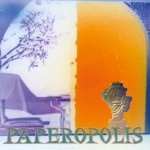
Artist: Lorenzo's Oil
Title: Paperopolis
Format: 12" + Download
Label: Pacific City Discs (@)
Rated:

Title: Paperopolis
Format: 12" + Download
Label: Pacific City Discs (@)
Rated:
"Paperopolis" doesn’t ask to be understood. It asks to be entered, preferably without a map, maybe slightly jet-lagged, with your internal compass gently malfunctioning. Lorenzo’s Oil - the meeting point between Spencer Clark (that indefatigable cartographer of hypnagogic pop zones) and Lorenzo Camera of Mondo Riviera - don’t build an album so much as a soft, unstable city made of sounds, flickering images, and half-remembered nights.
Musically, this record lives in the cracks between genres, and seems very comfortable there. Synths don’t behave like synths so much as weather systems: pads drift, sequences wobble, rhythms arrive as if broadcast from a late-night TV station nobody remembers tuning into. There’s a deliberate lo-fi tactility at play, but it’s not nostalgia for its own sake. These textures feel used, handled, smudged - like flyers peeled off a wall and reattached somewhere else.
The long opener, "Neo-Paperopolis Jump Suite", sets the coordinates immediately. It unfolds in chapters rather than movements, sliding from naïve keyboard figures into a gently propulsive groove, then dissolving into warped reflections of club music that feels filtered through fogged glass. Nothing here rushes; momentum is achieved through accumulation, not force. Clark’s instinct for psychedelic drift meets Camera’s sense of melodic suggestion, and the result is oddly physical for such a slippery record.
Throughout the album, rhythm functions less as a grid and more as a suggestion. "Upworld Groove (TV Version)" pulses with the logic of something overheard rather than performed, while "You Wouldn’t Understand It’s Swamp Thing" leans into a narcotic bounce that feels part dub, part dream-jazz, part imaginary soundtrack to a cartoon that never existed. There’s humor here too - not punchline humor, but that sideways grin you get when something is clearly enjoying its own strangeness.
Shorter tracks like "The Neverending Skylines of Taipei" work almost like postcards: quick, impressionistic flashes that hint at places without describing them. Meanwhile, "Central Jungle, Paperopolis" pulls everything inward, layering synth lines and rhythmic debris into a slow, humid sprawl that feels less composed than grown. The music doesn’t climax; it thickens, like air before rain.
What makes "Paperopolis" compelling is its refusal to resolve. There’s no grand statement, no conceptual hammer brought down at the end. Instead, Clark and Camera operate like urban explorers of the subconscious, documenting zones where past and future, kitsch and ritual, dance music and private hallucination coexist without argument. It’s psychedelic music that doesn’t insist on transcendence - it just opens a door behind your head and leaves it ajar.
In a time when so much electronic music is obsessed with clarity, "Paperopolis" opts for blur. And in doing so, it feels oddly honest. This is not a city of monuments, but of alleyways, side rooms, and places you swear you’ve been before - maybe in a dream, maybe on a cheap TV channel at 3 a.m. Either way, you’re already there.
Musically, this record lives in the cracks between genres, and seems very comfortable there. Synths don’t behave like synths so much as weather systems: pads drift, sequences wobble, rhythms arrive as if broadcast from a late-night TV station nobody remembers tuning into. There’s a deliberate lo-fi tactility at play, but it’s not nostalgia for its own sake. These textures feel used, handled, smudged - like flyers peeled off a wall and reattached somewhere else.
The long opener, "Neo-Paperopolis Jump Suite", sets the coordinates immediately. It unfolds in chapters rather than movements, sliding from naïve keyboard figures into a gently propulsive groove, then dissolving into warped reflections of club music that feels filtered through fogged glass. Nothing here rushes; momentum is achieved through accumulation, not force. Clark’s instinct for psychedelic drift meets Camera’s sense of melodic suggestion, and the result is oddly physical for such a slippery record.
Throughout the album, rhythm functions less as a grid and more as a suggestion. "Upworld Groove (TV Version)" pulses with the logic of something overheard rather than performed, while "You Wouldn’t Understand It’s Swamp Thing" leans into a narcotic bounce that feels part dub, part dream-jazz, part imaginary soundtrack to a cartoon that never existed. There’s humor here too - not punchline humor, but that sideways grin you get when something is clearly enjoying its own strangeness.
Shorter tracks like "The Neverending Skylines of Taipei" work almost like postcards: quick, impressionistic flashes that hint at places without describing them. Meanwhile, "Central Jungle, Paperopolis" pulls everything inward, layering synth lines and rhythmic debris into a slow, humid sprawl that feels less composed than grown. The music doesn’t climax; it thickens, like air before rain.
What makes "Paperopolis" compelling is its refusal to resolve. There’s no grand statement, no conceptual hammer brought down at the end. Instead, Clark and Camera operate like urban explorers of the subconscious, documenting zones where past and future, kitsch and ritual, dance music and private hallucination coexist without argument. It’s psychedelic music that doesn’t insist on transcendence - it just opens a door behind your head and leaves it ajar.
In a time when so much electronic music is obsessed with clarity, "Paperopolis" opts for blur. And in doing so, it feels oddly honest. This is not a city of monuments, but of alleyways, side rooms, and places you swear you’ve been before - maybe in a dream, maybe on a cheap TV channel at 3 a.m. Either way, you’re already there.
Comments
Stream
Browse by Genre
Industrial Music / Industrial Metal / Aggro Industrial / Electro Metal
Industrial Noise / Power Noise / Harsh Noise
Synth Pop / Electro Pop / Synth-Electronica
Techno / Trance / Goa / Drum'n'Bass / Jungle / Tribal / Trip-Hop
Ambient / Electronica / Ethereal / Dub / Soundscapes / Abstract
Experimental / Avantgarde / Weird & Wired / Glitch / Noise / Field Recording
Dark / Gothic / Wave / New Wave / Dark Wave / Industrial Gothic
New Music / Downtown / Avantgarde Jazz / New Classical / World