
Kahil El'Zabar's Ethnic Heritage Ensemble: Let The Spirit Out, Live At "mu" London
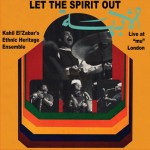
Artist: Kahil El'Zabar's Ethnic Heritage Ensemble (@)
Title: Let The Spirit Out, Live At "mu" London
Format: CD & 12" + Download
Label: Spiritmuse Records (http://spiritmuserecords.com/) (@)
Rated:
Title: Let The Spirit Out, Live At "mu" London
Format: CD & 12" + Download
Label: Spiritmuse Records (http://spiritmuserecords.com/) (@)
Rated:
There are live albums, and then there are recordings that feel less like documents and more like evidence. "Let The Spirit Out, Live at “mu” London" belongs firmly to the second category: proof that music can still function as ritual without costumes, incense, or nostalgia - just bodies in a room, listening hard, breathing together.
Kahil El’Zabar has been doing this kind of work for so long that the word "legend" risks sounding inadequate, almost bureaucratic. For over five decades, he has treated rhythm as a social force rather than a stylistic choice, folding African diasporic traditions, jazz improvisation, spoken invocation, and communal energy into what he once described - accurately - as a spiritual groove. The Ethnic Heritage Ensemble, founded in 1974, was never meant to be a band in the conventional sense; it was conceived as a living vessel for Great Black Music, adaptable enough to carry history forward without embalming it.
This double LP captures two nights at "mu", an audiophile listening space in London chosen precisely because it resists the usual club dynamics. No background chatter, no bar clatter - just attention. El’Zabar composed new material specifically for this setting, alongside fresh arrangements of well-worn standards, not to modernize them but to reopen their pores. The idea is simple and demanding: put the music in front of an audience and let the presence of that audience reshape it in real time.
From the opening moments of “From Your Heart”, led by El’Zabar’s kalimba and his unmistakable vocal cadence, the music announces its intent. This is not performance as spectacle; it’s an invitation. The groove is deep but unforced, the pulse elastic rather than authoritarian. Corey Wilkes’ trumpet cuts through with clarity and warmth, Alex Harding’s baritone sax brings a grainy physicality, and Ishmael Ali’s cello adds an unexpected vertical depth - less string section, more resonant spine.
The reimagined classics are telling choices. “Footprints” doesn’t swing so much as it walks with purpose, carrying Wayne Shorter’s harmonic DNA into a more grounded, percussive terrain. “Summertime” sheds its seasonal melancholy and emerges as a slow, communal chant - less lullaby, more reminder. “Caravan”, often treated as an exotic postcard, becomes something heavier and earthbound, driven by layered rhythms that feel closer to procession than travelogue.
What makes this album work isn’t virtuosity - though there’s plenty - but intention. El’Zabar doesn’t solo over the ensemble; he conducts energy. His introductions and spoken passages might look superfluous on paper, but in context they function like breath marks, recalibrating the room. When the title track finally arrives, stretching close to fifteen minutes, it feels earned rather than climactic: a gradual unsealing, rhythm turning into affirmation.
There’s a subtle humor here too, the kind that comes from confidence. El’Zabar knows exactly what he’s doing, and he’s not afraid to say it out loud. The message - release, freedom, connection - could sound grandiose in lesser hands. Here, it lands because the music backs it up. The spirit isn’t preached; it’s exercised.
Recorded cleanly but without sterilization, the sound preserves the physicality of the event: the air moving, the audience listening, the ensemble responding. The artwork by Nep Sidhu completes the circle, framing the music as something ceremonial rather than archival.
"Let The Spirit Out" is not about escape from the world; it’s about re-entering it with sharper senses. It reminds us that spiritual jazz, at its best, isn’t a genre at all but a practice - one that insists music can still heal without pretending everything is fine. Jump and shout if you want. Or just sit still and let the rhythm do the work.
Kahil El’Zabar has been doing this kind of work for so long that the word "legend" risks sounding inadequate, almost bureaucratic. For over five decades, he has treated rhythm as a social force rather than a stylistic choice, folding African diasporic traditions, jazz improvisation, spoken invocation, and communal energy into what he once described - accurately - as a spiritual groove. The Ethnic Heritage Ensemble, founded in 1974, was never meant to be a band in the conventional sense; it was conceived as a living vessel for Great Black Music, adaptable enough to carry history forward without embalming it.
This double LP captures two nights at "mu", an audiophile listening space in London chosen precisely because it resists the usual club dynamics. No background chatter, no bar clatter - just attention. El’Zabar composed new material specifically for this setting, alongside fresh arrangements of well-worn standards, not to modernize them but to reopen their pores. The idea is simple and demanding: put the music in front of an audience and let the presence of that audience reshape it in real time.
From the opening moments of “From Your Heart”, led by El’Zabar’s kalimba and his unmistakable vocal cadence, the music announces its intent. This is not performance as spectacle; it’s an invitation. The groove is deep but unforced, the pulse elastic rather than authoritarian. Corey Wilkes’ trumpet cuts through with clarity and warmth, Alex Harding’s baritone sax brings a grainy physicality, and Ishmael Ali’s cello adds an unexpected vertical depth - less string section, more resonant spine.
The reimagined classics are telling choices. “Footprints” doesn’t swing so much as it walks with purpose, carrying Wayne Shorter’s harmonic DNA into a more grounded, percussive terrain. “Summertime” sheds its seasonal melancholy and emerges as a slow, communal chant - less lullaby, more reminder. “Caravan”, often treated as an exotic postcard, becomes something heavier and earthbound, driven by layered rhythms that feel closer to procession than travelogue.
What makes this album work isn’t virtuosity - though there’s plenty - but intention. El’Zabar doesn’t solo over the ensemble; he conducts energy. His introductions and spoken passages might look superfluous on paper, but in context they function like breath marks, recalibrating the room. When the title track finally arrives, stretching close to fifteen minutes, it feels earned rather than climactic: a gradual unsealing, rhythm turning into affirmation.
There’s a subtle humor here too, the kind that comes from confidence. El’Zabar knows exactly what he’s doing, and he’s not afraid to say it out loud. The message - release, freedom, connection - could sound grandiose in lesser hands. Here, it lands because the music backs it up. The spirit isn’t preached; it’s exercised.
Recorded cleanly but without sterilization, the sound preserves the physicality of the event: the air moving, the audience listening, the ensemble responding. The artwork by Nep Sidhu completes the circle, framing the music as something ceremonial rather than archival.
"Let The Spirit Out" is not about escape from the world; it’s about re-entering it with sharper senses. It reminds us that spiritual jazz, at its best, isn’t a genre at all but a practice - one that insists music can still heal without pretending everything is fine. Jump and shout if you want. Or just sit still and let the rhythm do the work.
Comments
Stream
Browse by Genre
Industrial Music / Industrial Metal / Aggro Industrial / Electro Metal
Industrial Noise / Power Noise / Harsh Noise
Synth Pop / Electro Pop / Synth-Electronica
Techno / Trance / Goa / Drum'n'Bass / Jungle / Tribal / Trip-Hop
Ambient / Electronica / Ethereal / Dub / Soundscapes / Abstract
Experimental / Avantgarde / Weird & Wired / Glitch / Noise / Field Recording
Dark / Gothic / Wave / New Wave / Dark Wave / Industrial Gothic
New Music / Downtown / Avantgarde Jazz / New Classical / World