
VV.AA.: Salò, or The 120 Days Of Sodom
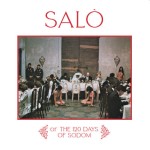
Artist: VV.AA.
Title: Salò, or The 120 Days Of Sodom
Format: CD + Download
Label: Cold Spring (@)
Rated:
Title: Salò, or The 120 Days Of Sodom
Format: CD + Download
Label: Cold Spring (@)
Rated:
Some releases arrive politely, asking for your attention. Others walk in carrying a historical crime scene and expect you to sit with it. This first official issue of the soundtrack to Salò, or the 120 Days of Sodom falls firmly into the second category, and it’s not remotely interested in being an easy listen. What a surprise!
Curated under the shadow of Pier Paolo Pasolini’s final, brutal statement, the music assembled here operates on a principle that still feels quietly perverse: beauty as indictment. The refined, often delicate compositions - drawn from the likes of Johann Sebastian Bach and Frédéric Chopin - don’t soften the violence of the film they accompany. They sharpen it. Civility becomes complicity.
At the center of this uneasy architecture sits Ennio Morricone, whose contributions here are deceptively restrained. “Son Tanto Triste” opens the sequence with a kind of mournful elegance that feels almost inappropriate given what follows. And that’s precisely the point. Morricone understood that horror rarely needs help being loud; it benefits more from contrast, from the quiet suggestion that something is fundamentally wrong beneath the surface.
The inclusion of “Addio a Pier Paolo Pasolini”, composed after the director’s murder, adds a layer that no amount of curatorial framing could invent. It’s not just a tribute; it’s an intrusion of reality into an already unbearable fiction. The boundary between artwork and aftermath collapses, and you’re left wondering whether the soundtrack documents a film, a worldview, or a rupture in history.
What makes this release particularly unsettling in isolation - detached from the film - is how incomplete it feels by design. The untitled fragments, the abrupt transitions, the occasional intrusion of voices from the cast: it all resists coherence. You’re not meant to follow this music. You’re meant to endure it, to notice how quickly refinement curdles into something else when placed in the wrong context.
Cold Spring’s decision to present this material now, decades later, inevitably raises the question of timing. Why revisit Salò in 2026, when the world has already perfected more subtle forms of cruelty? The uncomfortable answer is that Pasolini’s thesis - that power, when unchecked, aestheticizes its own violence - hasn’t aged at all. If anything, it’s become more efficient.
There is, admittedly, something almost darkly funny in the way the album’s structure mirrors its subject. Short, neatly contained pieces. Elegant, even. As if brutality could be archived, catalogued, and presented in digestible segments. A playlist of moral collapse.
And yet, despite everything - or because of it - the music retains a strange autonomy. Removed from the images, it reveals its own internal tensions: between sacred and profane, order and disintegration, composition and contamination. It doesn’t redeem the film, nor does it need to. It simply exposes the mechanisms by which beauty can be made to serve something far less beautiful.
Listening to this soundtrack is less about appreciation and more about recognition. Not of specific scenes, but of a pattern: the way culture dresses up its worst instincts in impeccable taste and calls it civilization. You can admire the craftsmanship, certainly. Just don’t pretend it’s neutral.
Curated under the shadow of Pier Paolo Pasolini’s final, brutal statement, the music assembled here operates on a principle that still feels quietly perverse: beauty as indictment. The refined, often delicate compositions - drawn from the likes of Johann Sebastian Bach and Frédéric Chopin - don’t soften the violence of the film they accompany. They sharpen it. Civility becomes complicity.
At the center of this uneasy architecture sits Ennio Morricone, whose contributions here are deceptively restrained. “Son Tanto Triste” opens the sequence with a kind of mournful elegance that feels almost inappropriate given what follows. And that’s precisely the point. Morricone understood that horror rarely needs help being loud; it benefits more from contrast, from the quiet suggestion that something is fundamentally wrong beneath the surface.
The inclusion of “Addio a Pier Paolo Pasolini”, composed after the director’s murder, adds a layer that no amount of curatorial framing could invent. It’s not just a tribute; it’s an intrusion of reality into an already unbearable fiction. The boundary between artwork and aftermath collapses, and you’re left wondering whether the soundtrack documents a film, a worldview, or a rupture in history.
What makes this release particularly unsettling in isolation - detached from the film - is how incomplete it feels by design. The untitled fragments, the abrupt transitions, the occasional intrusion of voices from the cast: it all resists coherence. You’re not meant to follow this music. You’re meant to endure it, to notice how quickly refinement curdles into something else when placed in the wrong context.
Cold Spring’s decision to present this material now, decades later, inevitably raises the question of timing. Why revisit Salò in 2026, when the world has already perfected more subtle forms of cruelty? The uncomfortable answer is that Pasolini’s thesis - that power, when unchecked, aestheticizes its own violence - hasn’t aged at all. If anything, it’s become more efficient.
There is, admittedly, something almost darkly funny in the way the album’s structure mirrors its subject. Short, neatly contained pieces. Elegant, even. As if brutality could be archived, catalogued, and presented in digestible segments. A playlist of moral collapse.
And yet, despite everything - or because of it - the music retains a strange autonomy. Removed from the images, it reveals its own internal tensions: between sacred and profane, order and disintegration, composition and contamination. It doesn’t redeem the film, nor does it need to. It simply exposes the mechanisms by which beauty can be made to serve something far less beautiful.
Listening to this soundtrack is less about appreciation and more about recognition. Not of specific scenes, but of a pattern: the way culture dresses up its worst instincts in impeccable taste and calls it civilization. You can admire the craftsmanship, certainly. Just don’t pretend it’s neutral.
Comments
Stream
Browse by Genre
Industrial Music / Industrial Metal / Aggro Industrial / Electro Metal
Industrial Noise / Power Noise / Harsh Noise
Synth Pop / Electro Pop / Synth-Electronica
Techno / Trance / Goa / Drum'n'Bass / Jungle / Tribal / Trip-Hop
Ambient / Electronica / Ethereal / Dub / Soundscapes / Abstract
Experimental / Avantgarde / Weird & Wired / Glitch / Noise / Field Recording
Dark / Gothic / Wave / New Wave / Dark Wave / Industrial Gothic
New Music / Downtown / Avantgarde Jazz / New Classical / World