
Magda Drozd: Divided By Dusk
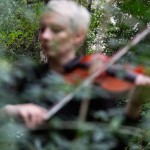
Artist: Magda Drozd (@)
Title: Divided By Dusk
Format: Tape + Download
Label: Präsens Editionen (@)
Rated:

Title: Divided By Dusk
Format: Tape + Download
Label: Präsens Editionen (@)
Rated:
Some records want to be heard. Others prefer to hover, like a presence you’re not entirely sure you imagined. "Divided By Dusk" belongs firmly to the second category, which is either admirable restraint or a polite refusal to entertain you. Depends how much patience you brought with you.
Magda Drozd has been circling this territory for a while now. From "Songs for Plants" through "Viscera", she’s built a language that avoids obvious gestures, as if melody itself were a risky commitment. A Warsaw-born composer now splitting her life between Zürich and London, she operates in that well-populated but still oddly intimate zone where sound art, folk memory, and electroacoustic composition overlap like half-erased maps. Here, though, the maps feel older, less reliable, and deliberately smudged.
The album unfolds in that suspiciously poetic time of day everyone romanticizes and nobody actually wants to navigate without a flashlight. “Eclipse” sets the tone with a kind of suspended duality, not so much light versus dark as both failing at the same time. It’s less a beginning than a soft disorientation. You’re not guided in, you’re absorbed, which is charming in theory and mildly unsettling in practice.
What makes "Divided By Dusk" quietly compelling is how it treats influence not as citation but as sediment. Drozd’s encounters with the Japanese experimental scene, particularly through collaborators like Rai Tateishi and Koshiro Hino, don’t result in postcard exoticism. Instead, they seep into the structure. On “Rounds”, the breath of the shinobue and the reedy pulse of the khaen feel less like guest appearances and more like ancient mechanisms briefly remembering how to function. Time folds in on itself, then shrugs.
At the same time, her renewed engagement with Polish folklore avoids the usual trap of reverence. “Piosenka Ludowa” doesn’t reconstruct tradition, it agitates it. The folk impulse here is restless, almost suspicious of its own past. It wants to dance, yes, but like someone who’s aware the floor might give way at any moment. This tension between invocation and erosion runs throughout the album, giving it that faintly haunted quality that experimental music loves and casual listeners tend to flee from.
There’s also a noticeable economy at work. Tracks like “Hungry Nightmares” and “Vertigo” don’t overstay their welcome, which is refreshing in a genre often addicted to duration as proof of seriousness. Drozd seems more interested in precision than immersion. She sketches states rather than building worlds, which can feel frustrating if you’re expecting narrative development, but rewarding if you’re willing to accept fragments as complete thoughts. A radical concept, apparently.
Technically, the album is immaculate without drawing attention to itself. The mixing by Glyn Maier and Nick Klein, along with Lawrence English’s mastering, gives everything a kind of tactile depth, like you could reach into the sound and come back with dust under your fingernails. Even the Lyra-8 textures, often prone to dominating whatever they touch, are kept on a short leash. No instrument is allowed to become the protagonist. Everyone gets to haunt equally.
By the time “From the Depths” closes the record, there’s no grand resolution waiting for you. Instead, Drozd offers a kind of acceptance. The past isn’t recovered, the rituals aren’t clarified, and the ghosts remain stubbornly uninterpreted. You’re left with traces, echoes, and the uncomfortable suspicion that meaning was never the point to begin with.
It’s tempting to call "Divided By Dusk" melancholic, but that feels slightly lazy. It’s more accurate to say it’s patient with ambiguity, which is a rarer and less marketable quality. The album doesn’t ask to be understood. It asks to be tolerated long enough to reveal its logic, and even then, it keeps a few doors closed out of principle.
Not exactly a crowd-pleaser. But then again, crowds rarely deserve this kind of quiet persistence.
Magda Drozd has been circling this territory for a while now. From "Songs for Plants" through "Viscera", she’s built a language that avoids obvious gestures, as if melody itself were a risky commitment. A Warsaw-born composer now splitting her life between Zürich and London, she operates in that well-populated but still oddly intimate zone where sound art, folk memory, and electroacoustic composition overlap like half-erased maps. Here, though, the maps feel older, less reliable, and deliberately smudged.
The album unfolds in that suspiciously poetic time of day everyone romanticizes and nobody actually wants to navigate without a flashlight. “Eclipse” sets the tone with a kind of suspended duality, not so much light versus dark as both failing at the same time. It’s less a beginning than a soft disorientation. You’re not guided in, you’re absorbed, which is charming in theory and mildly unsettling in practice.
What makes "Divided By Dusk" quietly compelling is how it treats influence not as citation but as sediment. Drozd’s encounters with the Japanese experimental scene, particularly through collaborators like Rai Tateishi and Koshiro Hino, don’t result in postcard exoticism. Instead, they seep into the structure. On “Rounds”, the breath of the shinobue and the reedy pulse of the khaen feel less like guest appearances and more like ancient mechanisms briefly remembering how to function. Time folds in on itself, then shrugs.
At the same time, her renewed engagement with Polish folklore avoids the usual trap of reverence. “Piosenka Ludowa” doesn’t reconstruct tradition, it agitates it. The folk impulse here is restless, almost suspicious of its own past. It wants to dance, yes, but like someone who’s aware the floor might give way at any moment. This tension between invocation and erosion runs throughout the album, giving it that faintly haunted quality that experimental music loves and casual listeners tend to flee from.
There’s also a noticeable economy at work. Tracks like “Hungry Nightmares” and “Vertigo” don’t overstay their welcome, which is refreshing in a genre often addicted to duration as proof of seriousness. Drozd seems more interested in precision than immersion. She sketches states rather than building worlds, which can feel frustrating if you’re expecting narrative development, but rewarding if you’re willing to accept fragments as complete thoughts. A radical concept, apparently.
Technically, the album is immaculate without drawing attention to itself. The mixing by Glyn Maier and Nick Klein, along with Lawrence English’s mastering, gives everything a kind of tactile depth, like you could reach into the sound and come back with dust under your fingernails. Even the Lyra-8 textures, often prone to dominating whatever they touch, are kept on a short leash. No instrument is allowed to become the protagonist. Everyone gets to haunt equally.
By the time “From the Depths” closes the record, there’s no grand resolution waiting for you. Instead, Drozd offers a kind of acceptance. The past isn’t recovered, the rituals aren’t clarified, and the ghosts remain stubbornly uninterpreted. You’re left with traces, echoes, and the uncomfortable suspicion that meaning was never the point to begin with.
It’s tempting to call "Divided By Dusk" melancholic, but that feels slightly lazy. It’s more accurate to say it’s patient with ambiguity, which is a rarer and less marketable quality. The album doesn’t ask to be understood. It asks to be tolerated long enough to reveal its logic, and even then, it keeps a few doors closed out of principle.
Not exactly a crowd-pleaser. But then again, crowds rarely deserve this kind of quiet persistence.
Comments
Stream
Browse by Genre
Industrial Music / Industrial Metal / Aggro Industrial / Electro Metal
Industrial Noise / Power Noise / Harsh Noise
Synth Pop / Electro Pop / Synth-Electronica
Techno / Trance / Goa / Drum'n'Bass / Jungle / Tribal / Trip-Hop
Ambient / Electronica / Ethereal / Dub / Soundscapes / Abstract
Experimental / Avantgarde / Weird & Wired / Glitch / Noise / Field Recording
Dark / Gothic / Wave / New Wave / Dark Wave / Industrial Gothic
New Music / Downtown / Avantgarde Jazz / New Classical / World