
Saturday, September 5, 2026
Jah Wobble & Jon Klein: Automated Paradise
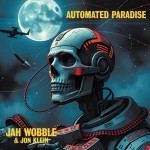
Artist: Jah Wobble & Jon Klein (@)
Title: Automated Paradise
Format: LP
Label: Dimple Discs (@)
Rated:
Title: Automated Paradise
Format: LP
Label: Dimple Discs (@)
Rated:
There are musicians who age into irrelevance, and then there are those who simply change the room they’re standing in while everyone else is still arguing about the furniture. Jah Wobble belongs firmly to the second category. On "Automated Paradise", alongside Jon Klein, he sounds less like a legacy act and more like someone who never accepted the premise of nostalgia in the first place.
Which is slightly inconvenient if you were hoping for a comfortable return to the ghost of Public Image Ltd and the looming shadow of "Metal Box". That DNA is still there, obviously. Wobble’s bass remains what it has always been: not accompaniment, but axis. It doesn’t support the track, it "is" the track, everything else negotiating its existence around it.
What’s different here is the way Klein’s guitar operates. Rather than competing for space, it slips between roles, sometimes textural, sometimes abrasive, occasionally almost melodic before retreating again. Having passed through the orbit of Siouxsie and the Banshees, Klein brings a sense of drama that never quite tips into excess. He knows when to withdraw, which is a rarer skill than most guitarists would like to admit.
“Fading Away” opens the album with a kind of understated inevitability. The groove is there, but it’s not trying to seduce you. It just exists, steady and slightly ominous, as if it has somewhere to be and you’re welcome to follow if you can keep up. “Make It Stop” sharpens the tone, introducing a more confrontational edge, though even here the aggression feels controlled, almost observational rather than explosive.
“Who Wins” and “Read Between The Lines” continue this balancing act between dub-inflected spaciousness and post-punk tension. There’s a sense of restraint running through the album, as if both musicians are deliberately avoiding the obvious move at every turn. It makes the listening experience slightly unpredictable in a low-key way. Not chaotic, just unwilling to settle.
The title track, brief and almost skeletal, feels like a conceptual hinge. “Automated Paradise” doesn’t expand, it compresses, reducing the album’s concerns to a kind of distilled gesture. After that, “Terminal Terminal The End” sounds like it might deliver some kind of conclusion, but of course it doesn’t. Titles lie. Music shrugs.
“Endless Sky” opens things up again, offering a rare moment of something close to release, though even here it’s tempered by a lingering ambiguity. By the time “Brockwell Lido” closes the record, there’s a faint sense of return, not to a specific place, but to a mood. Urban, reflective, slightly detached. The kind of ending that doesn’t resolve anything but feels appropriate anyway.
What makes "Automated Paradise" work is its refusal to dramatize its own relevance. Wobble’s long history, from collaborations with figures like Brian Eno to his genre-blurring solo work, could easily become a burden. Instead, it functions as a kind of background radiation, present but not overwhelming. Klein, with his equally varied trajectory, meets that energy with a quiet adaptability.
The result is an album that feels deliberate without being rigid, exploratory without pretending to reinvent the wheel. It doesn’t chase modernity, doesn’t retreat into past formulas. It just occupies its own space, calmly, almost stubbornly.
Not exactly paradise, automated or otherwise. But something more interesting: a system that still allows for human interference.
Which is slightly inconvenient if you were hoping for a comfortable return to the ghost of Public Image Ltd and the looming shadow of "Metal Box". That DNA is still there, obviously. Wobble’s bass remains what it has always been: not accompaniment, but axis. It doesn’t support the track, it "is" the track, everything else negotiating its existence around it.
What’s different here is the way Klein’s guitar operates. Rather than competing for space, it slips between roles, sometimes textural, sometimes abrasive, occasionally almost melodic before retreating again. Having passed through the orbit of Siouxsie and the Banshees, Klein brings a sense of drama that never quite tips into excess. He knows when to withdraw, which is a rarer skill than most guitarists would like to admit.
“Fading Away” opens the album with a kind of understated inevitability. The groove is there, but it’s not trying to seduce you. It just exists, steady and slightly ominous, as if it has somewhere to be and you’re welcome to follow if you can keep up. “Make It Stop” sharpens the tone, introducing a more confrontational edge, though even here the aggression feels controlled, almost observational rather than explosive.
“Who Wins” and “Read Between The Lines” continue this balancing act between dub-inflected spaciousness and post-punk tension. There’s a sense of restraint running through the album, as if both musicians are deliberately avoiding the obvious move at every turn. It makes the listening experience slightly unpredictable in a low-key way. Not chaotic, just unwilling to settle.
The title track, brief and almost skeletal, feels like a conceptual hinge. “Automated Paradise” doesn’t expand, it compresses, reducing the album’s concerns to a kind of distilled gesture. After that, “Terminal Terminal The End” sounds like it might deliver some kind of conclusion, but of course it doesn’t. Titles lie. Music shrugs.
“Endless Sky” opens things up again, offering a rare moment of something close to release, though even here it’s tempered by a lingering ambiguity. By the time “Brockwell Lido” closes the record, there’s a faint sense of return, not to a specific place, but to a mood. Urban, reflective, slightly detached. The kind of ending that doesn’t resolve anything but feels appropriate anyway.
What makes "Automated Paradise" work is its refusal to dramatize its own relevance. Wobble’s long history, from collaborations with figures like Brian Eno to his genre-blurring solo work, could easily become a burden. Instead, it functions as a kind of background radiation, present but not overwhelming. Klein, with his equally varied trajectory, meets that energy with a quiet adaptability.
The result is an album that feels deliberate without being rigid, exploratory without pretending to reinvent the wheel. It doesn’t chase modernity, doesn’t retreat into past formulas. It just occupies its own space, calmly, almost stubbornly.
Not exactly paradise, automated or otherwise. But something more interesting: a system that still allows for human interference.
Comments
Stream
Browse by Genre
Industrial Music / Industrial Metal / Aggro Industrial / Electro Metal
Industrial Noise / Power Noise / Harsh Noise
Synth Pop / Electro Pop / Synth-Electronica
Techno / Trance / Goa / Drum'n'Bass / Jungle / Tribal / Trip-Hop
Ambient / Electronica / Ethereal / Dub / Soundscapes / Abstract
Experimental / Avantgarde / Weird & Wired / Glitch / Noise / Field Recording
Dark / Gothic / Wave / New Wave / Dark Wave / Industrial Gothic
New Music / Downtown / Avantgarde Jazz / New Classical / World