
Emily Wittbrodt: Wearing Words
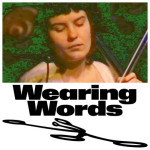
Artist: Emily Wittbrodt (@)
Title: Wearing Words
Format: 12" + Download
Label: Futura Resistenza (@)
Rated:

Title: Wearing Words
Format: 12" + Download
Label: Futura Resistenza (@)
Rated:
Emily Wittbrodt’s "Wearing Words" is built on a small, slightly maddening premise: what if language doesn’t belong to you, but you insist on using it anyway? Not as expression, but as adaptation. Not speaking, but wearing.
She describes the process as feeling “like wearing clothes that don’t belong to me”, a borrowed vocabulary that never quite settles on the skin. That image ends up doing more work than most album concepts manage in a lifetime. Because once you hear it, you can’t un-hear it: every phrase on this record sounds negotiated rather than owned, gently forced into melodic shapes that existed before meaning arrived.
Wittbrodt, trained in classical traditions but clearly uninterested in staying obedient to them, constructs the music first - clean, deliberate, almost architectural - and only later searches for the words that can inhabit it. Not decorate it, not explain it. Fit it. It’s a backwards method, and predictably, it produces a kind of friction that becomes the album’s real subject.
She has said she spent weeks doing nothing but chasing the right words, to the point of dreaming about them, as if language had turned into a low-level fever. You can hear that obsessive fine-tuning everywhere: lines that feel just slightly too tight, vowels stretched like fabric under tension, consonants landing with surgical precision. It’s meticulous, but not sterile. More like someone trying to tailor a suit in the dark.
Musically, "Wearing Words" drifts in a zone where chamber pop, baroque echoes, and restrained improvisation keep brushing against each other without ever fully merging. The cello remains the axis, warm but unsentimental, while accordion, clarinet, and electronics hover like secondary thoughts. Nothing insists. Nothing performs urgency. Even the more ornate passages feel as if they’re holding back, aware that too much certainty would break the spell.
Sandro HÄhnel’s voice is a crucial decision. Wittbrodt deliberately writes outside his natural range, forcing him into a softer, almost disembodied delivery. The result is a voice that doesn’t declare identity but suspends it. Gender blurs, authority dissolves, and what remains is something fragile, almost provisional. A voice that sounds like it’s trying on language rather than owning it.
There’s also a darker undercurrent Wittbrodt hints at: that people “wear words” not just out of discomfort, but out of strategy. Language as camouflage. Language as manipulation. It’s not hammered into a thesis, but it lingers behind the songs like a quiet suspicion that meaning itself might be compromised.
And that’s where the album becomes more than an elegant experiment. It starts to resemble a study of how we communicate when we’re not entirely sure we can. When language feels second-hand, when expression arrives late, when clarity is something you assemble rather than discover.
Tracks like “Lied” or the title piece don’t resolve this tension. They sit inside it. Melodies offer a sense of direction, while the words keep shifting underfoot, never fully settling. It’s beautiful in a slightly unstable way, like a sentence that almost says what you mean but leaves a residue of doubt.
In the end, "Wearing Words" doesn’t try to fix the gap between sound and language. It just exposes it, patiently, almost tenderly. Wittbrodt doesn’t claim fluency. She documents the effort.
And honestly, that’s a lot closer to how most people actually live with language than they’d like to admit.
She describes the process as feeling “like wearing clothes that don’t belong to me”, a borrowed vocabulary that never quite settles on the skin. That image ends up doing more work than most album concepts manage in a lifetime. Because once you hear it, you can’t un-hear it: every phrase on this record sounds negotiated rather than owned, gently forced into melodic shapes that existed before meaning arrived.
Wittbrodt, trained in classical traditions but clearly uninterested in staying obedient to them, constructs the music first - clean, deliberate, almost architectural - and only later searches for the words that can inhabit it. Not decorate it, not explain it. Fit it. It’s a backwards method, and predictably, it produces a kind of friction that becomes the album’s real subject.
She has said she spent weeks doing nothing but chasing the right words, to the point of dreaming about them, as if language had turned into a low-level fever. You can hear that obsessive fine-tuning everywhere: lines that feel just slightly too tight, vowels stretched like fabric under tension, consonants landing with surgical precision. It’s meticulous, but not sterile. More like someone trying to tailor a suit in the dark.
Musically, "Wearing Words" drifts in a zone where chamber pop, baroque echoes, and restrained improvisation keep brushing against each other without ever fully merging. The cello remains the axis, warm but unsentimental, while accordion, clarinet, and electronics hover like secondary thoughts. Nothing insists. Nothing performs urgency. Even the more ornate passages feel as if they’re holding back, aware that too much certainty would break the spell.
Sandro HÄhnel’s voice is a crucial decision. Wittbrodt deliberately writes outside his natural range, forcing him into a softer, almost disembodied delivery. The result is a voice that doesn’t declare identity but suspends it. Gender blurs, authority dissolves, and what remains is something fragile, almost provisional. A voice that sounds like it’s trying on language rather than owning it.
There’s also a darker undercurrent Wittbrodt hints at: that people “wear words” not just out of discomfort, but out of strategy. Language as camouflage. Language as manipulation. It’s not hammered into a thesis, but it lingers behind the songs like a quiet suspicion that meaning itself might be compromised.
And that’s where the album becomes more than an elegant experiment. It starts to resemble a study of how we communicate when we’re not entirely sure we can. When language feels second-hand, when expression arrives late, when clarity is something you assemble rather than discover.
Tracks like “Lied” or the title piece don’t resolve this tension. They sit inside it. Melodies offer a sense of direction, while the words keep shifting underfoot, never fully settling. It’s beautiful in a slightly unstable way, like a sentence that almost says what you mean but leaves a residue of doubt.
In the end, "Wearing Words" doesn’t try to fix the gap between sound and language. It just exposes it, patiently, almost tenderly. Wittbrodt doesn’t claim fluency. She documents the effort.
And honestly, that’s a lot closer to how most people actually live with language than they’d like to admit.
Comments
Stream
Browse by Genre
Industrial Music / Industrial Metal / Aggro Industrial / Electro Metal
Industrial Noise / Power Noise / Harsh Noise
Synth Pop / Electro Pop / Synth-Electronica
Techno / Trance / Goa / Drum'n'Bass / Jungle / Tribal / Trip-Hop
Ambient / Electronica / Ethereal / Dub / Soundscapes / Abstract
Experimental / Avantgarde / Weird & Wired / Glitch / Noise / Field Recording
Dark / Gothic / Wave / New Wave / Dark Wave / Industrial Gothic
New Music / Downtown / Avantgarde Jazz / New Classical / World