
Wednesday, October 7, 2026
Fr?d?ric L'Ep?e: Contre Courant
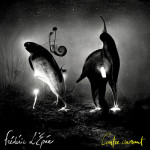
Artist: Fr?d?ric L'Ep?e (@)
Title: Contre Courant
Format: Download Only (MP3 + Lossless)
Label: Cuneiform (http://www.cuneiformrecords.com/) (@)
Rated:

Title: Contre Courant
Format: Download Only (MP3 + Lossless)
Label: Cuneiform (http://www.cuneiformrecords.com/) (@)
Rated:
Electric guitar music often suffers from a peculiar form of inflation. More pedals, more speed, more volume, more evidence that someone spent adolescence practicing scales instead of developing sustainable social skills. Frédéric L'Epée takes the opposite route on "Contre Courant", stripping the instrument of its habitual theatrics until what remains is touch, resonance, and the quiet confidence of someone uninterested in competing for attention.
Released by Cuneiform Records, the album feels less like a conventional guitar record than a patient argument for the electric guitar as a chamber instrument. L’Epée’s stated ambition - to create a solo electric repertoire analogous to classical recital traditions - could easily have resulted in something stiff or academic. Instead, "Contre Courant" breathes with remarkable intimacy. The pieces unfold like carefully observed thoughts rather than demonstrations of technique.
That restraint is crucial. L’Epée avoids the reflexive gestures associated with the instrument almost entirely: no grandstanding solos, no distortion-heavy catharsis, no endless declarations of emotional importance through volume. The guitar sounds mostly natural, almost exposed, and because of that every tonal shift matters. Harmonics shimmer briefly before dissolving, chords linger with delicate ambiguity, melodies emerge cautiously as if testing the air before continuing.
The title itself, French for “against the current”, proves apt. In a musical landscape increasingly addicted to immediacy and saturation, these compositions move slowly and with unusual patience. “Festina Lente” establishes the atmosphere immediately, balancing motion and stillness with a grace that recalls the paradox contained in its title: make haste slowly. The piece doesn’t progress toward climax so much as circulate through subtle transformations, rewarding attention rather than demanding it.
L’Epée’s affection for early twentieth-century French composers hovers throughout the record, particularly in “Sarabande”, “Trois Miniatures”, and the remarkable “Les Sonneurs”. You can sense traces of Claude Debussy, Maurice Ravel, and Erik Satie not through direct quotation, but through atmosphere: harmonic colors that seem to shift with the light, phrases that evaporate before fully resolving, emotional tones suspended somewhere between melancholy and tenderness. L’Epée appears less interested in imitation than in imagining an alternate musical history where these composers actually wrote for electric guitar. A strangely moving thought, honestly. History could have used more tasteful guitar music and fewer twelve-minute drum solos.
At times, the album edges toward minimalism, though never in a doctrinaire sense. “Pluie Inversée” and “Anchor” feel almost weightless, while “Méditation Polyrythmique” introduces rhythmic complexity without sacrificing clarity or warmth. Even the more substantial pieces, such as “Floating Forest” or “Le Ciel après nous”, avoid excess. The music continually resists overstatement, preferring implication to declaration.
This approach makes sense within the broader context of L’Epée’s career. Known for his work with Yang, where progressive rock structures intertwine with chamber-like precision, he has long occupied an unusual space between rock experimentation and contemporary composition. Here, however, the extroverted energy associated with ensemble work recedes, revealing what he describes as the “Yin” side of his musical personality: inward-looking, restrained, quietly luminous.
There’s something almost unfashionable about the album’s sincerity. "Contre Courant" does not hide behind irony, conceptual overload, or technological spectacle. It simply trusts sound itself to carry meaning. That trust can feel disarming in 2026, when so much music behaves as if terrified of silence or subtlety.
And perhaps that is the album’s greatest strength. It asks the listener not to consume, but to dwell. To pay attention to resonance, decay, hesitation. To remember that intimacy is not the absence of complexity, but another form of it entirely.
A radical proposition, apparently.
Released by Cuneiform Records, the album feels less like a conventional guitar record than a patient argument for the electric guitar as a chamber instrument. L’Epée’s stated ambition - to create a solo electric repertoire analogous to classical recital traditions - could easily have resulted in something stiff or academic. Instead, "Contre Courant" breathes with remarkable intimacy. The pieces unfold like carefully observed thoughts rather than demonstrations of technique.
That restraint is crucial. L’Epée avoids the reflexive gestures associated with the instrument almost entirely: no grandstanding solos, no distortion-heavy catharsis, no endless declarations of emotional importance through volume. The guitar sounds mostly natural, almost exposed, and because of that every tonal shift matters. Harmonics shimmer briefly before dissolving, chords linger with delicate ambiguity, melodies emerge cautiously as if testing the air before continuing.
The title itself, French for “against the current”, proves apt. In a musical landscape increasingly addicted to immediacy and saturation, these compositions move slowly and with unusual patience. “Festina Lente” establishes the atmosphere immediately, balancing motion and stillness with a grace that recalls the paradox contained in its title: make haste slowly. The piece doesn’t progress toward climax so much as circulate through subtle transformations, rewarding attention rather than demanding it.
L’Epée’s affection for early twentieth-century French composers hovers throughout the record, particularly in “Sarabande”, “Trois Miniatures”, and the remarkable “Les Sonneurs”. You can sense traces of Claude Debussy, Maurice Ravel, and Erik Satie not through direct quotation, but through atmosphere: harmonic colors that seem to shift with the light, phrases that evaporate before fully resolving, emotional tones suspended somewhere between melancholy and tenderness. L’Epée appears less interested in imitation than in imagining an alternate musical history where these composers actually wrote for electric guitar. A strangely moving thought, honestly. History could have used more tasteful guitar music and fewer twelve-minute drum solos.
At times, the album edges toward minimalism, though never in a doctrinaire sense. “Pluie Inversée” and “Anchor” feel almost weightless, while “Méditation Polyrythmique” introduces rhythmic complexity without sacrificing clarity or warmth. Even the more substantial pieces, such as “Floating Forest” or “Le Ciel après nous”, avoid excess. The music continually resists overstatement, preferring implication to declaration.
This approach makes sense within the broader context of L’Epée’s career. Known for his work with Yang, where progressive rock structures intertwine with chamber-like precision, he has long occupied an unusual space between rock experimentation and contemporary composition. Here, however, the extroverted energy associated with ensemble work recedes, revealing what he describes as the “Yin” side of his musical personality: inward-looking, restrained, quietly luminous.
There’s something almost unfashionable about the album’s sincerity. "Contre Courant" does not hide behind irony, conceptual overload, or technological spectacle. It simply trusts sound itself to carry meaning. That trust can feel disarming in 2026, when so much music behaves as if terrified of silence or subtlety.
And perhaps that is the album’s greatest strength. It asks the listener not to consume, but to dwell. To pay attention to resonance, decay, hesitation. To remember that intimacy is not the absence of complexity, but another form of it entirely.
A radical proposition, apparently.
Comments
Stream
Browse by Genre
Industrial Music / Industrial Metal / Aggro Industrial / Electro Metal
Industrial Noise / Power Noise / Harsh Noise
Synth Pop / Electro Pop / Synth-Electronica
Techno / Trance / Goa / Drum'n'Bass / Jungle / Tribal / Trip-Hop
Ambient / Electronica / Ethereal / Dub / Soundscapes / Abstract
Experimental / Avantgarde / Weird & Wired / Glitch / Noise / Field Recording
Dark / Gothic / Wave / New Wave / Dark Wave / Industrial Gothic
New Music / Downtown / Avantgarde Jazz / New Classical / World