
Tuesday, September 1, 2026
Taxology: A Deep Dive In The Colourful And Mysterious Garden Of Mr. Taxology
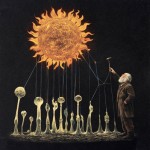
Artist: Taxology
Title: A Deep Dive In The Colourful And Mysterious Garden Of Mr. Taxology
Format: CD + Download
Label: NOS Records (@)
Rated:

Title: A Deep Dive In The Colourful And Mysterious Garden Of Mr. Taxology
Format: CD + Download
Label: NOS Records (@)
Rated:
There’s something mildly encouraging about two musicians barely out of high school deciding not to form yet another interchangeable indie-rock band about emotional confusion and cheap beer, but instead building a psychedelic concept album around botanical taxonomy, hypnagogic narration, and orchestral arrangements. Humanity occasionally stumbles into grace by accident.
Taxology’s debut, "A Deep Dive In The Colourful And Mysterious Garden Of Mr. Taxology", arrives with the kind of absurdly elaborate title that practically dares listeners to take it seriously. The surprising thing is that it earns that seriousness. Emerging from Taranto, the southern Italian duo of Andrea Rizzi and Giuseppe Bitonte construct an album that feels less like a conventional debut and more like a carefully cultivated ecosystem: a surreal greenhouse where progressive pop, psychedelic chamber music, cinematic spoken-word interludes, and faded dream logic all coexist under strange artificial sunlight.
The concept itself could have collapsed under its own decorative ambitions. Taxonomy as a metaphor for consciousness is exactly the sort of premise that can become unbearable after twelve minutes if handled without restraint. Yet Taxology avoid turning the record into a university lecture disguised as psychedelia. Instead, the scientific nomenclature becomes an organizing principle for mood and transformation. Tracks behave like living organisms, each possessing its own texture, temperature, and emotional metabolism. The garden is not ornamental. It breathes.
Musically, the album occupies a fascinating liminal space between vintage Italian progressive traditions and contemporary psych-pop sensibilities. One can hear faint echoes of the theatrical surrealism of Italian progressive rock from the 1970s, but filtered through a younger generation raised equally on streaming-era eclecticism, soundtrack culture, and bedroom-production intimacy. There are moments where the album seems to wander through abandoned libraries of library music, only to suddenly stumble into kaleidoscopic folk passages, dreamy orchestral detours, or grooves that briefly flirt with funk before dissolving into mist again.
The instrumentation deserves particular attention because it never feels included merely for prestige or ornament. Sitar, clarinet, flute, cello, timpani, viola, mandolin: these elements move through the album organically, like strange plants intertwining rather than guest appearances politely waiting for applause. Andrea Rizzi’s production is especially impressive given the home-studio context. The arrangements possess an expansive, almost cinematic depth without losing the handmade quality that keeps the album emotionally approachable. You can hear curiosity inside the production choices, which is increasingly rare in an era where so much “psychedelic” music sounds generated by algorithms trained exclusively on vintage pedal advertisements.
The narrated sections by Bruno Vergani function as portals more than explanations. They guide the listener without reducing the mystery. That restraint becomes one of the album’s strongest qualities: "A Deep Dive In The Colourful And Mysterious Garden Of Mr. Taxology" never fully explains itself because dreams do not issue instruction manuals. The listener is invited to drift through associations rather than decode hidden meanings like a bored detective in a prog-rock escape room.
Tracks such as “Mandragora Caulescens” and “Daphne Mezereum” reveal the duo’s talent for balancing melodic warmth with subtle disorientation. Elsewhere, pieces like “The Garden” and “Clara Lunaris” unfold with a cinematic patience that recalls the peculiar emotional logic of waking up from a vivid dream and temporarily forgetting which century you belong to. Even the shorter interstitial pieces contribute to the album’s architecture, creating the sensation of moving through rooms within a larger imagined structure.
What makes the record particularly compelling is its refusal to become cynical. Many contemporary psychedelic releases hide behind irony or retro fetishism, terrified of sincerity. Taxology instead embrace wonder openly, which is much harder and infinitely riskier. The album believes in imagination without needing to posture as “important”. That innocence, combined with the sophistication of the arrangements, gives the music a peculiar luminosity.
There is also something quietly moving about hearing such young musicians create work so unconcerned with immediacy or commercial pragmatism. These are compositions built around atmosphere, patience, symbolic resonance, and internal coherence. In an attention economy optimized for interruption, Taxology made an album that asks listeners to wander slowly through an imaginary garden and contemplate the possibility that classification itself might become poetry. A reckless decision, financially speaking. Artistically, however, it works remarkably well.
By the time “Pieris Japonica” closes the journey, the garden no longer feels imaginary at all. It has become psychological terrain: half sanctuary, half hallucination, populated by fragile melodies and shifting identities. "A Deep Dive In The Colourful And Mysterious Garden Of Mr. Taxology" is not merely an impressive debut. It is the sound of two young artists discovering that music can still function as world-building, ritual, and transformation rather than background decoration for scrolling through advertisements for ergonomic socks. A comforting thought, however temporary.
Taxology’s debut, "A Deep Dive In The Colourful And Mysterious Garden Of Mr. Taxology", arrives with the kind of absurdly elaborate title that practically dares listeners to take it seriously. The surprising thing is that it earns that seriousness. Emerging from Taranto, the southern Italian duo of Andrea Rizzi and Giuseppe Bitonte construct an album that feels less like a conventional debut and more like a carefully cultivated ecosystem: a surreal greenhouse where progressive pop, psychedelic chamber music, cinematic spoken-word interludes, and faded dream logic all coexist under strange artificial sunlight.
The concept itself could have collapsed under its own decorative ambitions. Taxonomy as a metaphor for consciousness is exactly the sort of premise that can become unbearable after twelve minutes if handled without restraint. Yet Taxology avoid turning the record into a university lecture disguised as psychedelia. Instead, the scientific nomenclature becomes an organizing principle for mood and transformation. Tracks behave like living organisms, each possessing its own texture, temperature, and emotional metabolism. The garden is not ornamental. It breathes.
Musically, the album occupies a fascinating liminal space between vintage Italian progressive traditions and contemporary psych-pop sensibilities. One can hear faint echoes of the theatrical surrealism of Italian progressive rock from the 1970s, but filtered through a younger generation raised equally on streaming-era eclecticism, soundtrack culture, and bedroom-production intimacy. There are moments where the album seems to wander through abandoned libraries of library music, only to suddenly stumble into kaleidoscopic folk passages, dreamy orchestral detours, or grooves that briefly flirt with funk before dissolving into mist again.
The instrumentation deserves particular attention because it never feels included merely for prestige or ornament. Sitar, clarinet, flute, cello, timpani, viola, mandolin: these elements move through the album organically, like strange plants intertwining rather than guest appearances politely waiting for applause. Andrea Rizzi’s production is especially impressive given the home-studio context. The arrangements possess an expansive, almost cinematic depth without losing the handmade quality that keeps the album emotionally approachable. You can hear curiosity inside the production choices, which is increasingly rare in an era where so much “psychedelic” music sounds generated by algorithms trained exclusively on vintage pedal advertisements.
The narrated sections by Bruno Vergani function as portals more than explanations. They guide the listener without reducing the mystery. That restraint becomes one of the album’s strongest qualities: "A Deep Dive In The Colourful And Mysterious Garden Of Mr. Taxology" never fully explains itself because dreams do not issue instruction manuals. The listener is invited to drift through associations rather than decode hidden meanings like a bored detective in a prog-rock escape room.
Tracks such as “Mandragora Caulescens” and “Daphne Mezereum” reveal the duo’s talent for balancing melodic warmth with subtle disorientation. Elsewhere, pieces like “The Garden” and “Clara Lunaris” unfold with a cinematic patience that recalls the peculiar emotional logic of waking up from a vivid dream and temporarily forgetting which century you belong to. Even the shorter interstitial pieces contribute to the album’s architecture, creating the sensation of moving through rooms within a larger imagined structure.
What makes the record particularly compelling is its refusal to become cynical. Many contemporary psychedelic releases hide behind irony or retro fetishism, terrified of sincerity. Taxology instead embrace wonder openly, which is much harder and infinitely riskier. The album believes in imagination without needing to posture as “important”. That innocence, combined with the sophistication of the arrangements, gives the music a peculiar luminosity.
There is also something quietly moving about hearing such young musicians create work so unconcerned with immediacy or commercial pragmatism. These are compositions built around atmosphere, patience, symbolic resonance, and internal coherence. In an attention economy optimized for interruption, Taxology made an album that asks listeners to wander slowly through an imaginary garden and contemplate the possibility that classification itself might become poetry. A reckless decision, financially speaking. Artistically, however, it works remarkably well.
By the time “Pieris Japonica” closes the journey, the garden no longer feels imaginary at all. It has become psychological terrain: half sanctuary, half hallucination, populated by fragile melodies and shifting identities. "A Deep Dive In The Colourful And Mysterious Garden Of Mr. Taxology" is not merely an impressive debut. It is the sound of two young artists discovering that music can still function as world-building, ritual, and transformation rather than background decoration for scrolling through advertisements for ergonomic socks. A comforting thought, however temporary.
Comments
Stream
Browse by Genre
Industrial Music / Industrial Metal / Aggro Industrial / Electro Metal
Industrial Noise / Power Noise / Harsh Noise
Synth Pop / Electro Pop / Synth-Electronica
Techno / Trance / Goa / Drum'n'Bass / Jungle / Tribal / Trip-Hop
Ambient / Electronica / Ethereal / Dub / Soundscapes / Abstract
Experimental / Avantgarde / Weird & Wired / Glitch / Noise / Field Recording
Dark / Gothic / Wave / New Wave / Dark Wave / Industrial Gothic
New Music / Downtown / Avantgarde Jazz / New Classical / World