
b.mez: Under Circuitous Skies
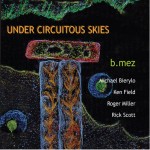
Artist: b.mez (http://birdsongsofthemesozoic.org/)
Title: Under Circuitous Skies
Format: Download Only (MP3 + Lossless)
Label: Cuneiform (http://www.cuneiformrecords.com/) (@)
Rated:

Title: Under Circuitous Skies
Format: Download Only (MP3 + Lossless)
Label: Cuneiform (http://www.cuneiformrecords.com/) (@)
Rated:
For musicians with roots in progressive composition, experimental rock, and contemporary chamber music, improvisation often functions as a side road: a place to stretch ideas before returning to the safety of structure. "Under Circuitous Skies", the latest release by b.mez, suggests a different possibility. Here, improvisation is not a detour. It is the destination itself, and the four musicians involved seem remarkably comfortable navigating without a map.
The project emerged from members of the long-running Boston collective Birdsongs of the Mesozoic, a group whose singular blend of rock energy, minimalist repetition, modern composition, and adventurous instrumentation has occupied a unique corner of American experimental music since the early 1980s. While Birdsongs largely developed through written material, Michael Bierylo, Ken Field, and Rick Scott gradually felt the need to explore what might happen when composition was removed from the equation. The result became b.mez, a laboratory for spontaneous creation that eventually welcomed back Roger Miller, Birdsongs co-founder and one of the most inventive figures to emerge from the American avant-rock underground.
The first surprise of "Under Circuitous Skies" is how little it resembles the common stereotypes of free improvisation. There are no endless displays of instrumental brinkmanship, no self-congratulatory chaos masquerading as freedom. Instead, the album unfolds with the patience of four experienced conversationalists who understand that listening is often more important than speaking.
The title track establishes this immediately. Sounds drift into existence rather than announcing themselves. Electronics, reeds, keyboards, and processed textures intermingle so naturally that identifying individual sources becomes largely irrelevant. What emerges is a living ecosystem rather than a collection of instrumental performances. The music appears to be discovering itself moment by moment, which is perhaps the highest compliment one can pay an improvised recording.
Throughout the album, the quartet displays a remarkable sense of proportion. "Salting the Clouds" condenses its ideas into a brief atmospheric sketch, while "Stratospheric" expands outward with slow, deliberate confidence. Elsewhere, "Cross Talk" feels appropriately named, not because the players compete for attention but because multiple streams of thought seem to intersect simultaneously, creating fleeting alignments before drifting apart again.
One of the most intriguing aspects of the record is its relationship with electronics. Despite extensive processing and looping, the music rarely feels technological in the conventional sense. The electronics do not impose order upon the performances; they behave more like weather systems. Sounds accumulate, erode, refract, and reappear. Human gestures remain visible beneath every layer of manipulation. It is electronic music that stubbornly refuses to become machine music.
Roger Miller's presence proves particularly significant. Decades of work with Mission of Burma, Birdsongs of the Mesozoic, and numerous experimental projects have given him a musical vocabulary that combines curiosity with restraint. His contributions never dominate the proceedings, yet his ability to destabilise a texture at precisely the right moment often pushes the music into unexpected territory.
The album's most memorable passages occur when abstraction and imagery briefly overlap. "Your Planet is as Good as Mine" unfolds like an interplanetary negotiation conducted entirely through sound, while "Prehistory Viewed from Above" closes the record with a curious sense of temporal dislocation. The title evokes geological distance, and the music follows suit, as if surveying vast stretches of time from an impossible vantage point. One imagines ancient landscapes observed by satellites that haven't yet been invented. Human beings, naturally, would probably use such technology to argue on social media.
What distinguishes "Under Circuitous Skies" from many contemporary improvisational releases is its refusal to settle into either serenity or confrontation. The music constantly negotiates between consonance and friction, familiarity and mystery. Moments of beauty emerge naturally, only to be interrupted by textures that complicate their meaning. Yet nothing feels arbitrary. Every gesture seems connected to an evolving collective logic that remains invisible but undeniable.
There is also a subtle sense of trust permeating the entire recording. Trust between musicians, certainly, but also trust in the listener. The quartet never rushes to explain itself. Themes are suggested rather than stated. Directions change without warning. Connections reveal themselves gradually. The album rewards attention not through dramatic revelations but through accumulation, the way a landscape becomes more interesting the longer one inhabits it.
Fittingly, "Under Circuitous Skies" feels less like a document of performances than a document of discovery. Over the course of three recording days, four seasoned improvisers created something that remains elusive without becoming obscure, sophisticated without becoming academic. The result is an album that treats uncertainty not as a problem to solve but as a condition worth exploring.
Beneath its wandering surfaces and shifting horizons lies a simple proposition: sometimes the most meaningful journeys are the ones undertaken without knowing exactly where they lead. Few records embody that principle with such intelligence, patience, and quiet wonder.
The project emerged from members of the long-running Boston collective Birdsongs of the Mesozoic, a group whose singular blend of rock energy, minimalist repetition, modern composition, and adventurous instrumentation has occupied a unique corner of American experimental music since the early 1980s. While Birdsongs largely developed through written material, Michael Bierylo, Ken Field, and Rick Scott gradually felt the need to explore what might happen when composition was removed from the equation. The result became b.mez, a laboratory for spontaneous creation that eventually welcomed back Roger Miller, Birdsongs co-founder and one of the most inventive figures to emerge from the American avant-rock underground.
The first surprise of "Under Circuitous Skies" is how little it resembles the common stereotypes of free improvisation. There are no endless displays of instrumental brinkmanship, no self-congratulatory chaos masquerading as freedom. Instead, the album unfolds with the patience of four experienced conversationalists who understand that listening is often more important than speaking.
The title track establishes this immediately. Sounds drift into existence rather than announcing themselves. Electronics, reeds, keyboards, and processed textures intermingle so naturally that identifying individual sources becomes largely irrelevant. What emerges is a living ecosystem rather than a collection of instrumental performances. The music appears to be discovering itself moment by moment, which is perhaps the highest compliment one can pay an improvised recording.
Throughout the album, the quartet displays a remarkable sense of proportion. "Salting the Clouds" condenses its ideas into a brief atmospheric sketch, while "Stratospheric" expands outward with slow, deliberate confidence. Elsewhere, "Cross Talk" feels appropriately named, not because the players compete for attention but because multiple streams of thought seem to intersect simultaneously, creating fleeting alignments before drifting apart again.
One of the most intriguing aspects of the record is its relationship with electronics. Despite extensive processing and looping, the music rarely feels technological in the conventional sense. The electronics do not impose order upon the performances; they behave more like weather systems. Sounds accumulate, erode, refract, and reappear. Human gestures remain visible beneath every layer of manipulation. It is electronic music that stubbornly refuses to become machine music.
Roger Miller's presence proves particularly significant. Decades of work with Mission of Burma, Birdsongs of the Mesozoic, and numerous experimental projects have given him a musical vocabulary that combines curiosity with restraint. His contributions never dominate the proceedings, yet his ability to destabilise a texture at precisely the right moment often pushes the music into unexpected territory.
The album's most memorable passages occur when abstraction and imagery briefly overlap. "Your Planet is as Good as Mine" unfolds like an interplanetary negotiation conducted entirely through sound, while "Prehistory Viewed from Above" closes the record with a curious sense of temporal dislocation. The title evokes geological distance, and the music follows suit, as if surveying vast stretches of time from an impossible vantage point. One imagines ancient landscapes observed by satellites that haven't yet been invented. Human beings, naturally, would probably use such technology to argue on social media.
What distinguishes "Under Circuitous Skies" from many contemporary improvisational releases is its refusal to settle into either serenity or confrontation. The music constantly negotiates between consonance and friction, familiarity and mystery. Moments of beauty emerge naturally, only to be interrupted by textures that complicate their meaning. Yet nothing feels arbitrary. Every gesture seems connected to an evolving collective logic that remains invisible but undeniable.
There is also a subtle sense of trust permeating the entire recording. Trust between musicians, certainly, but also trust in the listener. The quartet never rushes to explain itself. Themes are suggested rather than stated. Directions change without warning. Connections reveal themselves gradually. The album rewards attention not through dramatic revelations but through accumulation, the way a landscape becomes more interesting the longer one inhabits it.
Fittingly, "Under Circuitous Skies" feels less like a document of performances than a document of discovery. Over the course of three recording days, four seasoned improvisers created something that remains elusive without becoming obscure, sophisticated without becoming academic. The result is an album that treats uncertainty not as a problem to solve but as a condition worth exploring.
Beneath its wandering surfaces and shifting horizons lies a simple proposition: sometimes the most meaningful journeys are the ones undertaken without knowing exactly where they lead. Few records embody that principle with such intelligence, patience, and quiet wonder.
Comments
Stream
Browse by Genre
Industrial Music / Industrial Metal / Aggro Industrial / Electro Metal
Industrial Noise / Power Noise / Harsh Noise
Synth Pop / Electro Pop / Synth-Electronica
Techno / Trance / Goa / Drum'n'Bass / Jungle / Tribal / Trip-Hop
Ambient / Electronica / Ethereal / Dub / Soundscapes / Abstract
Experimental / Avantgarde / Weird & Wired / Glitch / Noise / Field Recording
Dark / Gothic / Wave / New Wave / Dark Wave / Industrial Gothic
New Music / Downtown / Avantgarde Jazz / New Classical / World