
Saturday, October 17, 2026
Emmanuel De La Paix: Chromaverse (and human structures)
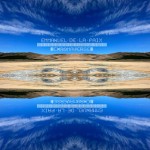
Artist: Emmanuel De La Paix (@)
Title: Chromaverse (and human structures)
Format: Download Only (MP3 + Lossless)
Label: Broque (@)
Rated:

Title: Chromaverse (and human structures)
Format: Download Only (MP3 + Lossless)
Label: Broque (@)
Rated:
Some albums invite the listener into a landscape. Others build a house. Emmanuel De La Paix's "Chromaverse (and human structures)" does something stranger: it constructs an entire complex of interconnected rooms, hands you a key of uncertain origin, and quietly disappears before explaining the floor plan.
Released on the ever-curious Broque imprint, the album unfolds as a continuous sixty-minute arc divided into fourteen interconnected pieces. While many ambient works employ the language of journeys, De La Paix seems more interested in architecture. Not architecture as engineering, but architecture as psychology: the invisible structures people build inside themselves to house memories, fears, desires, and the occasional irrational attachment to objects they haven't used since 2014 but might need someday.
The concept is deceptively simple. Each composition corresponds to a numbered room inspired by the vocabulary of horror cinema. Yet this is not horror in the conventional sense. There are no jump scares, no monsters emerging from sonic closets. Instead, the album explores a subtler form of unease: the feeling of entering an unfamiliar space and sensing that something has already happened there, though you cannot determine what.
From the opening "Sound Room - 014", De La Paix establishes a delicate balance between presence and absence. The textures seem almost suspended in midair, barely touching the ground. Tiny details emerge at the edge of perception, encouraging attentive listening without demanding it. The influence of artists such as múm, Sigur Rós, Radiohead, and Björk can certainly be detected, particularly in the album's willingness to treat atmosphere as a primary compositional tool rather than mere decoration. Yet the record avoids becoming derivative by pursuing its own peculiar internal logic.
The early pieces move with remarkable restraint. "Studio 2 Noise - 023" and "Wave Room - 069" feel like explorations of empty corridors, where every sound acquires significance simply because there are so few of them. The listener becomes aware of minute shifts in texture, much as one notices tiny changes in light when sitting alone in a quiet room for longer than modern life typically permits.
As the album progresses, density begins to accumulate. "Bright Lava" and "Synth Mode - 216" mark a turning point where the previously sparse environments acquire weight and momentum. Analog synthesizers swell against digital manipulations, while distorted rhythmic elements appear like structural stress fractures running through the building. The contrast between fragility and force becomes increasingly central.
One of the record's most intriguing qualities is its refusal to separate beauty from uncertainty. Even at its most turbulent, the music remains oddly inviting. "Joylato (3 Gusti)" - a title that sounds either delightfully whimsical or suspiciously like an ice cream order placed during an existential crisis - introduces an unexpected warmth amid the album's more introspective passages. Such moments prevent the conceptual framework from becoming oppressive.
The central section, particularly "Day One - 3120" and "Shif Cargo - 14579", reveals De La Paix's skill as a long-form architect. Rather than relying on dramatic climaxes, he allows tensions to accumulate gradually through subtle modifications of timbre and spatial depth. The listener often realizes a transformation has occurred only after it is already complete.
By the time "Doom Room - 304" arrives, the album reaches its emotional nadir. Yet even here, the darkness feels contemplative rather than threatening. The room is haunted less by external forces than by the traces of human presence itself. De La Paix seems fascinated by the way spaces retain emotional residue, how walls become repositories of invisible histories.
The closing sequence, culminating in "Summer Terrace - 1408", provides neither resolution nor escape. Instead, it offers something more valuable: perspective. The turbulence subsides, textures become lighter, and the architecture begins to dissolve. One leaves not because the journey is finished, but because the building has quietly transformed into open sky.
What makes "Chromaverse (and human structures)" particularly successful is its understanding of scale. Despite its ambient foundations, the album never drifts into passive background music. Every sound appears carefully positioned within an evolving structure, every transition serving the larger design. De La Paix demonstrates a mature grasp of pacing, allowing silence, tension, and release to coexist without competing for attention.
In the end, the record functions as a meditation on interiority itself. The "human structures" of the title are not merely buildings, rooms, or conceptual frameworks. They are the emotional architectures through which we navigate existence. Some are sturdy. Some are temporary. Some contain locked doors we avoid opening.
"Chromaverse (and human structures)" wanders through all of them with patience, curiosity, and a quiet sense of wonder. It reminds us that the most mysterious rooms are rarely abandoned houses or cinematic nightmares. More often, they are the ones we carry around inside us every day.
Released on the ever-curious Broque imprint, the album unfolds as a continuous sixty-minute arc divided into fourteen interconnected pieces. While many ambient works employ the language of journeys, De La Paix seems more interested in architecture. Not architecture as engineering, but architecture as psychology: the invisible structures people build inside themselves to house memories, fears, desires, and the occasional irrational attachment to objects they haven't used since 2014 but might need someday.
The concept is deceptively simple. Each composition corresponds to a numbered room inspired by the vocabulary of horror cinema. Yet this is not horror in the conventional sense. There are no jump scares, no monsters emerging from sonic closets. Instead, the album explores a subtler form of unease: the feeling of entering an unfamiliar space and sensing that something has already happened there, though you cannot determine what.
From the opening "Sound Room - 014", De La Paix establishes a delicate balance between presence and absence. The textures seem almost suspended in midair, barely touching the ground. Tiny details emerge at the edge of perception, encouraging attentive listening without demanding it. The influence of artists such as múm, Sigur Rós, Radiohead, and Björk can certainly be detected, particularly in the album's willingness to treat atmosphere as a primary compositional tool rather than mere decoration. Yet the record avoids becoming derivative by pursuing its own peculiar internal logic.
The early pieces move with remarkable restraint. "Studio 2 Noise - 023" and "Wave Room - 069" feel like explorations of empty corridors, where every sound acquires significance simply because there are so few of them. The listener becomes aware of minute shifts in texture, much as one notices tiny changes in light when sitting alone in a quiet room for longer than modern life typically permits.
As the album progresses, density begins to accumulate. "Bright Lava" and "Synth Mode - 216" mark a turning point where the previously sparse environments acquire weight and momentum. Analog synthesizers swell against digital manipulations, while distorted rhythmic elements appear like structural stress fractures running through the building. The contrast between fragility and force becomes increasingly central.
One of the record's most intriguing qualities is its refusal to separate beauty from uncertainty. Even at its most turbulent, the music remains oddly inviting. "Joylato (3 Gusti)" - a title that sounds either delightfully whimsical or suspiciously like an ice cream order placed during an existential crisis - introduces an unexpected warmth amid the album's more introspective passages. Such moments prevent the conceptual framework from becoming oppressive.
The central section, particularly "Day One - 3120" and "Shif Cargo - 14579", reveals De La Paix's skill as a long-form architect. Rather than relying on dramatic climaxes, he allows tensions to accumulate gradually through subtle modifications of timbre and spatial depth. The listener often realizes a transformation has occurred only after it is already complete.
By the time "Doom Room - 304" arrives, the album reaches its emotional nadir. Yet even here, the darkness feels contemplative rather than threatening. The room is haunted less by external forces than by the traces of human presence itself. De La Paix seems fascinated by the way spaces retain emotional residue, how walls become repositories of invisible histories.
The closing sequence, culminating in "Summer Terrace - 1408", provides neither resolution nor escape. Instead, it offers something more valuable: perspective. The turbulence subsides, textures become lighter, and the architecture begins to dissolve. One leaves not because the journey is finished, but because the building has quietly transformed into open sky.
What makes "Chromaverse (and human structures)" particularly successful is its understanding of scale. Despite its ambient foundations, the album never drifts into passive background music. Every sound appears carefully positioned within an evolving structure, every transition serving the larger design. De La Paix demonstrates a mature grasp of pacing, allowing silence, tension, and release to coexist without competing for attention.
In the end, the record functions as a meditation on interiority itself. The "human structures" of the title are not merely buildings, rooms, or conceptual frameworks. They are the emotional architectures through which we navigate existence. Some are sturdy. Some are temporary. Some contain locked doors we avoid opening.
"Chromaverse (and human structures)" wanders through all of them with patience, curiosity, and a quiet sense of wonder. It reminds us that the most mysterious rooms are rarely abandoned houses or cinematic nightmares. More often, they are the ones we carry around inside us every day.
Comments
Stream
Browse by Genre
Industrial Music / Industrial Metal / Aggro Industrial / Electro Metal
Industrial Noise / Power Noise / Harsh Noise
Synth Pop / Electro Pop / Synth-Electronica
Techno / Trance / Goa / Drum'n'Bass / Jungle / Tribal / Trip-Hop
Ambient / Electronica / Ethereal / Dub / Soundscapes / Abstract
Experimental / Avantgarde / Weird & Wired / Glitch / Noise / Field Recording
Dark / Gothic / Wave / New Wave / Dark Wave / Industrial Gothic
New Music / Downtown / Avantgarde Jazz / New Classical / World