
Saturday, August 29, 2026
Vidna Obmana: Twilight of Perception Redux: Volume Three 1996-2006
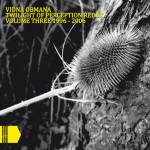
Artist: Vidna Obmana
Title: Twilight of Perception Redux: Volume Three 1996-2006
Format: CD x 3 (triple CD)
Label: Zoharum (http://zoharum.com/) (@)
Rated:

Title: Twilight of Perception Redux: Volume Three 1996-2006
Format: CD x 3 (triple CD)
Label: Zoharum (http://zoharum.com/) (@)
Rated:
Some artists release archives because history demands organization. Others release archives because there are still treasures hidden in the attic. Dirk Serries, operating under the enduring banner of Vidna Obmana, belongs firmly to the latter category. Listening to "Twilight of Perception Redux: Volume Three 1996-2006" feels less like opening a box of leftovers and more like discovering an entire wing of a museum that somehow escaped public attention for two decades.
For those familiar with ambient music's deeper currents, Serries requires little introduction. Since the 1980s, the Belgian composer has occupied a singular position within experimental music, moving effortlessly between dark ambient, drone, electro-acoustic improvisation, minimalist abstraction, and countless collaborative ventures. While many artists spend a career refining a recognizable signature, Serries has often behaved more like an explorer mapping unknown territories, abandoning established routes as soon as they become comfortable.
This third volume in the "Twilight of Perception Redux" series gathers material created between 1996 and 2006, a particularly fertile period in the Vidna Obmana chronology. Eighteen tracks spread across three discs offer not merely a collection of rarities but an alternative history of an artist constantly refining his relationship with atmosphere, texture, and sonic architecture. Thirteen of these pieces were previously unreleased, while the remaining works originally appeared on obscure compilations or limited releases long since absorbed into the collector's marketplace, that peculiar ecosystem where CDs occasionally become more expensive than the equipment needed to play them.
What immediately emerges is the remarkable coherence of the material. Collections of archival recordings often reveal why certain tracks remained unreleased. Here, the opposite occurs. One repeatedly wonders how pieces of this quality managed to remain hidden for so long.
The opening sequence establishes many of the characteristics that made Vidna Obmana such a distinctive voice within ambient music. "Majestic Trip" unfolds with patient grandeur, while "Mechanical Blow" introduces subtle tensions between organic resonance and technological presence. Throughout the compilation, Serries demonstrates an uncommon ability to create environments that feel simultaneously earthly and extraterrestrial. These are not simply ambient backdrops. They are inhabited spaces, alive with movement, memory, and suggestion.
What distinguished Vidna Obmana from many of his contemporaries was his refusal to rely exclusively on synthesizers. Across these recordings, one encounters overtone flutes, fujara, percussion, processed voices, rhythmic fragments, and countless abstract mutations woven into the fabric of the compositions. The result often resembles an imagined anthropology of impossible civilizations. One can almost picture archaeologists from another galaxy carefully excavating evidence of rituals humanity never actually performed.
Long-form pieces such as "Intersection" and "Threshold Of Obstruction" demonstrate Serries' mastery of duration. Rather than moving toward obvious climaxes, these works evolve through gradual transformations, allowing tiny shifts in timbre and density to become meaningful events. Time behaves differently inside these compositions. Minutes cease functioning as measurements and instead become landscapes through which the listener slowly travels.
The period covered by this compilation was also one during which ambient music was undergoing significant transformation. The genre was expanding beyond its early definitions, absorbing influences from industrial music, world music, field recordings, and experimental electronics. Vidna Obmana stood at the crossroads of these developments without ever appearing eager to join any particular movement. There is an independence to these recordings that remains striking today. They neither chase trends nor react against them. They simply exist according to their own internal logic.
Tracks such as "Travelworld", "Totems", and "Temple" reveal another dimension of Serries' artistry: his ability to evoke spiritual resonance without resorting to easy mysticism. These compositions possess a ceremonial quality, yet they avoid the clichés that often plague music attempting to sound transcendent. Nothing here feels decorative. The atmosphere emerges naturally from the interaction of sound, space, and silence.
Perhaps the most fascinating aspect of "Twilight of Perception Redux: Volume Three" is how contemporary it feels. Despite originating from recordings made between 1996 and 2006, the material remains astonishingly fresh. Modern drone, ambient, and sound-art practitioners continue exploring territories that Serries was already navigating decades ago. Listening to these tracks today is a reminder that innovation often occurs quietly, without demanding attention, patiently waiting for future generations to catch up.
The remastering undertaken by Serries himself enhances the collection without sacrificing its original character. The sound remains immersive, detailed, and spacious, allowing the subtle complexities of the recordings to fully emerge. Combined with the extensive commentary and elegant presentation from Zoharum, this release functions both as an archival document and as a rewarding standalone experience.
Ultimately, "Twilight of Perception Redux: Volume Three 1996-2006" succeeds because it transcends the limitations often associated with retrospective collections. Rather than merely preserving the past, it reactivates it. These recordings do not feel like historical artifacts sealed behind glass. They breathe. They wander. They continue asking questions.
And perhaps that is the enduring achievement of Vidna Obmana. While much ambient music seeks to calm the mind, Serries has always seemed more interested in expanding it, opening small doorways into unfamiliar territories and inviting us to step through. Some doors lead to beautiful places. Others lead somewhere stranger. The wisest response is probably the same in either case: keep listening.
For those familiar with ambient music's deeper currents, Serries requires little introduction. Since the 1980s, the Belgian composer has occupied a singular position within experimental music, moving effortlessly between dark ambient, drone, electro-acoustic improvisation, minimalist abstraction, and countless collaborative ventures. While many artists spend a career refining a recognizable signature, Serries has often behaved more like an explorer mapping unknown territories, abandoning established routes as soon as they become comfortable.
This third volume in the "Twilight of Perception Redux" series gathers material created between 1996 and 2006, a particularly fertile period in the Vidna Obmana chronology. Eighteen tracks spread across three discs offer not merely a collection of rarities but an alternative history of an artist constantly refining his relationship with atmosphere, texture, and sonic architecture. Thirteen of these pieces were previously unreleased, while the remaining works originally appeared on obscure compilations or limited releases long since absorbed into the collector's marketplace, that peculiar ecosystem where CDs occasionally become more expensive than the equipment needed to play them.
What immediately emerges is the remarkable coherence of the material. Collections of archival recordings often reveal why certain tracks remained unreleased. Here, the opposite occurs. One repeatedly wonders how pieces of this quality managed to remain hidden for so long.
The opening sequence establishes many of the characteristics that made Vidna Obmana such a distinctive voice within ambient music. "Majestic Trip" unfolds with patient grandeur, while "Mechanical Blow" introduces subtle tensions between organic resonance and technological presence. Throughout the compilation, Serries demonstrates an uncommon ability to create environments that feel simultaneously earthly and extraterrestrial. These are not simply ambient backdrops. They are inhabited spaces, alive with movement, memory, and suggestion.
What distinguished Vidna Obmana from many of his contemporaries was his refusal to rely exclusively on synthesizers. Across these recordings, one encounters overtone flutes, fujara, percussion, processed voices, rhythmic fragments, and countless abstract mutations woven into the fabric of the compositions. The result often resembles an imagined anthropology of impossible civilizations. One can almost picture archaeologists from another galaxy carefully excavating evidence of rituals humanity never actually performed.
Long-form pieces such as "Intersection" and "Threshold Of Obstruction" demonstrate Serries' mastery of duration. Rather than moving toward obvious climaxes, these works evolve through gradual transformations, allowing tiny shifts in timbre and density to become meaningful events. Time behaves differently inside these compositions. Minutes cease functioning as measurements and instead become landscapes through which the listener slowly travels.
The period covered by this compilation was also one during which ambient music was undergoing significant transformation. The genre was expanding beyond its early definitions, absorbing influences from industrial music, world music, field recordings, and experimental electronics. Vidna Obmana stood at the crossroads of these developments without ever appearing eager to join any particular movement. There is an independence to these recordings that remains striking today. They neither chase trends nor react against them. They simply exist according to their own internal logic.
Tracks such as "Travelworld", "Totems", and "Temple" reveal another dimension of Serries' artistry: his ability to evoke spiritual resonance without resorting to easy mysticism. These compositions possess a ceremonial quality, yet they avoid the clichés that often plague music attempting to sound transcendent. Nothing here feels decorative. The atmosphere emerges naturally from the interaction of sound, space, and silence.
Perhaps the most fascinating aspect of "Twilight of Perception Redux: Volume Three" is how contemporary it feels. Despite originating from recordings made between 1996 and 2006, the material remains astonishingly fresh. Modern drone, ambient, and sound-art practitioners continue exploring territories that Serries was already navigating decades ago. Listening to these tracks today is a reminder that innovation often occurs quietly, without demanding attention, patiently waiting for future generations to catch up.
The remastering undertaken by Serries himself enhances the collection without sacrificing its original character. The sound remains immersive, detailed, and spacious, allowing the subtle complexities of the recordings to fully emerge. Combined with the extensive commentary and elegant presentation from Zoharum, this release functions both as an archival document and as a rewarding standalone experience.
Ultimately, "Twilight of Perception Redux: Volume Three 1996-2006" succeeds because it transcends the limitations often associated with retrospective collections. Rather than merely preserving the past, it reactivates it. These recordings do not feel like historical artifacts sealed behind glass. They breathe. They wander. They continue asking questions.
And perhaps that is the enduring achievement of Vidna Obmana. While much ambient music seeks to calm the mind, Serries has always seemed more interested in expanding it, opening small doorways into unfamiliar territories and inviting us to step through. Some doors lead to beautiful places. Others lead somewhere stranger. The wisest response is probably the same in either case: keep listening.
Comments
Stream
Browse by Genre
Industrial Music / Industrial Metal / Aggro Industrial / Electro Metal
Industrial Noise / Power Noise / Harsh Noise
Synth Pop / Electro Pop / Synth-Electronica
Techno / Trance / Goa / Drum'n'Bass / Jungle / Tribal / Trip-Hop
Ambient / Electronica / Ethereal / Dub / Soundscapes / Abstract
Experimental / Avantgarde / Weird & Wired / Glitch / Noise / Field Recording
Dark / Gothic / Wave / New Wave / Dark Wave / Industrial Gothic
New Music / Downtown / Avantgarde Jazz / New Classical / World