
Wednesday, November 18, 2026
Fauna: Taiga Trans
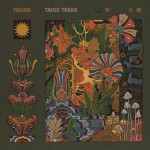


Some albums invite the listener into a room. Others open a window onto a landscape. "Taiga Trans", the debut full-length from Gothenburg collective Fauna, feels more like stumbling upon a gathering deep inside a forest where nobody bothers explaining what is happening because explanation would only ruin it. There are drums. There is dancing. There may be a ritual underway. There is certainly a flute. Beyond that, certainty becomes negotiable.
Fauna arrive carrying an unusually rich cultural baggage, though they wear it lightly. Emerging from Sweden's fertile underground scene, the collective brings together musicians with roots stretching across Syria, Turkey, France, Finland, Poland, and Sweden. In lesser hands, such diversity might become a marketing slogan. Here it becomes a living process. The music does not present itself as a fusion of traditions so much as a place where traditions have forgotten where they came from and started building something new together.
The band's origins lie in informal jam sessions between guitarist Tommie Ek and bassist Ibrahim Shabo, two musicians who had spent years operating within more conventional rock settings. Eventually they reached that familiar point in a creative life where established formulas begin to feel like well-furnished cages. The answer was experimentation: hand drums, unusual guitar sounds, repetition, improvisation, and a gradual opening of the musical doors to a larger community of like-minded explorers.
The result is "Taiga Trans", an album that occupies a fascinating space between psychedelic rock, krautrock, folk traditions, acid house, trance music, and something much older than any of those categories. Listening to it often feels like hearing several centuries of musical history negotiating a temporary peace treaty.
The opening "Bland stenar" immediately establishes Fauna's method. A saz introduces a taut melodic framework while percussion and bass begin assembling a groove sturdy enough to survive minor geological events. Electric guitars enter less as lead instruments than as weather systems. The track moves forward with the patient inevitability of roots finding cracks in stone. There is propulsion, but not urgency. The music trusts repetition to reveal its secrets gradually.
This faith in repetition links Fauna to a lineage stretching from the motorik experiments of German kosmische music to traditional trance practices found across multiple cultures. Yet the band avoids nostalgia. The rhythms may be ancient in spirit, but the production feels unmistakably contemporary. Electronic textures drift through the arrangements like invisible currents, subtly reshaping the landscape.
"En munfull sand" and "Dunans torka" deepen this approach. Layers of percussion interlock with hypnotic bass figures while voices emerge and disappear within the mix. Shabo's multilingual lyrics, delivered alongside Alexandra Shahbo and flautist Fauna Buvat, function less as narrative vehicles than as additional textures. Language becomes rhythm. Meaning dissolves into atmosphere. Anyone hoping for clear semantic explanations may need to consult a different department of human activity.
One of the album's most impressive achievements is its handling of tension. Many trance-oriented records rely on predictable cycles of build and release. Fauna prefer subtler methods. "Bland trÄden", one of the album's longest pieces, evolves through incremental shifts so gradual that one barely notices the transformation until suddenly realizing they have arrived somewhere entirely different. The experience resembles walking through a forest and discovering that dusk has arrived without announcing itself.
The instrumental colours deserve special mention. Buvat's flute often serves as the album's secret weapon, weaving through the dense rhythmic structures with an elegance that recalls both ancient folk traditions and contemporary experimental music. The darbuka and saz bring textures rarely encountered in modern psychedelic rock, while never feeling ornamental. These instruments are not exotic decorations; they are fundamental voices within the conversation.
"Boreala Ändlösheten" acts as a brief atmospheric pivot before "Du ska få se" introduces one of the record's most overtly dance-oriented moments. Here, the group's fascination with techno and rave culture surfaces most clearly. Yet even at its most club-adjacent, the music retains an earthy quality. This is dance music for people who occasionally stop dancing to stare thoughtfully at moss.
That moss receives its own frozen monument in "Frusen mossa", a track that perfectly captures the album's strange balance of movement and stillness. The groove remains hypnotic, but there is also a contemplative dimension, a sense that the repetition is designed not merely to energise but to alter perception itself.
The closing "Blodröda rubiner" serves as a fitting culmination. Nearly eight minutes long, it gathers many of the album's recurring themes into a final ecstatic procession. Voices, percussion, guitars, and electronics converge into something that feels simultaneously ancient and futuristic. One can imagine the track being played around a campfire, inside a warehouse, or during some post-apocalyptic harvest festival. It would probably work in all three situations.
What ultimately distinguishes "Taiga Trans" is its sincerity. In an era where genre-crossing often arrives packaged as calculated eclecticism, Fauna sound genuinely committed to exploration. Their music emerges from curiosity rather than strategy. The collective nature of the project reinforces this impression. No single voice dominates. The album feels less like a statement from individual musicians than the document of a community discovering itself in real time.
There is also something quietly hopeful in the record's construction. Here are musicians from different cultural backgrounds creating a shared musical language without erasing their differences. The result is neither utopian fantasy nor political manifesto. It is simply evidence that collaboration remains one of humanity's more productive habits, despite centuries of contradictory evidence.
By the end of "Taiga Trans", the listener may not know exactly where they have been. Somewhere between forest and dancefloor, between ritual and rave, between memory and invention. Fortunately, certainty was never the point. Fauna are interested in transport rather than destination.
And for forty-three remarkable minutes, they make getting lost feel like a perfectly reasonable plan.
Comments
Stream
Browse by Genre
Industrial Music / Industrial Metal / Aggro Industrial / Electro Metal
Industrial Noise / Power Noise / Harsh Noise
Synth Pop / Electro Pop / Synth-Electronica
Techno / Trance / Goa / Drum'n'Bass / Jungle / Tribal / Trip-Hop
Ambient / Electronica / Ethereal / Dub / Soundscapes / Abstract
Experimental / Avantgarde / Weird & Wired / Glitch / Noise / Field Recording
Dark / Gothic / Wave / New Wave / Dark Wave / Industrial Gothic
New Music / Downtown / Avantgarde Jazz / New Classical / World