
Rapoon: :COLD WAR : drum'n'bass:
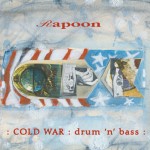


Some anniversaries are celebrated with nostalgia. Others return like unfinished business. Twenty-five years after "Cold War" first emerged from Robin Storey's inexhaustible imagination, its expanded resurrection feels less like an archival curiosity than an uncomfortable reminder that history possesses an alarming talent for recycling itself. Humanity, apparently convinced that every generation deserves its own geopolitical anxiety, continues to insist on sequels no one requested.
Since the late 1980s, following his departure from the pioneering industrial collective Zoviet France, Robin Storey has built Rapoon into one of experimental music's richest and most idiosyncratic universes. Rather than embracing the rigid aesthetics of industrial or ambient music, he developed an approach where looping structures, ethnographic echoes, ritual percussion and electronic manipulation coexist without hierarchy. His albums often resemble imagined geographies, places assembled from memory, myth and radio interference rather than any recognizable map.
Originally released in 2001, "Cold War" was something of an anomaly even within Rapoon's sprawling catalogue. At a time when drum'n'bass had already matured beyond its explosive beginnings, Storey appropriated its vocabulary without becoming indebted to it. The fractured breakbeats, muscular basslines and restless momentum never aimed for club functionality. Instead, they became another layer within his long-standing fascination with repetition, trance and cultural cross-pollination. Jungle rhythms collide with Middle Eastern melodic fragments, looping vocal traces and drifting atmospheres until genre itself becomes almost irrelevant.
Listening today, the original two discs remain remarkably resistant to dating. Tracks such as "Lunarists In The Jungle", "White Silence" or "Rubicon" unfold like unstable ecosystems where rhythm functions less as propulsion than as gravity. Beats constantly threaten to dominate before dissolving into clouds of processed voices, tribal percussion or ghostly drones. Every composition appears to negotiate between movement and suspension, refusing either complete stillness or straightforward momentum.
Storey's production remains wonderfully imperfect by contemporary standards. Rather than the immaculate precision that now defines so much electronic music, these pieces breathe through accumulated texture. Loops rub against one another, frequencies blur at the edges, and details emerge almost accidentally after repeated listens. The music feels assembled by sedimentation rather than engineering, each layer preserving traces of previous ones beneath its surface.
The newly added third disc avoids the common trap of anniversary editions becoming museum exhibitions. Rather than polishing old material into modern gloss, these reinterpretations extend the original ideas into today's fractured political landscape. "Another Thing Again" immediately establishes a broader, darker scale, while "Descended Across Europe" and "The Bomb Doors Are Open" resonate with an unease that contemporary listeners hardly need explained. Their power lies precisely in avoiding explicit commentary. Storey has always understood that suggestion ages far better than slogans.
One of Rapoon's greatest strengths has always been its ability to absorb influences without displaying them like collector's trophies. Dub, industrial, world music, ambient, techno, musique concrète and ritual percussion all appear throughout ":COLD WAR : drum'n'bass:", yet none remain in their original form. Everything passes through Storey's peculiar compositional metabolism until it belongs entirely to the Rapoon vocabulary.
There is also an understated sense of irony running beneath the record. Titles like "You've Been A Great Contestant...You've Won Nothing" or "The Soviet Pants" introduce flashes of absurd humour into an otherwise serious landscape. They serve as subtle reminders that political systems, ideologies and historical narratives often collapse under the weight of their own theatricality. Even catastrophe occasionally wears ill-fitting trousers.
What makes this expanded edition particularly valuable is that it highlights how prophetic Rapoon often appeared without ever attempting prophecy. Storey was never interested in predicting specific events. Instead, he explored recurring emotional climates: tension, displacement, uncertainty, resilience. Those conditions unfortunately remain as contemporary as ever.
Far from functioning as a nostalgic reissue, ":COLD WAR : drum'n'bass:" reveals an artist whose experiments have quietly outlived many of the genres they once intersected. Twenty-five years later, the rhythms still pulse with nervous energy, the atmospheres remain richly enigmatic, and the questions linger unresolved. The Cold War may have officially ended decades ago. Rapoon gently reminds us that the psychological climate surrounding it never really packed its bags.
Since the late 1980s, following his departure from the pioneering industrial collective Zoviet France, Robin Storey has built Rapoon into one of experimental music's richest and most idiosyncratic universes. Rather than embracing the rigid aesthetics of industrial or ambient music, he developed an approach where looping structures, ethnographic echoes, ritual percussion and electronic manipulation coexist without hierarchy. His albums often resemble imagined geographies, places assembled from memory, myth and radio interference rather than any recognizable map.
Originally released in 2001, "Cold War" was something of an anomaly even within Rapoon's sprawling catalogue. At a time when drum'n'bass had already matured beyond its explosive beginnings, Storey appropriated its vocabulary without becoming indebted to it. The fractured breakbeats, muscular basslines and restless momentum never aimed for club functionality. Instead, they became another layer within his long-standing fascination with repetition, trance and cultural cross-pollination. Jungle rhythms collide with Middle Eastern melodic fragments, looping vocal traces and drifting atmospheres until genre itself becomes almost irrelevant.
Listening today, the original two discs remain remarkably resistant to dating. Tracks such as "Lunarists In The Jungle", "White Silence" or "Rubicon" unfold like unstable ecosystems where rhythm functions less as propulsion than as gravity. Beats constantly threaten to dominate before dissolving into clouds of processed voices, tribal percussion or ghostly drones. Every composition appears to negotiate between movement and suspension, refusing either complete stillness or straightforward momentum.
Storey's production remains wonderfully imperfect by contemporary standards. Rather than the immaculate precision that now defines so much electronic music, these pieces breathe through accumulated texture. Loops rub against one another, frequencies blur at the edges, and details emerge almost accidentally after repeated listens. The music feels assembled by sedimentation rather than engineering, each layer preserving traces of previous ones beneath its surface.
The newly added third disc avoids the common trap of anniversary editions becoming museum exhibitions. Rather than polishing old material into modern gloss, these reinterpretations extend the original ideas into today's fractured political landscape. "Another Thing Again" immediately establishes a broader, darker scale, while "Descended Across Europe" and "The Bomb Doors Are Open" resonate with an unease that contemporary listeners hardly need explained. Their power lies precisely in avoiding explicit commentary. Storey has always understood that suggestion ages far better than slogans.
One of Rapoon's greatest strengths has always been its ability to absorb influences without displaying them like collector's trophies. Dub, industrial, world music, ambient, techno, musique concrète and ritual percussion all appear throughout ":COLD WAR : drum'n'bass:", yet none remain in their original form. Everything passes through Storey's peculiar compositional metabolism until it belongs entirely to the Rapoon vocabulary.
There is also an understated sense of irony running beneath the record. Titles like "You've Been A Great Contestant...You've Won Nothing" or "The Soviet Pants" introduce flashes of absurd humour into an otherwise serious landscape. They serve as subtle reminders that political systems, ideologies and historical narratives often collapse under the weight of their own theatricality. Even catastrophe occasionally wears ill-fitting trousers.
What makes this expanded edition particularly valuable is that it highlights how prophetic Rapoon often appeared without ever attempting prophecy. Storey was never interested in predicting specific events. Instead, he explored recurring emotional climates: tension, displacement, uncertainty, resilience. Those conditions unfortunately remain as contemporary as ever.
Far from functioning as a nostalgic reissue, ":COLD WAR : drum'n'bass:" reveals an artist whose experiments have quietly outlived many of the genres they once intersected. Twenty-five years later, the rhythms still pulse with nervous energy, the atmospheres remain richly enigmatic, and the questions linger unresolved. The Cold War may have officially ended decades ago. Rapoon gently reminds us that the psychological climate surrounding it never really packed its bags.
Comments
Stream
Browse by Genre
Industrial Music / Industrial Metal / Aggro Industrial / Electro Metal
Industrial Noise / Power Noise / Harsh Noise
Synth Pop / Electro Pop / Synth-Electronica
Techno / Trance / Goa / Drum'n'Bass / Jungle / Tribal / Trip-Hop
Ambient / Electronica / Ethereal / Dub / Soundscapes / Abstract
Experimental / Avantgarde / Weird & Wired / Glitch / Noise / Field Recording
Dark / Gothic / Wave / New Wave / Dark Wave / Industrial Gothic
New Music / Downtown / Avantgarde Jazz / New Classical / World