
Tuesday, October 20, 2026
Réka Csiszér & Radwan Ghazi Moumneh: Le Révélateur
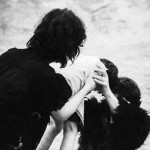
Artist: Réka Csiszér & Radwan Ghazi Moumneh (@)
Title: Le Révélateur
Format: LP
Label: Asadun Alay Records (@)
Rated:

Title: Le Révélateur
Format: LP
Label: Asadun Alay Records (@)
Rated:
Le Révélateur is not a soundtrack in the conventional sense, but a shared breathing space between Réka Csiszér and Radwan Ghazi Moumneh and Philippe Garrel’s 1968 silent film. It doesn’t accompany the image; it behaves like a second current running underneath it, occasionally surfacing, occasionally swallowing it.
The film itself is built on absence - dialogue stripped away, narrative reduced to a wandering child and parents moving through a desolate landscape. Csiszér and Moumneh respond by refusing anything that would “fill” that absence. Instead, they extend it, making it audible. Both artists are already fluent in unstable sonic languages. Moumneh, through Jerusalem In My Heart, has long worked at the intersection of electronics, voice, and Middle Eastern instrumental traditions, often allowing friction and fragility to remain audible rather than corrected. Csiszér, across projects like VÍZ, approaches voice and composition as shifting material states - something closer to weather than statement. In combination, nothing settles into a single identity. Everything remains slightly in negotiation.
The instrumentation - cello, buzuq, rababa, voice, electronics, and field recordings - functions less as ensemble and more as a shifting ecosystem. Nothing stabilizes for long. Strings don’t resolve into harmony so much as hover, tense and exposed. Electronics don’t build atmosphere in a cinematic sense; they fracture it into unstable layers. Voice appears not as narration but as fragile emergence, often dissolving into texture before it can settle into meaning.
What’s central here is not fusion but friction. Each element retains its identity just long enough to be recognisable, then drifts into something less fixed. This creates a listening experience that mirrors the film’s emotional condition: movement without arrival, presence without certainty, continuity without resolution.
The connection to Garrel’s work is not illustrative. There are no musical “translations” of scenes, no thematic cues. Instead, the music inhabits the same psychological weather: disorientation, suspended threat, and a persistent sense that something is always about to be revealed but never quite is.
The structure - eight movements titled simply with ordinal numbers in Arabic from one to eight - reinforces this logic. The absence of descriptive titles removes narrative framing entirely. What remains is sequence, progression, duration. Not stories, but positions in time.
Across the album, silence is not empty space but active material. It presses against the sound, shapes it, sometimes even leads it. The result is a score that feels less composed than uncovered, as if it already existed inside the film and was slowly extracted rather than written.
By the end, Le Révélateur doesn’t resolve the film’s opacity. It intensifies it. What remains is not interpretation, but sustained instability - an audio environment that refuses to settle into explanation, and instead stays close to the film’s original condition: moving, quietly, through a world that never fully becomes legible.
The film itself is built on absence - dialogue stripped away, narrative reduced to a wandering child and parents moving through a desolate landscape. Csiszér and Moumneh respond by refusing anything that would “fill” that absence. Instead, they extend it, making it audible. Both artists are already fluent in unstable sonic languages. Moumneh, through Jerusalem In My Heart, has long worked at the intersection of electronics, voice, and Middle Eastern instrumental traditions, often allowing friction and fragility to remain audible rather than corrected. Csiszér, across projects like VÍZ, approaches voice and composition as shifting material states - something closer to weather than statement. In combination, nothing settles into a single identity. Everything remains slightly in negotiation.
The instrumentation - cello, buzuq, rababa, voice, electronics, and field recordings - functions less as ensemble and more as a shifting ecosystem. Nothing stabilizes for long. Strings don’t resolve into harmony so much as hover, tense and exposed. Electronics don’t build atmosphere in a cinematic sense; they fracture it into unstable layers. Voice appears not as narration but as fragile emergence, often dissolving into texture before it can settle into meaning.
What’s central here is not fusion but friction. Each element retains its identity just long enough to be recognisable, then drifts into something less fixed. This creates a listening experience that mirrors the film’s emotional condition: movement without arrival, presence without certainty, continuity without resolution.
The connection to Garrel’s work is not illustrative. There are no musical “translations” of scenes, no thematic cues. Instead, the music inhabits the same psychological weather: disorientation, suspended threat, and a persistent sense that something is always about to be revealed but never quite is.
The structure - eight movements titled simply with ordinal numbers in Arabic from one to eight - reinforces this logic. The absence of descriptive titles removes narrative framing entirely. What remains is sequence, progression, duration. Not stories, but positions in time.
Across the album, silence is not empty space but active material. It presses against the sound, shapes it, sometimes even leads it. The result is a score that feels less composed than uncovered, as if it already existed inside the film and was slowly extracted rather than written.
By the end, Le Révélateur doesn’t resolve the film’s opacity. It intensifies it. What remains is not interpretation, but sustained instability - an audio environment that refuses to settle into explanation, and instead stays close to the film’s original condition: moving, quietly, through a world that never fully becomes legible.
Comments
Stream
Browse by Genre
Industrial Music / Industrial Metal / Aggro Industrial / Electro Metal
Industrial Noise / Power Noise / Harsh Noise
Synth Pop / Electro Pop / Synth-Electronica
Techno / Trance / Goa / Drum'n'Bass / Jungle / Tribal / Trip-Hop
Ambient / Electronica / Ethereal / Dub / Soundscapes / Abstract
Experimental / Avantgarde / Weird & Wired / Glitch / Noise / Field Recording
Dark / Gothic / Wave / New Wave / Dark Wave / Industrial Gothic
New Music / Downtown / Avantgarde Jazz / New Classical / World