
Thursday, October 29, 2026
ZÖJ: May The Devil's Ear Be Deaf
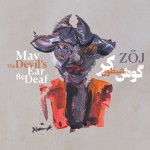
Artist: ZÖJ (@)
Title: May The Devil's Ear Be Deaf
Format: CD + Download
Label: Parenthèses Records (@)
Rated:

Title: May The Devil's Ear Be Deaf
Format: CD + Download
Label: Parenthèses Records (@)
Rated:
Some expressions refuse to travel neatly across languages. The Persian phrase that lends its name to ZÖJ's third album is one of them. "May the devil's ear be deaf" is at once a blessing, a superstition, and a quiet acknowledgment that beauty has always attracted unwanted attention. It is the verbal equivalent of knocking on wood after speaking of happiness, except it carries centuries of cultural memory behind it. Appropriately, ZÖJ transform this fragile wish into music that feels equally protective and exposed, as though every note were offered to the world while simultaneously hoping the wrong ears never hear it.
The Australian duo, formed by Iranian-born vocalist and kamancheh virtuoso Gelareh Pour alongside drummer and percussionist Brian O'Dwyer, has steadily established itself as one of the most compelling voices in contemporary intercultural music. Rather than treating different musical traditions as decorative ingredients to be mixed for cosmopolitan effect, ZÖJ pursue something considerably rarer: a genuine dialogue in which neither tradition dominates nor dilutes the other. Their work emerges from mutual listening rather than cultural arithmetic, and that distinction makes all the difference.
Recorded live at the Banff Centre in Canada without overdubs or studio polishing, "May The Devil's Ear Be Deaf" embraces risk as part of its expressive vocabulary. Every sound exists because it happened exactly once. There are no opportunities for correction, no digital safety nets waiting backstage. In an era where recordings are often edited until they resemble architectural blueprints more than performances, such commitment feels quietly radical. Perfection, it turns out, is sometimes the least interesting thing musicians can pursue.
Across four expansive pieces, the duo inhabits a landscape where Persian poetry, free improvisation, chamber music, contemporary classical sensibilities and exploratory jazz coexist without ever feeling artificially stitched together. Gelareh Pour's voice becomes more than a vehicle for language. It sighs, mourns, rises and fractures with extraordinary emotional precision, often dissolving into the sustained cries of the kamancheh until instrument and singer appear to share the same breath. O'Dwyer's percussion, meanwhile, avoids the temptation to anchor or decorate. His playing responds like weather: sometimes turbulent, sometimes barely perceptible, but always altering the emotional pressure of the surrounding space.
The opening "Termites", built around Mahmud Moshref Azad Tehrani's haunting poem, unfolds with remarkable restraint. Fear is not portrayed through violence but through delicate instability. The recurring image of paper, vulnerable to rain and insects alike, mirrors the music itself: every phrase seems almost too fragile to survive its own resonance. Yet it persists. There is quiet courage in that persistence.
Elsewhere, "Woe to the Ear" draws upon the mystical poetry of Hushang Ebtehaj, meditating on the eternal distance between hearing and understanding. The irony is delicious. Humans have spent millennia confusing the two with astonishing consistency. We attend concerts, consume podcasts, argue online and call it listening. ZÖJ gently expose the difference. Their music demands attention that extends beyond the ears, asking the listener to remain present even when meaning escapes immediate comprehension.
What distinguishes this album from many cross-cultural collaborations is its refusal to exoticise its own sources. Persian musical language is never presented as something mysterious for Western ears to marvel at, nor is contemporary improvisation treated as inherently more progressive than tradition. Instead, both become living practices capable of questioning one another. This reciprocity lends the performances remarkable dignity.
The production deserves equal praise. The live recording captures subtle interactions between voice, bow, drum and room without flattening their dynamic range. Silence becomes an active participant throughout the album, allowing resonance to linger naturally instead of being filled with unnecessary information. One frequently hears not only the instruments themselves but the air they disturb.
Beneath the album's considerable technical accomplishment lies something profoundly human. Its central concern is vulnerability: how to create beauty despite knowing that beauty itself can invite loss, envy or destruction. Rather than retreating into caution, ZÖJ respond with openness. Their music acknowledges fear without surrendering to it.
"May The Devil's Ear Be Deaf" ultimately feels less like a collection of compositions than a carefully guarded ritual, one in which memory, poetry and improvisation become different dialects of the same emotional language. It reminds us that tenderness is not the opposite of strength but one of its most demanding forms. And perhaps that old Persian blessing contains another hidden truth: sometimes the devil does not need to be defeated. Sometimes it is enough that, for forty minutes, it simply fails to hear.
Comments
Stream
Browse by Genre
Industrial Music / Industrial Metal / Aggro Industrial / Electro Metal
Industrial Noise / Power Noise / Harsh Noise
Synth Pop / Electro Pop / Synth-Electronica
Techno / Trance / Goa / Drum'n'Bass / Jungle / Tribal / Trip-Hop
Ambient / Electronica / Ethereal / Dub / Soundscapes / Abstract
Experimental / Avantgarde / Weird & Wired / Glitch / Noise / Field Recording
Dark / Gothic / Wave / New Wave / Dark Wave / Industrial Gothic
New Music / Downtown / Avantgarde Jazz / New Classical / World