
Monday, September 21, 2026
Dario Calderone: The Infinite Garden
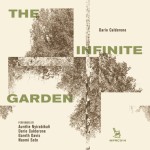
Artist: Dario Calderone (@)
Title: The Infinite Garden
Format: CD + Download
Label: Moving Furniture Records (@)
Rated:

Title: The Infinite Garden
Format: CD + Download
Label: Moving Furniture Records (@)
Rated:
There is a peculiar sentence hidden in the album's credits. After listing the performers, Dario Calderone offers thanks not only to his fellow musicians, but also to birds, raindrops, foxes, earthworms, radio waves, bushes, fungi, passing cars, memories, dreams, ghosts and meteorological events. It initially reads like the acknowledgements page of someone who has spent perhaps a little too much time listening to the wind. Then the music begins, and one realizes the list is neither whimsical nor metaphorical. Every one of those presences is, in some way, part of the ensemble.
"The Infinite Garden" is less an album than an ecological proposition. It suggests that listening is never confined to performers and audience, but extends toward everything occupying the same moment in time. Nature, technology, coincidence and human intention cease to be separate categories. They simply become participants.
Italian double bassist and composer Dario Calderone has spent nearly two decades immersed in contemporary music, collaborating with many of its most adventurous composers while developing a practice rooted in both rigorous interpretation and exploratory performance. A student of the legendary Stefano Scodanibbio, Calderone has consistently viewed the double bass as something far richer than a supporting instrument. Throughout his career, whether performing with the Nieuw Ensemble, Nieuw Amsterdams Peil, or in numerous solo projects, his work has demonstrated an uncommon sensitivity toward the physicality of sound itself.
That sensibility reaches perhaps its clearest expression here.
Recorded in Amsterdam's Amstelpark during a cloudy January afternoon in 2025, "The Infinite Garden" unfolds as a single thirty-five-minute composition performed by an exceptional quartet: Calderone on double bass, Aurélie Nyirabikali Lierman on voice, Naomi Sato on the Japanese "sho", and Gareth Davis on bass clarinet. Surrounding them is an ever-changing live soundscape captured directly from the park itself, allowing weather, wildlife, distant traffic and the unpredictable movements of public space to become equal collaborators in the musical process. The work reflects Calderone's broader concept of "global listening," dissolving boundaries between performers, environment and audience.
The temptation is to describe this as field recording accompanied by improvisation.
That would miss the point entirely.
The environmental sounds never function as background ambience. They possess agency. A distant aeroplane does not interrupt the music; it alters its direction. A brief gust of wind changes the emotional weight of a sustained "sho" chord. Rain becomes rhythm without ever behaving like percussion. Even silence refuses to remain empty, constantly revealing microscopic layers of acoustic life.
The quartet responds with extraordinary restraint.
Naomi Sato's "sho", an ancient Japanese mouth organ capable of producing luminous clusters of sustained harmony, seems almost designed for this environment. Rather than introducing melody, it suspends time, creating shimmering harmonic fields that merge seamlessly with the park's own acoustic atmosphere. Her decades of work bringing the instrument into contemporary music have made her uniquely capable of allowing tradition to breathe inside radically modern contexts.
Gareth Davis approaches the bass clarinet with similar patience. Known for collaborations spanning composers such as Chaya Czernowin and improvisers including Elliott Sharp and Merzbow, Davis has long demonstrated an ability to inhabit musical spaces where certainty is deliberately withheld. Here his instrument rarely asserts itself. Instead, it emerges gradually from the surrounding environment, sometimes resembling distant birdsong, sometimes a slowly shifting geological formation.
Aurélie Nyirabikali Lierman's contribution may be the album's quiet revelation.
Her artistic practice has consistently blurred the lines between radio art, vocal performance and sound ecology, often drawing upon extensive field recordings collected throughout East Africa, a methodology she has described as "Afrique Concrète". That fascination with transforming lived environments into compositional material resonates perfectly with Calderone's concept. Her voice appears less interested in language than in presence itself, hovering somewhere between breath, invocation and remembered speech.
Calderone's double bass anchors everything without ever behaving traditionally.
Rather than establishing harmonic foundations, the instrument explores resonance, friction and weight. Bowed harmonics dissolve into surrounding air. Deep resonances interact with environmental frequencies until it becomes impossible to distinguish instrument from landscape.
What emerges is not improvisation in the conventional sense but negotiation.
Every sound requires permission from every other sound.
One of the album's most compelling achievements lies in its rejection of hierarchy. Contemporary composition often incorporates environmental recordings as aesthetic material. "The Infinite Garden" instead grants them equal citizenship. Human performers do not master nature; they coexist with it.
There is something quietly political in this refusal.
The project imagines listening itself as an act of inclusiveness. Rather than constructing a carefully controlled sonic object, Calderone embraces uncertainty, accepting that the world outside the performers' intentions will inevitably participate. In an era increasingly dominated by algorithmic precision and digital perfection, such openness feels almost radical.
The result occasionally demands patience.
Listeners searching for dramatic developments or easily identifiable thematic progression may initially find themselves adrift. The composition unfolds organically, more like observing changing light across a landscape than following a narrative. Yet surrendering those expectations becomes part of the experience. Gradually, one begins hearing relationships previously overlooked: how distant traffic echoes clarinet timbres, how birds answer sustained harmonies, how footsteps unexpectedly introduce rhythmic counterpoint.
By the closing minutes, the title begins making profound sense.
Gardens are often understood as carefully controlled spaces where nature is disciplined into pleasing arrangements. Calderone imagines something altogether different: an infinite garden where nothing is excluded, where cultivated and wild coexist, where boundaries remain permeable and every participant alters the whole.
It is tempting to call this ambient music.
It is certainly peaceful.
But peace is not the same as passivity.
"The Infinite Garden" asks something surprisingly demanding of its listeners. It asks them to abandon the comforting illusion that music begins when musicians start playing and ends when they stop. Instead, it proposes that listening has always been larger than performance itself.
Perhaps that is Calderone's most generous invitation.
Not simply to hear more carefully, but to realize that the world has been performing all along.
"The Infinite Garden" is less an album than an ecological proposition. It suggests that listening is never confined to performers and audience, but extends toward everything occupying the same moment in time. Nature, technology, coincidence and human intention cease to be separate categories. They simply become participants.
Italian double bassist and composer Dario Calderone has spent nearly two decades immersed in contemporary music, collaborating with many of its most adventurous composers while developing a practice rooted in both rigorous interpretation and exploratory performance. A student of the legendary Stefano Scodanibbio, Calderone has consistently viewed the double bass as something far richer than a supporting instrument. Throughout his career, whether performing with the Nieuw Ensemble, Nieuw Amsterdams Peil, or in numerous solo projects, his work has demonstrated an uncommon sensitivity toward the physicality of sound itself.
That sensibility reaches perhaps its clearest expression here.
Recorded in Amsterdam's Amstelpark during a cloudy January afternoon in 2025, "The Infinite Garden" unfolds as a single thirty-five-minute composition performed by an exceptional quartet: Calderone on double bass, Aurélie Nyirabikali Lierman on voice, Naomi Sato on the Japanese "sho", and Gareth Davis on bass clarinet. Surrounding them is an ever-changing live soundscape captured directly from the park itself, allowing weather, wildlife, distant traffic and the unpredictable movements of public space to become equal collaborators in the musical process. The work reflects Calderone's broader concept of "global listening," dissolving boundaries between performers, environment and audience.
The temptation is to describe this as field recording accompanied by improvisation.
That would miss the point entirely.
The environmental sounds never function as background ambience. They possess agency. A distant aeroplane does not interrupt the music; it alters its direction. A brief gust of wind changes the emotional weight of a sustained "sho" chord. Rain becomes rhythm without ever behaving like percussion. Even silence refuses to remain empty, constantly revealing microscopic layers of acoustic life.
The quartet responds with extraordinary restraint.
Naomi Sato's "sho", an ancient Japanese mouth organ capable of producing luminous clusters of sustained harmony, seems almost designed for this environment. Rather than introducing melody, it suspends time, creating shimmering harmonic fields that merge seamlessly with the park's own acoustic atmosphere. Her decades of work bringing the instrument into contemporary music have made her uniquely capable of allowing tradition to breathe inside radically modern contexts.
Gareth Davis approaches the bass clarinet with similar patience. Known for collaborations spanning composers such as Chaya Czernowin and improvisers including Elliott Sharp and Merzbow, Davis has long demonstrated an ability to inhabit musical spaces where certainty is deliberately withheld. Here his instrument rarely asserts itself. Instead, it emerges gradually from the surrounding environment, sometimes resembling distant birdsong, sometimes a slowly shifting geological formation.
Aurélie Nyirabikali Lierman's contribution may be the album's quiet revelation.
Her artistic practice has consistently blurred the lines between radio art, vocal performance and sound ecology, often drawing upon extensive field recordings collected throughout East Africa, a methodology she has described as "Afrique Concrète". That fascination with transforming lived environments into compositional material resonates perfectly with Calderone's concept. Her voice appears less interested in language than in presence itself, hovering somewhere between breath, invocation and remembered speech.
Calderone's double bass anchors everything without ever behaving traditionally.
Rather than establishing harmonic foundations, the instrument explores resonance, friction and weight. Bowed harmonics dissolve into surrounding air. Deep resonances interact with environmental frequencies until it becomes impossible to distinguish instrument from landscape.
What emerges is not improvisation in the conventional sense but negotiation.
Every sound requires permission from every other sound.
One of the album's most compelling achievements lies in its rejection of hierarchy. Contemporary composition often incorporates environmental recordings as aesthetic material. "The Infinite Garden" instead grants them equal citizenship. Human performers do not master nature; they coexist with it.
There is something quietly political in this refusal.
The project imagines listening itself as an act of inclusiveness. Rather than constructing a carefully controlled sonic object, Calderone embraces uncertainty, accepting that the world outside the performers' intentions will inevitably participate. In an era increasingly dominated by algorithmic precision and digital perfection, such openness feels almost radical.
The result occasionally demands patience.
Listeners searching for dramatic developments or easily identifiable thematic progression may initially find themselves adrift. The composition unfolds organically, more like observing changing light across a landscape than following a narrative. Yet surrendering those expectations becomes part of the experience. Gradually, one begins hearing relationships previously overlooked: how distant traffic echoes clarinet timbres, how birds answer sustained harmonies, how footsteps unexpectedly introduce rhythmic counterpoint.
By the closing minutes, the title begins making profound sense.
Gardens are often understood as carefully controlled spaces where nature is disciplined into pleasing arrangements. Calderone imagines something altogether different: an infinite garden where nothing is excluded, where cultivated and wild coexist, where boundaries remain permeable and every participant alters the whole.
It is tempting to call this ambient music.
It is certainly peaceful.
But peace is not the same as passivity.
"The Infinite Garden" asks something surprisingly demanding of its listeners. It asks them to abandon the comforting illusion that music begins when musicians start playing and ends when they stop. Instead, it proposes that listening has always been larger than performance itself.
Perhaps that is Calderone's most generous invitation.
Not simply to hear more carefully, but to realize that the world has been performing all along.
Comments
Stream
Browse by Genre
Industrial Music / Industrial Metal / Aggro Industrial / Electro Metal
Industrial Noise / Power Noise / Harsh Noise
Synth Pop / Electro Pop / Synth-Electronica
Techno / Trance / Goa / Drum'n'Bass / Jungle / Tribal / Trip-Hop
Ambient / Electronica / Ethereal / Dub / Soundscapes / Abstract
Experimental / Avantgarde / Weird & Wired / Glitch / Noise / Field Recording
Dark / Gothic / Wave / New Wave / Dark Wave / Industrial Gothic
New Music / Downtown / Avantgarde Jazz / New Classical / World