
Friday, September 25, 2026
Matthias Muche’s BONECRUSHER: Densities - for 12 trombones & percussion
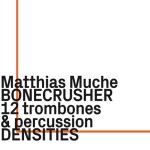
Artist: Matthias Muche’s BONECRUSHER (@)
Title: Densities - for 12 trombones & percussion
Format: Download Only (MP3 + Lossless)
Label: Hat Hut Records (@)
Rated:

Title: Densities - for 12 trombones & percussion
Format: Download Only (MP3 + Lossless)
Label: Hat Hut Records (@)
Rated:
There are twelve trombones on "Densities". This is the sort of information that ought to be stated early, partly because it is impressive, and partly because twelve trombones sound like the beginning of either a magnificent musical experiment or an exceptionally elaborate way of upsetting the neighbours.
Matthias Muche’s BONECRUSHER belongs firmly to the first category. Since its formation, the ensemble has treated the trombone less as a brass instrument in the conventional sense than as a complicated physical apparatus: a column of air, a collection of vibrating surfaces, a system of valves, slides, breath and resonance capable of producing sounds that seem to belong to several musical families at once. On "Densities", this idea has matured into something remarkably cohesive. The thirteen musicians do not merely produce a large sound. They create a body.
Muche, a Cologne-based composer and trombonist, has spent much of his career investigating precisely this territory, where instrumental technique becomes inseparable from the physical behaviour of sound. His work has earned him recognition including the WDR Jazz Prize for improvisation, but "Densities" makes little interest in credentials. The music is too busy examining the molecular structure of a trombone to worry about its résumé.
The album begins with “Butter”, and the title is almost perversely gentle considering what follows. The trombones accumulate in layers, initially suggesting a low-frequency weather system before gradually revealing the extraordinary number of events occurring inside it. Air becomes grain; tones become pressure; individual attacks dissolve into a thickened acoustic surface. The impression is not of twelve players standing next to one another but of one enormous instrument discovering that it has twelve mouths.
That distinction is crucial. Much of the fascination here comes from the way BONECRUSHER constantly shifts the listener’s perception of scale. A sound that initially seems monumental can suddenly disclose a tiny tremor inside it. A seemingly continuous drone turns out to be composed of subtly moving pitches and timbral variations. The music therefore possesses an unusual kind of depth: not the depth produced by reverberation or electronics, but one created entirely by the internal friction of acoustic material.
“Quater” pushes this principle further. Microtonal movements, abrupt articulations and overlapping gestures create a situation in which apparent disorder gradually reveals a remarkably precise organisation. The trombones seem to smear themselves across one another, yet small harmonic relationships keep emerging from the confusion. There is something almost tactile about it, as though the composition were being kneaded into shape rather than conventionally played.
This is where Muche’s compositional thinking becomes particularly compelling. The large ensemble is not used simply to amplify an idea. It changes the nature of the idea itself. Music written for one trombone can contain ambiguity, breath and physical instability; multiplied by twelve, those properties become architecture. A gesture is no longer merely a gesture. It becomes a surface, a pressure field, a mass with edges.
Matthias Müller’s “Up & Down” approaches the same problem from another direction. Its sustained harmonies and carefully controlled internal movement make the ensemble appear almost static at first, although the apparent stillness is constantly being modified. The trombones breathe into one another, generating small shifts in colour and pitch that gradually alter the whole structure. It is an excellent demonstration of how much movement can be hidden inside a sound that, from a distance, appears motionless.
Then comes Johannes Bauer’s “Brass / Breath / Brisk”, originally conceived in the late 1990s and here transformed from its solo/tape origins into an ensemble piece through the work of Jeb Bishop, Matthias Müller and Muche. The historical dimension matters. Bauer, who died in 2016, was one of the great European trombonists of free improvisation, and his presence is felt not through nostalgia but through the physical unruliness of the material. The piece has a rougher grain than the preceding works, with blocks of brass colliding, separating and reforming while Etienne Nillesen’s prepared snare provides a wonderfully economical counterweight.
Nillesen deserves particular attention because his percussion does not behave like percussion in any ordinary orchestral sense. The snare becomes another resonating object, sometimes sharply articulated, sometimes almost suspended within the brass. Its presence prevents the twelve trombones from becoming an entirely self-contained organism. It punctures the mass, gives it a skeleton, occasionally reminds us that rhythm has not been abolished, merely buried somewhere under several tonnes of brass.
And that is perhaps the central achievement of "Densities": it manages to be massive without becoming blunt.
There is plenty here that could easily have collapsed into undifferentiated heaviness. Twelve trombones offer a frighteningly efficient route towards sonic obesity. Instead, BONECRUSHER repeatedly finds cracks inside the density. Breaths, overtones, unstable pitches, tiny articulations and differences in attack remain audible. The music can be abrasive, even physically imposing, but it is rarely merely loud. Its power comes from the complexity packed inside the weight.
The title consequently works on several levels. These are densities of sound, certainly, but also densities of bodies, air, time and attention. The album asks what happens when an instrument normally associated with a single voice is multiplied until individuality begins to disappear. What remains is neither anonymity nor uniformity. It is a collective identity in which the smallest discrepancies become part of the composition.
There is something quietly philosophical about that. The ensemble does not erase the individual players; it makes their differences useful. Twelve trombones can approximate a single organism precisely because no twelve human beings will ever produce exactly the same sound. The imperfections are not defects to be corrected but the material from which the larger form emerges.
Muche's fascination with the trombone therefore reaches beyond extended technique. He is interested in what happens when an instrument is treated as a physical proposition rather than a predetermined vocabulary. The trombone is allowed to be metallic, breathy, granular, vocal, mechanical, spectral and occasionally almost orchestral. It can growl like machinery one moment and become astonishingly fragile the next.
That fragility is what saves "Densities" from becoming a mere demonstration of force. Beneath the muscular title and the intimidating personnel list there is a surprisingly delicate record, one that pays attention to the smallest variations in pressure and resonance. The brute and the microscopic coexist without cancelling one another.
Listening to it is consequently less like hearing a brass ensemble and more like standing inside a machine that has developed an unexpectedly sophisticated inner life.
Which is a fairly good reason to forgive it for having twelve trombones.
"Densities" is an imposing, meticulous and occasionally beautiful piece of contemporary acoustic music. It demonstrates how much can still be extracted from an instrument whose conventional identity seems almost too familiar to surprise us anymore. Muche and BONECRUSHER do not reinvent the trombone by disguising it. They do something more interesting: they expose the strange thing that was already hiding inside it.
The result is music of considerable physical presence, but also of patience and precision. It crushes bones only metaphorically. The ears, however, are invited to undergo a rather more elaborate treatment.
Matthias Muche’s BONECRUSHER belongs firmly to the first category. Since its formation, the ensemble has treated the trombone less as a brass instrument in the conventional sense than as a complicated physical apparatus: a column of air, a collection of vibrating surfaces, a system of valves, slides, breath and resonance capable of producing sounds that seem to belong to several musical families at once. On "Densities", this idea has matured into something remarkably cohesive. The thirteen musicians do not merely produce a large sound. They create a body.
Muche, a Cologne-based composer and trombonist, has spent much of his career investigating precisely this territory, where instrumental technique becomes inseparable from the physical behaviour of sound. His work has earned him recognition including the WDR Jazz Prize for improvisation, but "Densities" makes little interest in credentials. The music is too busy examining the molecular structure of a trombone to worry about its résumé.
The album begins with “Butter”, and the title is almost perversely gentle considering what follows. The trombones accumulate in layers, initially suggesting a low-frequency weather system before gradually revealing the extraordinary number of events occurring inside it. Air becomes grain; tones become pressure; individual attacks dissolve into a thickened acoustic surface. The impression is not of twelve players standing next to one another but of one enormous instrument discovering that it has twelve mouths.
That distinction is crucial. Much of the fascination here comes from the way BONECRUSHER constantly shifts the listener’s perception of scale. A sound that initially seems monumental can suddenly disclose a tiny tremor inside it. A seemingly continuous drone turns out to be composed of subtly moving pitches and timbral variations. The music therefore possesses an unusual kind of depth: not the depth produced by reverberation or electronics, but one created entirely by the internal friction of acoustic material.
“Quater” pushes this principle further. Microtonal movements, abrupt articulations and overlapping gestures create a situation in which apparent disorder gradually reveals a remarkably precise organisation. The trombones seem to smear themselves across one another, yet small harmonic relationships keep emerging from the confusion. There is something almost tactile about it, as though the composition were being kneaded into shape rather than conventionally played.
This is where Muche’s compositional thinking becomes particularly compelling. The large ensemble is not used simply to amplify an idea. It changes the nature of the idea itself. Music written for one trombone can contain ambiguity, breath and physical instability; multiplied by twelve, those properties become architecture. A gesture is no longer merely a gesture. It becomes a surface, a pressure field, a mass with edges.
Matthias Müller’s “Up & Down” approaches the same problem from another direction. Its sustained harmonies and carefully controlled internal movement make the ensemble appear almost static at first, although the apparent stillness is constantly being modified. The trombones breathe into one another, generating small shifts in colour and pitch that gradually alter the whole structure. It is an excellent demonstration of how much movement can be hidden inside a sound that, from a distance, appears motionless.
Then comes Johannes Bauer’s “Brass / Breath / Brisk”, originally conceived in the late 1990s and here transformed from its solo/tape origins into an ensemble piece through the work of Jeb Bishop, Matthias Müller and Muche. The historical dimension matters. Bauer, who died in 2016, was one of the great European trombonists of free improvisation, and his presence is felt not through nostalgia but through the physical unruliness of the material. The piece has a rougher grain than the preceding works, with blocks of brass colliding, separating and reforming while Etienne Nillesen’s prepared snare provides a wonderfully economical counterweight.
Nillesen deserves particular attention because his percussion does not behave like percussion in any ordinary orchestral sense. The snare becomes another resonating object, sometimes sharply articulated, sometimes almost suspended within the brass. Its presence prevents the twelve trombones from becoming an entirely self-contained organism. It punctures the mass, gives it a skeleton, occasionally reminds us that rhythm has not been abolished, merely buried somewhere under several tonnes of brass.
And that is perhaps the central achievement of "Densities": it manages to be massive without becoming blunt.
There is plenty here that could easily have collapsed into undifferentiated heaviness. Twelve trombones offer a frighteningly efficient route towards sonic obesity. Instead, BONECRUSHER repeatedly finds cracks inside the density. Breaths, overtones, unstable pitches, tiny articulations and differences in attack remain audible. The music can be abrasive, even physically imposing, but it is rarely merely loud. Its power comes from the complexity packed inside the weight.
The title consequently works on several levels. These are densities of sound, certainly, but also densities of bodies, air, time and attention. The album asks what happens when an instrument normally associated with a single voice is multiplied until individuality begins to disappear. What remains is neither anonymity nor uniformity. It is a collective identity in which the smallest discrepancies become part of the composition.
There is something quietly philosophical about that. The ensemble does not erase the individual players; it makes their differences useful. Twelve trombones can approximate a single organism precisely because no twelve human beings will ever produce exactly the same sound. The imperfections are not defects to be corrected but the material from which the larger form emerges.
Muche's fascination with the trombone therefore reaches beyond extended technique. He is interested in what happens when an instrument is treated as a physical proposition rather than a predetermined vocabulary. The trombone is allowed to be metallic, breathy, granular, vocal, mechanical, spectral and occasionally almost orchestral. It can growl like machinery one moment and become astonishingly fragile the next.
That fragility is what saves "Densities" from becoming a mere demonstration of force. Beneath the muscular title and the intimidating personnel list there is a surprisingly delicate record, one that pays attention to the smallest variations in pressure and resonance. The brute and the microscopic coexist without cancelling one another.
Listening to it is consequently less like hearing a brass ensemble and more like standing inside a machine that has developed an unexpectedly sophisticated inner life.
Which is a fairly good reason to forgive it for having twelve trombones.
"Densities" is an imposing, meticulous and occasionally beautiful piece of contemporary acoustic music. It demonstrates how much can still be extracted from an instrument whose conventional identity seems almost too familiar to surprise us anymore. Muche and BONECRUSHER do not reinvent the trombone by disguising it. They do something more interesting: they expose the strange thing that was already hiding inside it.
The result is music of considerable physical presence, but also of patience and precision. It crushes bones only metaphorically. The ears, however, are invited to undergo a rather more elaborate treatment.
Comments
Stream
Browse by Genre
Industrial Music / Industrial Metal / Aggro Industrial / Electro Metal
Industrial Noise / Power Noise / Harsh Noise
Synth Pop / Electro Pop / Synth-Electronica
Techno / Trance / Goa / Drum'n'Bass / Jungle / Tribal / Trip-Hop
Ambient / Electronica / Ethereal / Dub / Soundscapes / Abstract
Experimental / Avantgarde / Weird & Wired / Glitch / Noise / Field Recording
Dark / Gothic / Wave / New Wave / Dark Wave / Industrial Gothic
New Music / Downtown / Avantgarde Jazz / New Classical / World