
Sunday, October 11, 2026
Extra Large Unit: Steam Waterfall
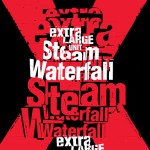


There is something wonderfully unreasonable about calling a 25-piece ensemble an “Extra Large Unit”. At that scale, the adjective starts to lose its meaning and the noun becomes almost comic: this is less a band than a temporary ecosystem, complete with percussion, winds, strings, accordion, harp, voice, four dancers and, eventually, a small invasion of ping-pong balls. Civilization has always had a peculiar talent for organizing enormous quantities of people in order to make something happen, and Paal Nilssen-Love's "Steam Waterfall" turns that impulse into a remarkably coherent musical experiment.
Recorded live at the Oslo Jazz Festival in August 2022, the 75-minute piece expands the Large Unit into its most populous incarnation yet. But numbers are ultimately the least interesting thing about it. What matters is the way Nilssen-Love uses such an unwieldy organism without trying to tame it. Written passages, graphic scores, conceptual instructions, individual solos and collective improvisations coexist without producing the dreadful sensation of a committee meeting disguised as contemporary music.
The opening is particularly revealing. Before the music properly announces itself, we hear the audience entering the space. It is a small gesture, but it immediately unsettles the conventional boundary between performance and preparation. The concert is already happening because people are arriving to hear it. The musicians are not yet performing, but the social machinery surrounding performance has begun. From there, "Steam Waterfall" proceeds less like a conventional composition than like a series of doors opening onto one another.
Nilssen-Love's central concern is precisely this instability: where does a concert begin, and where does it finish? What constitutes a piece when the composer establishes some conditions but leaves considerable responsibility to the performers? These questions could easily produce the kind of solemn theoretical exercise that makes audiences suddenly develop an urgent interest in the emergency exit. Instead, "Steam Waterfall" keeps translating its ideas into physical sound.
The sheer variety of the instrumentation helps. Four tubas alone can alter the gravitational field of an ensemble; several saxophones and clarinets create shifting masses of breath and pressure; harp, accordion, guitar, cello and viola introduce entirely different densities. Then there are multiple percussionists, including Korean traditional drums and gongs, alongside the enormous rhythmic apparatus of Nilssen-Love himself. Rather than presenting these elements as a catalogue of timbres, the piece lets them collide, separate, overlap and disappear. The result is frequently chaotic, but rarely arbitrary. That distinction is crucial. Chaos here is not the absence of structure. It is what structure looks like after being handed over to twenty-five musicians and four dancers and told to behave itself.
Nilssen-Love has long demonstrated an unusual ability to make improvisation feel collective rather than merely simultaneous. His Large Unit project, begun in 2013, has become a particularly fertile laboratory for this approach, bringing together musicians from different generations and musical backgrounds. "Steam Waterfall" pushes that principle further by incorporating younger players he encountered through workshops and teaching. The ensemble therefore becomes partly an orchestra, partly an improvisational network, and partly an experiment in musical transmission.
There is also a refreshing physicality to the recording. One can almost imagine the stage as an unstable map, with sounds appearing in different zones and musical groups forming temporary alliances before dissolving again. The four dancers are not ornamental additions but part of the larger investigation into movement, coordination and collective action. By the end, when 100 ping-pong balls are thrown across the stage, the distinction between musical score and event becomes deliciously ridiculous. The balls bounce on instruments and floor, glasses are apparently sacrificed to the occasion, and suddenly the supposedly abstract question of what a concert is has acquired a very concrete answer: sometimes it involves trying not to get hit by a small white sphere.
Yet the humour does not trivialize the music. Quite the opposite. It exposes the artificiality of the solemn concert ritual. A performance can contain carefully organized material, improvisation, physical movement, accidents, audience behaviour and sheer nonsense, and all of those things can belong to the same artistic space.
The recording itself benefits from being approached as an event rather than a conventional studio album. There is a sense of architecture continually being assembled and dismantled. Large blocks of ensemble sound can give way to smaller configurations, rhythmic density can evaporate into sparse gestures, and individual voices briefly emerge from the mass before being swallowed back into it. The piece breathes according to its own strange metabolism. This is where the title becomes apt. A waterfall suggests continuity and force, while steam suggests transformation, diffusion and instability. "Steam Waterfall" combines both conditions: a large body of sound constantly changing state. Nothing stays fixed for long, but neither does everything simply dissolve.
The most impressive achievement is perhaps that Nilssen-Love never seems particularly interested in demonstrating how clever the concept is. The concept serves the music rather than the reverse. The questions about authorship, duration and audience are embedded in the performance instead of being placed above it like an instruction manual. And that makes the final absurdity of those ping-pong balls strangely appropriate. After 75 minutes of negotiating composition, improvisation, collective responsibility and the boundaries of the concert, the ensemble arrives at something wonderfully primitive: objects bouncing around a room while 25 musicians and four dancers participate in the commotion. The grand philosophical question ends with physics.
Human beings, after all, remain remarkably complicated creatures for organisms that can be entertained by balls bouncing on a floor.
"Steam Waterfall" is therefore not simply an enormous improvisational performance. It is a study in collective attention, a composition that keeps asking how much control music actually needs before it becomes alive. Its answer is neither total freedom nor rigid authorship, but a precarious middle ground where instructions, intuition, accident and personality continually negotiate with one another.
The music survives that negotiation because the musicians listen. That may sound like a modest conclusion, but in a world increasingly obsessed with control, automation and predetermined outcomes, it has considerable weight. Here, structure creates the conditions for uncertainty, and uncertainty becomes the source of vitality.
The Unit is large. The music is larger still. And somewhere underneath it all, probably, a ping-pong ball is still bouncing.
Recorded live at the Oslo Jazz Festival in August 2022, the 75-minute piece expands the Large Unit into its most populous incarnation yet. But numbers are ultimately the least interesting thing about it. What matters is the way Nilssen-Love uses such an unwieldy organism without trying to tame it. Written passages, graphic scores, conceptual instructions, individual solos and collective improvisations coexist without producing the dreadful sensation of a committee meeting disguised as contemporary music.
The opening is particularly revealing. Before the music properly announces itself, we hear the audience entering the space. It is a small gesture, but it immediately unsettles the conventional boundary between performance and preparation. The concert is already happening because people are arriving to hear it. The musicians are not yet performing, but the social machinery surrounding performance has begun. From there, "Steam Waterfall" proceeds less like a conventional composition than like a series of doors opening onto one another.
Nilssen-Love's central concern is precisely this instability: where does a concert begin, and where does it finish? What constitutes a piece when the composer establishes some conditions but leaves considerable responsibility to the performers? These questions could easily produce the kind of solemn theoretical exercise that makes audiences suddenly develop an urgent interest in the emergency exit. Instead, "Steam Waterfall" keeps translating its ideas into physical sound.
The sheer variety of the instrumentation helps. Four tubas alone can alter the gravitational field of an ensemble; several saxophones and clarinets create shifting masses of breath and pressure; harp, accordion, guitar, cello and viola introduce entirely different densities. Then there are multiple percussionists, including Korean traditional drums and gongs, alongside the enormous rhythmic apparatus of Nilssen-Love himself. Rather than presenting these elements as a catalogue of timbres, the piece lets them collide, separate, overlap and disappear. The result is frequently chaotic, but rarely arbitrary. That distinction is crucial. Chaos here is not the absence of structure. It is what structure looks like after being handed over to twenty-five musicians and four dancers and told to behave itself.
Nilssen-Love has long demonstrated an unusual ability to make improvisation feel collective rather than merely simultaneous. His Large Unit project, begun in 2013, has become a particularly fertile laboratory for this approach, bringing together musicians from different generations and musical backgrounds. "Steam Waterfall" pushes that principle further by incorporating younger players he encountered through workshops and teaching. The ensemble therefore becomes partly an orchestra, partly an improvisational network, and partly an experiment in musical transmission.
There is also a refreshing physicality to the recording. One can almost imagine the stage as an unstable map, with sounds appearing in different zones and musical groups forming temporary alliances before dissolving again. The four dancers are not ornamental additions but part of the larger investigation into movement, coordination and collective action. By the end, when 100 ping-pong balls are thrown across the stage, the distinction between musical score and event becomes deliciously ridiculous. The balls bounce on instruments and floor, glasses are apparently sacrificed to the occasion, and suddenly the supposedly abstract question of what a concert is has acquired a very concrete answer: sometimes it involves trying not to get hit by a small white sphere.
Yet the humour does not trivialize the music. Quite the opposite. It exposes the artificiality of the solemn concert ritual. A performance can contain carefully organized material, improvisation, physical movement, accidents, audience behaviour and sheer nonsense, and all of those things can belong to the same artistic space.
The recording itself benefits from being approached as an event rather than a conventional studio album. There is a sense of architecture continually being assembled and dismantled. Large blocks of ensemble sound can give way to smaller configurations, rhythmic density can evaporate into sparse gestures, and individual voices briefly emerge from the mass before being swallowed back into it. The piece breathes according to its own strange metabolism. This is where the title becomes apt. A waterfall suggests continuity and force, while steam suggests transformation, diffusion and instability. "Steam Waterfall" combines both conditions: a large body of sound constantly changing state. Nothing stays fixed for long, but neither does everything simply dissolve.
The most impressive achievement is perhaps that Nilssen-Love never seems particularly interested in demonstrating how clever the concept is. The concept serves the music rather than the reverse. The questions about authorship, duration and audience are embedded in the performance instead of being placed above it like an instruction manual. And that makes the final absurdity of those ping-pong balls strangely appropriate. After 75 minutes of negotiating composition, improvisation, collective responsibility and the boundaries of the concert, the ensemble arrives at something wonderfully primitive: objects bouncing around a room while 25 musicians and four dancers participate in the commotion. The grand philosophical question ends with physics.
Human beings, after all, remain remarkably complicated creatures for organisms that can be entertained by balls bouncing on a floor.
"Steam Waterfall" is therefore not simply an enormous improvisational performance. It is a study in collective attention, a composition that keeps asking how much control music actually needs before it becomes alive. Its answer is neither total freedom nor rigid authorship, but a precarious middle ground where instructions, intuition, accident and personality continually negotiate with one another.
The music survives that negotiation because the musicians listen. That may sound like a modest conclusion, but in a world increasingly obsessed with control, automation and predetermined outcomes, it has considerable weight. Here, structure creates the conditions for uncertainty, and uncertainty becomes the source of vitality.
The Unit is large. The music is larger still. And somewhere underneath it all, probably, a ping-pong ball is still bouncing.
Comments
Stream
Browse by Genre
Industrial Music / Industrial Metal / Aggro Industrial / Electro Metal
Industrial Noise / Power Noise / Harsh Noise
Synth Pop / Electro Pop / Synth-Electronica
Techno / Trance / Goa / Drum'n'Bass / Jungle / Tribal / Trip-Hop
Ambient / Electronica / Ethereal / Dub / Soundscapes / Abstract
Experimental / Avantgarde / Weird & Wired / Glitch / Noise / Field Recording
Dark / Gothic / Wave / New Wave / Dark Wave / Industrial Gothic
New Music / Downtown / Avantgarde Jazz / New Classical / World