
Monday, October 12, 2026
It Was Her Idea: Daughter of War
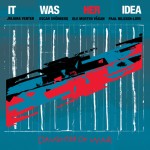
Artist: It Was Her Idea
Title: Daughter of War
Format: CD & 12" + Download
Label: PNL Records (@)
Rated:

Title: Daughter of War
Format: CD & 12" + Download
Label: PNL Records (@)
Rated:
There is something suspiciously self-protective about calling a band "It Was Her Idea". It sounds like the musical equivalent of leaving the room before the vase hits the floor. Whatever happened, somebody else suggested it.
In this case, however, the name is almost too appropriate. "Daughter of War" is the debut of a quartet that seems to have been assembled not because its members wanted to reproduce a particular genre, but because four already well-developed musical personalities had discovered that their individual obsessions could be made to interfere productively with one another.
Juliana Venter, Oscar Grönberg, Ole Morten Vågan and Paal Nilssen-Love began playing together in 2022, each bringing compositions to the group. The result is not a Nilssen-Love project with three supporting musicians, nor a conventional vocal quartet. The writing belongs to all four, and that difference is audible almost immediately.
Venter is the obvious focal point, but not necessarily because she sings in the way one expects a vocalist to sing. Her background already gives away the problem with that assumption. Born in Pretoria and raised between Namibia and South Africa before moving through several European cities and eventually settling in Norway, she has worked across classical singing, theatre, film, jazz, free improvisation, contemporary music, folk traditions and extended vocal techniques. Her voice therefore refuses to sit politely on top of the instrumentation. It moves through it.
The opening track, “Three Free Wheels”, provides a good introduction. Piano and double bass establish an atmosphere that initially feels almost chamber-like, with Grönberg's harmonic language creating an uncertain floor beneath the piece. Venter enters without immediately revealing the full extent of what she can do. There is something almost cautious about the beginning, but the caution does not last. Her voice starts to bend away from conventional melodic behaviour, and the quartet gradually reveals itself as something considerably stranger than an acoustic jazz group.
The music seems to be asking a deceptively simple question: what exactly is a song when the singer is allowed to treat singing as only one of the available possibilities? The answer changes from track to track.
“Tickle Tickle” is more mischievous, with the quartet playing around repetition, articulation and rhythmic expectation. The title is almost embarrassingly cheerful for music that keeps refusing to settle into a stable mood. This is one of the pleasures of the album: its seriousness is continually interrupted by a sense of play. Nilssen-Love's drumming is particularly effective because he does not dominate the proceedings. He can puncture a phrase, shadow it, or simply leave enough room for the piano and bass to establish their own little traps.
Grönberg is crucial here. His piano playing gives the quartet an unusually flexible harmonic centre, capable of suggesting a conventional jazz language before suddenly stepping sideways. He has become an increasingly visible presence in the Scandinavian scene, and this recording makes clear why. His contribution is not simply accompaniment. He often seems to be constructing temporary rooms for Venter's voice to enter, occupy and then dismantle.
Ole Morten Vågan provides the other indispensable architectural element. The double bass is both foundation and disturbance, capable of maintaining the physical weight of the ensemble while also pulling against its apparent direction. His long-standing relationship with Nilssen-Love makes the pairing feel natural, but the combination is more interesting than that familiarity might suggest. Without the enormous instrumentation of Large Unit or the relentless rhythmic pressure of some of Nilssen-Love's other projects, the drummer has to listen differently. Here he is less a force of nature than an exceptionally alert conversationalist.
Then comes the title track.
“Daughter of War” is built around music by Juliana Venter and a poem by Khaleda Froagh, the Afghan poet whose work addresses conflict, violence, displacement and the persistence of human experience under circumstances designed to destroy it. This is where the record's eccentricity suddenly acquires gravity.
Venter does not turn the poem into a theatrical monologue in the conventional sense. Her performance is visceral, but also controlled. She can sound exposed without becoming sentimental, and the trio understands that the most effective accompaniment is sometimes almost nothing. Piano, bass and drums create a shifting frame around her rather than forcing the text into a predetermined emotional shape.
There is an important distinction here. The piece is not powerful because it is “about war”. There are already far too many records congratulating themselves for having Serious Themes. It is powerful because Venter makes the voice carry the tension between the personal and the historical. The title suggests a person born into circumstances she did not choose. The song consequently feels less like a declaration about geopolitics than an attempt to give individual presence to something usually discussed in numbers, maps and headlines.
The war is enormous. The voice is not. That imbalance is precisely what makes the piece work.
After this centre of gravity, “Three Grooves for Freya” offers a change of temperature. The piece is more rhythmically playful, but the quartet still avoids the temptation to become a straightforward groove band. The title itself hints at a compositional interest in small units and repeated structures, and Nilssen-Love seems particularly comfortable in this setting, where rhythm can be suggested rather than unleashed.
Then comes “Baæ Baæ Lille Lakselus”, lasting barely eighty seconds.
Human beings have a peculiar habit of putting tiny things in the middle of serious things and then acting surprised when the tiny thing changes everything. Here the miniature piece works almost like a musical wink. Its brevity prevents the album from becoming overdetermined. Just when the listener might start constructing an elaborate theory about the relationship between voice, violence, improvisation and Scandinavian contemporary music, the quartet gives the whole intellectual machinery a gentle shove.
It is useful.
“Cough Song” is considerably more extended and much less decorative. The voice becomes physical again, approaching the body as a source of rhythm and texture rather than merely pitch. The cough itself is an almost absurdly ordinary bodily event, but in this context it becomes musical material. Venter's performance can be abrasive, comic, vulnerable and unsettling without clearly announcing which of these qualities the listener is supposed to choose. That ambiguity is one of the album's strengths.
The quartet does not always distinguish between the beautiful and the awkward. A vocal gesture can be attractive because it is technically accomplished, or because it sounds as though the body is struggling to produce it. A piano chord can function harmonically and then suddenly become a percussive object. A bass line can establish a tonal centre only to undermine it seconds later.
This is where the “noise” and “conceptual” elements mentioned in the album's description actually become meaningful. They are not genres pasted onto a jazz foundation. They describe a willingness to regard musical behaviour itself as material.
The closing “Little Cage” takes this principle to its sparsest extreme. The piece has been compared to the chance-oriented experiments associated with John Cage, and that comparison is useful without needing to turn the track into a Cage imitation. What matters is the removal of expectation.
After the vocal and instrumental density of the preceding tracks, "Little Cage" feels almost like someone has opened a window. Small sounds become conspicuous. Space acquires weight. The quartet no longer needs to demonstrate what it can do because it has already spent the preceding forty minutes demonstrating that it can do rather a lot.
There is also something revealing about the album's sequencing. "Daughter of War" is not constructed as a continuous escalation from accessibility towards abstraction, nor does it proceed according to the usual experimental-music logic in which each track is required to become more difficult than the last. It behaves more like a collection of encounters. Each composition proposes a different relationship between the four musicians, and the album's coherence emerges from the personalities rather than from a single stylistic formula.
That may be why the debut feels convincing without feeling completely settled.
The recording, made by Dag Erik Johansen at Athletic Sound in Halden in May 2025 and subsequently mixed and mastered by Joe Talia, gives the quartet enough definition for those relationships to remain audible. Nothing is buried simply because the music is unconventional. The instruments retain their physical identities, while Venter's voice occupies the centre without becoming artificially separated from the trio.
That balance is essential. Because "Daughter of War" is ultimately not a vocalist-plus-trio record.
It is four composers negotiating what happens when their materials collide.
Nilssen-Love's presence is perhaps the most misleading thing about the project. His name carries associations with large-scale improvisation, percussion-heavy intensity and the kind of free jazz in which the drummer occasionally appears to have declared war on the concept of moderation. Here, however, he is part of a much more intimate mechanism. His playing is often economical, attentive to the spaces between gestures. The album demonstrates that his musical identity is not dependent on sheer volume or physical force.
Venter provides the emotional volatility, Grönberg much of the harmonic uncertainty, Vågan the muscular elasticity of the bass, and Nilssen-Love the rhythmic intelligence that keeps these competing tendencies from becoming four separate records accidentally occupying the same CD.
There is humour in the arrangement of all this seriousness. The band is called "It Was Her Idea". There is a song about coughing. There is a Norwegian children's-song title involving a little salmon louse. There are pieces whose names sound like instructions from a surrealist kindergarten. And yet the album can turn, without warning, towards a poem about war and human devastation.
That tonal flexibility prevents the record from becoming solemn. And solemnity would have been its enemy.
"Daughter of War" works because it understands that experimental music does not need to wear a black suit at all times. It can be grotesque, playful, fragile, irritating, beautiful and politically serious within the same forty-five minutes. Human beings are inconveniently complicated creatures, and music that reflects that complexity is usually more convincing than music that tries to tidy it away.
The album's title track may therefore be its emotional centre, but the record as a whole is more interesting than that one piece. Its real achievement lies in the way the quartet refuses to establish a hierarchy between song, improvisation, composition, noise and theatrical gesture. Everything is allowed into the same room, provided it has something to contribute. And perhaps the most promising thing about this debut is that it does not sound like the final definition of "It Was Her Idea".
It sounds like four musicians have discovered a useful problem. How far can they push the relationship between voice and instruments without turning either into decoration? How much structure can survive improvisation? How strange can a song become before it stops being a song?
"Daughter of War" does not answer these questions conclusively. It does something better. It keeps making them audible.
In this case, however, the name is almost too appropriate. "Daughter of War" is the debut of a quartet that seems to have been assembled not because its members wanted to reproduce a particular genre, but because four already well-developed musical personalities had discovered that their individual obsessions could be made to interfere productively with one another.
Juliana Venter, Oscar Grönberg, Ole Morten Vågan and Paal Nilssen-Love began playing together in 2022, each bringing compositions to the group. The result is not a Nilssen-Love project with three supporting musicians, nor a conventional vocal quartet. The writing belongs to all four, and that difference is audible almost immediately.
Venter is the obvious focal point, but not necessarily because she sings in the way one expects a vocalist to sing. Her background already gives away the problem with that assumption. Born in Pretoria and raised between Namibia and South Africa before moving through several European cities and eventually settling in Norway, she has worked across classical singing, theatre, film, jazz, free improvisation, contemporary music, folk traditions and extended vocal techniques. Her voice therefore refuses to sit politely on top of the instrumentation. It moves through it.
The opening track, “Three Free Wheels”, provides a good introduction. Piano and double bass establish an atmosphere that initially feels almost chamber-like, with Grönberg's harmonic language creating an uncertain floor beneath the piece. Venter enters without immediately revealing the full extent of what she can do. There is something almost cautious about the beginning, but the caution does not last. Her voice starts to bend away from conventional melodic behaviour, and the quartet gradually reveals itself as something considerably stranger than an acoustic jazz group.
The music seems to be asking a deceptively simple question: what exactly is a song when the singer is allowed to treat singing as only one of the available possibilities? The answer changes from track to track.
“Tickle Tickle” is more mischievous, with the quartet playing around repetition, articulation and rhythmic expectation. The title is almost embarrassingly cheerful for music that keeps refusing to settle into a stable mood. This is one of the pleasures of the album: its seriousness is continually interrupted by a sense of play. Nilssen-Love's drumming is particularly effective because he does not dominate the proceedings. He can puncture a phrase, shadow it, or simply leave enough room for the piano and bass to establish their own little traps.
Grönberg is crucial here. His piano playing gives the quartet an unusually flexible harmonic centre, capable of suggesting a conventional jazz language before suddenly stepping sideways. He has become an increasingly visible presence in the Scandinavian scene, and this recording makes clear why. His contribution is not simply accompaniment. He often seems to be constructing temporary rooms for Venter's voice to enter, occupy and then dismantle.
Ole Morten Vågan provides the other indispensable architectural element. The double bass is both foundation and disturbance, capable of maintaining the physical weight of the ensemble while also pulling against its apparent direction. His long-standing relationship with Nilssen-Love makes the pairing feel natural, but the combination is more interesting than that familiarity might suggest. Without the enormous instrumentation of Large Unit or the relentless rhythmic pressure of some of Nilssen-Love's other projects, the drummer has to listen differently. Here he is less a force of nature than an exceptionally alert conversationalist.
Then comes the title track.
“Daughter of War” is built around music by Juliana Venter and a poem by Khaleda Froagh, the Afghan poet whose work addresses conflict, violence, displacement and the persistence of human experience under circumstances designed to destroy it. This is where the record's eccentricity suddenly acquires gravity.
Venter does not turn the poem into a theatrical monologue in the conventional sense. Her performance is visceral, but also controlled. She can sound exposed without becoming sentimental, and the trio understands that the most effective accompaniment is sometimes almost nothing. Piano, bass and drums create a shifting frame around her rather than forcing the text into a predetermined emotional shape.
There is an important distinction here. The piece is not powerful because it is “about war”. There are already far too many records congratulating themselves for having Serious Themes. It is powerful because Venter makes the voice carry the tension between the personal and the historical. The title suggests a person born into circumstances she did not choose. The song consequently feels less like a declaration about geopolitics than an attempt to give individual presence to something usually discussed in numbers, maps and headlines.
The war is enormous. The voice is not. That imbalance is precisely what makes the piece work.
After this centre of gravity, “Three Grooves for Freya” offers a change of temperature. The piece is more rhythmically playful, but the quartet still avoids the temptation to become a straightforward groove band. The title itself hints at a compositional interest in small units and repeated structures, and Nilssen-Love seems particularly comfortable in this setting, where rhythm can be suggested rather than unleashed.
Then comes “Baæ Baæ Lille Lakselus”, lasting barely eighty seconds.
Human beings have a peculiar habit of putting tiny things in the middle of serious things and then acting surprised when the tiny thing changes everything. Here the miniature piece works almost like a musical wink. Its brevity prevents the album from becoming overdetermined. Just when the listener might start constructing an elaborate theory about the relationship between voice, violence, improvisation and Scandinavian contemporary music, the quartet gives the whole intellectual machinery a gentle shove.
It is useful.
“Cough Song” is considerably more extended and much less decorative. The voice becomes physical again, approaching the body as a source of rhythm and texture rather than merely pitch. The cough itself is an almost absurdly ordinary bodily event, but in this context it becomes musical material. Venter's performance can be abrasive, comic, vulnerable and unsettling without clearly announcing which of these qualities the listener is supposed to choose. That ambiguity is one of the album's strengths.
The quartet does not always distinguish between the beautiful and the awkward. A vocal gesture can be attractive because it is technically accomplished, or because it sounds as though the body is struggling to produce it. A piano chord can function harmonically and then suddenly become a percussive object. A bass line can establish a tonal centre only to undermine it seconds later.
This is where the “noise” and “conceptual” elements mentioned in the album's description actually become meaningful. They are not genres pasted onto a jazz foundation. They describe a willingness to regard musical behaviour itself as material.
The closing “Little Cage” takes this principle to its sparsest extreme. The piece has been compared to the chance-oriented experiments associated with John Cage, and that comparison is useful without needing to turn the track into a Cage imitation. What matters is the removal of expectation.
After the vocal and instrumental density of the preceding tracks, "Little Cage" feels almost like someone has opened a window. Small sounds become conspicuous. Space acquires weight. The quartet no longer needs to demonstrate what it can do because it has already spent the preceding forty minutes demonstrating that it can do rather a lot.
There is also something revealing about the album's sequencing. "Daughter of War" is not constructed as a continuous escalation from accessibility towards abstraction, nor does it proceed according to the usual experimental-music logic in which each track is required to become more difficult than the last. It behaves more like a collection of encounters. Each composition proposes a different relationship between the four musicians, and the album's coherence emerges from the personalities rather than from a single stylistic formula.
That may be why the debut feels convincing without feeling completely settled.
The recording, made by Dag Erik Johansen at Athletic Sound in Halden in May 2025 and subsequently mixed and mastered by Joe Talia, gives the quartet enough definition for those relationships to remain audible. Nothing is buried simply because the music is unconventional. The instruments retain their physical identities, while Venter's voice occupies the centre without becoming artificially separated from the trio.
That balance is essential. Because "Daughter of War" is ultimately not a vocalist-plus-trio record.
It is four composers negotiating what happens when their materials collide.
Nilssen-Love's presence is perhaps the most misleading thing about the project. His name carries associations with large-scale improvisation, percussion-heavy intensity and the kind of free jazz in which the drummer occasionally appears to have declared war on the concept of moderation. Here, however, he is part of a much more intimate mechanism. His playing is often economical, attentive to the spaces between gestures. The album demonstrates that his musical identity is not dependent on sheer volume or physical force.
Venter provides the emotional volatility, Grönberg much of the harmonic uncertainty, Vågan the muscular elasticity of the bass, and Nilssen-Love the rhythmic intelligence that keeps these competing tendencies from becoming four separate records accidentally occupying the same CD.
There is humour in the arrangement of all this seriousness. The band is called "It Was Her Idea". There is a song about coughing. There is a Norwegian children's-song title involving a little salmon louse. There are pieces whose names sound like instructions from a surrealist kindergarten. And yet the album can turn, without warning, towards a poem about war and human devastation.
That tonal flexibility prevents the record from becoming solemn. And solemnity would have been its enemy.
"Daughter of War" works because it understands that experimental music does not need to wear a black suit at all times. It can be grotesque, playful, fragile, irritating, beautiful and politically serious within the same forty-five minutes. Human beings are inconveniently complicated creatures, and music that reflects that complexity is usually more convincing than music that tries to tidy it away.
The album's title track may therefore be its emotional centre, but the record as a whole is more interesting than that one piece. Its real achievement lies in the way the quartet refuses to establish a hierarchy between song, improvisation, composition, noise and theatrical gesture. Everything is allowed into the same room, provided it has something to contribute. And perhaps the most promising thing about this debut is that it does not sound like the final definition of "It Was Her Idea".
It sounds like four musicians have discovered a useful problem. How far can they push the relationship between voice and instruments without turning either into decoration? How much structure can survive improvisation? How strange can a song become before it stops being a song?
"Daughter of War" does not answer these questions conclusively. It does something better. It keeps making them audible.
Comments
Stream
Browse by Genre
Industrial Music / Industrial Metal / Aggro Industrial / Electro Metal
Industrial Noise / Power Noise / Harsh Noise
Synth Pop / Electro Pop / Synth-Electronica
Techno / Trance / Goa / Drum'n'Bass / Jungle / Tribal / Trip-Hop
Ambient / Electronica / Ethereal / Dub / Soundscapes / Abstract
Experimental / Avantgarde / Weird & Wired / Glitch / Noise / Field Recording
Dark / Gothic / Wave / New Wave / Dark Wave / Industrial Gothic
New Music / Downtown / Avantgarde Jazz / New Classical / World