
Wednesday, October 28, 2026
Jake Muir: Pareidolia
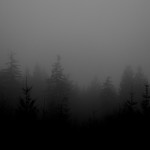


There is a delicious absurdity in the idea behind Jake Muir’s "Pareidolia": take the most atmospheric fragments from hundreds of death-metal and black-metal records, remove most of the things that would normally identify them as metal, slow them down until their bones become difficult to recognise, and then ask the listener to believe that something heavy is still happening. It sounds like an elaborate prank on genre taxonomy. It turns out to be considerably more serious than that.
The title provides the key. Pareidolia is the tendency to discover recognisable forms in random patterns: faces in clouds, animals in stains, divine apparitions in burnt toast, presumably Satan in an unfortunate patch of bathroom mould. Muir applies the same perceptual trick to sound. He wants us to hear metal where the obvious evidence of metal has largely disappeared. The riffs are no longer riffs in any conventional sense, the vocals have been reduced to spectral matter, the guitars become geological formations, and rhythm frequently evaporates altogether. Yet the music retains an unmistakable sense of menace.
Muir is particularly well suited to this kind of forensic listening. The Los Angeles-based artist, DJ and field recordist has built much of his practice around found sound and the transformation of material whose original context is gradually obscured. His previous work has moved through such unlikely territories as church bells and vintage erotic-film soundtracks, while "Talisman", his 2022 collaboration with Evan Caminiti, helped push him toward processing guitar and reconsidering his longstanding relationship with rock music. "Pareidolia" feels like the logical consequence of that investigation: less a tribute to metal than an archaeological excavation of the places where metal stops behaving like metal.
This distinction matters. Muir is not sampling the spectacular bits. There are no heroic solos here, no blast-beat fireworks, no growled declarations demanding that somebody open the gates of hell immediately. Instead, he has gone after the margins: introductions, interludes, atmospheric passages, sustained guitar textures and other moments that metal listeners may regard as connective tissue. By isolating them, he discovers that the supposedly secondary material was carrying an enormous amount of the genre’s emotional architecture all along.
"Beithir" establishes the method with a certain slyness. What might once have functioned as a prelude becomes the event itself. Guitar-derived textures stretch beyond their original proportions, losing the reassuring coordinates of song form. The sound is heavy without having to demonstrate heaviness. "Necrotic Mist" continues the process, with its title practically doing some of the listener's interpretive work in advance. The music itself is more ambiguous: something seems to be emerging from the murk, but every attempt to identify it makes it dissolve further.
Then comes "Unholy Apparitions", where Muir's sense of sonic misdirection becomes particularly effective. Foley-like noises, distorted vocal residues and unstable textures seem to occupy different layers of reality. Nothing quite announces its source. Instead of asking “What am I hearing?”, the track encourages the more irrational question “What does this sound resemble?” That small psychological shift is precisely where pareidolia begins.
"Oblivion" is among the album’s most convincing demonstrations of Muir’s central argument. Its slow-moving, doom-laden weight has the physical presence associated with extreme metal, but without the aggression normally required to communicate it. The piece does not attack. It looms. This is an important distinction, because "Pareidolia" repeatedly suggests that volume and heaviness are not synonymous. A sound can be enormous while remaining almost motionless. It can feel oppressive without actually becoming loud.
This is where the album brushes against dark ambient, drone and the more experimental descendants of industrial music. Comparisons with Lustmord are understandable, particularly because both artists understand that darkness can be constructed through scale, resonance and subtraction rather than through sheer sonic violence. But Muir's particular achievement is to retain a peculiar metallic tension inside those otherwise ambient structures. The guitars may have been chemically processed beyond recognition, yet something of their original threat survives.
"Each Uisge" makes the transformation almost beautiful. High-pitched guitar fragments rise over choral-like pads, while small vocal disturbances appear and vanish before they can become language. The title refers to a water spirit from Scottish folklore, and the music has an appropriately unstable quality: attractive enough to approach, strange enough to make approaching it seem like a questionable life decision.
"Celestial Visions" offers one of the album's more luminous passages, although Muir never allows brightness to become comfort. This is not ambient music designed to improve the user's morning routine, increase productivity or help them discover their inner chakras while answering emails. Its moments of beauty remain contaminated by the material from which they were extracted. The celestial is never entirely separated from the necrotic.
That tension becomes especially potent on "Anima". Here the decelerated metal vocabulary seems to acquire an almost sensual quality. Heavy guitar residues and metallic clatter are transformed into something slower, warmer and strangely intimate. It is a reminder that Muir's work has never been particularly interested in keeping genres in their assigned emotional departments. Eroticism can coexist with decay; tenderness can emerge from distortion; a black-metal guitar can become almost voluptuous once somebody stops insisting that it behave like a black-metal guitar.
The closing "Cathedral of Decay" gathers these contradictions rather beautifully. Its title sounds like something that should be printed in Gothic lettering on a shirt sold by a man who has not seen daylight since 1997, but the music itself is much more elusive. The “cathedral” is not a building so much as a spatial effect, constructed from resonance and distance. And “decay” is not simply horror. It is transformation, the gradual loss of a thing's original identity until another form becomes possible.
This is perhaps what separates "Pareidolia" from a clever sampling exercise. Muir is not simply demonstrating that metal contains ambient music. He is asking what remains of a genre once its recognisable gestures have been stripped away. If you remove the drums, the growls, the riff structures, the theatrical aggression and the cultural uniforms, can the underlying emotional substance survive?
His answer is an unexpectedly confident yes.
In fact, the album suggests something more provocative: perhaps some of metal's most powerful qualities were never located in its loudness at all. They were in its fascination with vastness, dread, ritual, repetition, altered states and sounds that seem to come from somewhere older and less hospitable than ordinary human life. Once those qualities are isolated, they do not necessarily need distortion pedals or a drummer with a personal vendetta against silence.
Muir's real sleight of hand, then, is not turning metal into ambient music. It is making us reconsider how little metal actually needs in order to remain metal.
"Pareidolia" leaves behind a strange residue, like finding an ancient symbol in a patch of moss and then becoming mildly concerned that the moss has noticed you. The original records are mostly invisible. Their identities have been blurred, stretched, liquefied and rearranged. Yet their emotional fingerprints remain.
Heavy music, Muir discovers, does not necessarily require impact. Sometimes all it needs is the suspicion that something enormous is hiding inside the fog.
Comments
Stream
Browse by Genre
Industrial Music / Industrial Metal / Aggro Industrial / Electro Metal
Industrial Noise / Power Noise / Harsh Noise
Synth Pop / Electro Pop / Synth-Electronica
Techno / Trance / Goa / Drum'n'Bass / Jungle / Tribal / Trip-Hop
Ambient / Electronica / Ethereal / Dub / Soundscapes / Abstract
Experimental / Avantgarde / Weird & Wired / Glitch / Noise / Field Recording
Dark / Gothic / Wave / New Wave / Dark Wave / Industrial Gothic
New Music / Downtown / Avantgarde Jazz / New Classical / World