
Tuesday, September 15, 2026
Futuro Ancestrale: Elsewhen
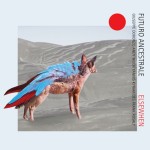
Artist: Futuro Ancestrale (@)
Title: Elsewhen
Format: CD
Label: Unsounds Records/Tora Records (@)
Rated:

Title: Elsewhen
Format: CD
Label: Unsounds Records/Tora Records (@)
Rated:
There is something wonderfully inconvenient about the title "Elsewhen". Not elsewhere, but else-when: an alternative time rather than an alternative place. It suggests that history might be less like a line than a badly organised cupboard, with different centuries and geographies rummaging around in the same drawer. Futuro Ancestrale’s second album takes precisely this temporal confusion as its playground, bringing together Giuseppe Doronzo’s baritone saxophone and an assortment of traditional instruments with the live electronics of Yannis Kyriakides, Andy Moor’s electric guitar and Frank Rosaly’s drums. The result is neither “world music” nor fusion in the conventional sense, but something considerably more slippery: a music in which old materials are allowed to become strange again.
Doronzo is particularly well equipped for this sort of mischief. Born in Barletta in 1987 and based in Amsterdam, he has developed a practice around the baritone saxophone that moves between contemporary composition, jazz improvisation, microtonality and non-Western traditions. His work with instruments such as the Iranian ney-anban, Chinese hulusi and Albanian longari has never amounted simply to collecting exotic timbres like musical fridge magnets. His interest lies in what happens when those sounds enter an improvisational environment and start behaving differently. Tora Records, the Amsterdam label he founded in 2018, has likewise become a home for music occupying the borderlands between improvisation, electro-acoustic composition and non-Western traditions.
On "Elsewhen", electronics are not pasted onto an ancestral vocabulary as some kind of futuristic wallpaper. They interfere with it. Kyriakides’ sampling and processing can make a flute seem briefly detached from its physical origin, while Moor and Rosaly provide a nervous, often surprisingly muscular framework in which these sounds can circulate. "Eye of the Hurricane" is a good example: the hulusi carries a breathy, almost folkloric identity, but the guitar and drums prevent it from settling comfortably into a picturesque pastoral scene. The electronic interventions further complicate the picture, turning recognisable acoustic gestures into fragments of another chronology. It is as if someone had placed an old photograph on a scanner and then decided that the scanner deserved a solo.
"Ghostline" works differently. The Albanian cyla dyjare, with its peculiar double-voice character, meets drums and electronics in a piece that seems to move rather than simply develop. There is something almost tactile about the way Doronzo’s instrumental colours are retained while being made unstable around the edges. The music does not imitate a shepherd wandering through some idealised Balkan landscape; it makes the very idea of musical memory slightly unreliable. What we hear feels inherited and newly manufactured at the same time.
That tension becomes particularly intriguing in "Scindone". The title refers to a peculiar belief from Lucanian folk medicine, where the scindone is a mysterious headache attributed to exposure to the sun after a day of working in the fields. According to the tradition, however, its real origin is considerably stranger: the condition can be contracted by urinating against a rainbow, after which it supposedly torments the victim throughout the night. The cure is no less ritualistic: before sunrise, the afflicted person must leave the house without speaking to anyone, pass beneath three masonry arches and repeat a protective formula. It is an extraordinary piece of popular imagination, somewhere between medical explanation, superstition and ceremonial magic, and it gives the track an altogether different historical resonance. In this context, Scindone becomes more than a reference to an old Apulian or Southern Italian custom. It evokes a world in which illness, landscape, weather, work and the supernatural are still entangled, where the boundaries between physical experience and symbolic belief have never been tidied up by modernity. Doronzo does not attempt to reconstruct that world literally. Instead, its strange logic seems to seep into the music, adding another layer to "Elsewhen"’s fascination with forms of knowledge that survive outside official histories. The past here is not noble, picturesque or conveniently ancient. It is superstitious, bodily, occasionally absurd and wonderfully difficult to explain, which may be precisely why it remains so evocative.
The same principle governs "Faló", inspired by the Chadian kakaki and by seasonal fire rituals. The piece has a ceremonial quality, but not the sort that demands incense and a respectful silence from the listener. Rosaly’s percussion gives it physical weight, while the electronic treatment and Doronzo’s instrumental interventions prevent the ritual atmosphere from becoming decorative. "Saturno", "Blind Needle" and "Underrun" move further into less obviously folkloric territory, where the album’s vocabulary begins to feel increasingly hybrid. The instruments cease to function as cultural labels and become active participants in an evolving sonic grammar.
This is also where the presence of Andy Moor becomes important. His guitar does not behave like the polite Western representative invited to the intercultural dinner to demonstrate that everyone can get along. His abrasive, electronically extended vocabulary has long belonged to the more unruly corners of European improvisation, from The Ex and Dog Faced Hermans to Lean Left and numerous collaborations. In Futuro Ancestrale he provides friction rather than validation. Frank Rosaly, meanwhile, is equally capable of resisting the obvious role of “the drummer”: his percussion can establish pulse, density or suspense, but it also leaves considerable negative space around the other musicians. Earlier criticism of the trio’s first album already noticed their unusual restraint, particularly in the way Rosaly and Moor avoided turning Doronzo’s unusual instrumental palette into an excuse for perpetual sonic assault.
The arrival of Kyriakides changes the equation substantially. His electronics make "Elsewhen" feel less like an expansion of the first Futuro Ancestrale album than a mutation of it. The earlier trio recording, "Futuro Ancestrale" (Clean Feed, 2024), was recorded live at Amsterdam’s Bimhuis and already explored the collision of baritone saxophone, guitar, percussion and non-Western instruments. Reviews of that album repeatedly identified its unusual balance between heaviness, space, ritual suggestion and improvisational freedom. "Elsewhen" takes that vocabulary and introduces a technological layer capable of altering the evidence while it is being presented.
That makes the album’s recurring fascination with duality more than a conceptual decoration. Acoustic/electronic, ancient/contemporary, composed/improvised, local/distant: these oppositions are constantly being proposed and then quietly sabotaged. "Elsewhen" is strongest when it refuses to decide which side belongs to which era. The hulusi can sound futuristic; the electronics can acquire something almost archaeological; the baritone saxophone can become less a jazz instrument than a large breathing machine whose ancestry is temporarily unavailable.
There is also a more delicate question underneath all this cultural cross-pollination. How do you use instruments associated with particular traditions without reducing them to exotic colour? Futuro Ancestrale does not solve that problem through reverence. It approaches it through interaction. The traditional instruments are not placed behind glass, but neither are they stripped of their identities and thrown into an anonymous experimental soup. Their distinct timbres remain audible while the surrounding musicians continuously challenge what those timbres are allowed to mean. That distinction matters.
The album’s nine pieces therefore feel less like compositions about the past than experiments in how the past behaves once it has been electrically disturbed. "Driftlight", the closing eight-minute piece, is especially effective in this respect, leaving enough space for the album’s various temporal layers to coexist without demanding a grand finale. There is no neat reconciliation, no ceremonial handshake between ancestors and synthesizers. Civilization survives another album without finding a solution to history, which is probably for the best.
Doronzo’s music has always seemed interested in the possibility that tradition can remain alive precisely by refusing to remain unchanged. "Elsewhen" pushes that idea further. Its “ancestral” material is not there to certify authenticity, while its futuristic electronics are not there to certify modernity. Both are simply materials, vulnerable to transformation, misunderstanding, collision and rediscovery. The album’s real subject is therefore not cultural fusion but temporal friction: the strange moment when something very old becomes unfamiliar again.
And perhaps that is why "Elsewhen" works. It does not ask the past to explain the present, nor does it ask the future to rescue it. It lets different times interfere with one another until their boundaries become audible rather than theoretical. Somewhere between Doronzo’s deep baritone, a double flute from Albania, a Chinese gourd flute, Moor’s guitar, Rosaly’s percussion and Kyriakides’ restless electronics, history stops behaving like history and starts behaving like sound.
Doronzo is particularly well equipped for this sort of mischief. Born in Barletta in 1987 and based in Amsterdam, he has developed a practice around the baritone saxophone that moves between contemporary composition, jazz improvisation, microtonality and non-Western traditions. His work with instruments such as the Iranian ney-anban, Chinese hulusi and Albanian longari has never amounted simply to collecting exotic timbres like musical fridge magnets. His interest lies in what happens when those sounds enter an improvisational environment and start behaving differently. Tora Records, the Amsterdam label he founded in 2018, has likewise become a home for music occupying the borderlands between improvisation, electro-acoustic composition and non-Western traditions.
On "Elsewhen", electronics are not pasted onto an ancestral vocabulary as some kind of futuristic wallpaper. They interfere with it. Kyriakides’ sampling and processing can make a flute seem briefly detached from its physical origin, while Moor and Rosaly provide a nervous, often surprisingly muscular framework in which these sounds can circulate. "Eye of the Hurricane" is a good example: the hulusi carries a breathy, almost folkloric identity, but the guitar and drums prevent it from settling comfortably into a picturesque pastoral scene. The electronic interventions further complicate the picture, turning recognisable acoustic gestures into fragments of another chronology. It is as if someone had placed an old photograph on a scanner and then decided that the scanner deserved a solo.
"Ghostline" works differently. The Albanian cyla dyjare, with its peculiar double-voice character, meets drums and electronics in a piece that seems to move rather than simply develop. There is something almost tactile about the way Doronzo’s instrumental colours are retained while being made unstable around the edges. The music does not imitate a shepherd wandering through some idealised Balkan landscape; it makes the very idea of musical memory slightly unreliable. What we hear feels inherited and newly manufactured at the same time.
That tension becomes particularly intriguing in "Scindone". The title refers to a peculiar belief from Lucanian folk medicine, where the scindone is a mysterious headache attributed to exposure to the sun after a day of working in the fields. According to the tradition, however, its real origin is considerably stranger: the condition can be contracted by urinating against a rainbow, after which it supposedly torments the victim throughout the night. The cure is no less ritualistic: before sunrise, the afflicted person must leave the house without speaking to anyone, pass beneath three masonry arches and repeat a protective formula. It is an extraordinary piece of popular imagination, somewhere between medical explanation, superstition and ceremonial magic, and it gives the track an altogether different historical resonance. In this context, Scindone becomes more than a reference to an old Apulian or Southern Italian custom. It evokes a world in which illness, landscape, weather, work and the supernatural are still entangled, where the boundaries between physical experience and symbolic belief have never been tidied up by modernity. Doronzo does not attempt to reconstruct that world literally. Instead, its strange logic seems to seep into the music, adding another layer to "Elsewhen"’s fascination with forms of knowledge that survive outside official histories. The past here is not noble, picturesque or conveniently ancient. It is superstitious, bodily, occasionally absurd and wonderfully difficult to explain, which may be precisely why it remains so evocative.
The same principle governs "Faló", inspired by the Chadian kakaki and by seasonal fire rituals. The piece has a ceremonial quality, but not the sort that demands incense and a respectful silence from the listener. Rosaly’s percussion gives it physical weight, while the electronic treatment and Doronzo’s instrumental interventions prevent the ritual atmosphere from becoming decorative. "Saturno", "Blind Needle" and "Underrun" move further into less obviously folkloric territory, where the album’s vocabulary begins to feel increasingly hybrid. The instruments cease to function as cultural labels and become active participants in an evolving sonic grammar.
This is also where the presence of Andy Moor becomes important. His guitar does not behave like the polite Western representative invited to the intercultural dinner to demonstrate that everyone can get along. His abrasive, electronically extended vocabulary has long belonged to the more unruly corners of European improvisation, from The Ex and Dog Faced Hermans to Lean Left and numerous collaborations. In Futuro Ancestrale he provides friction rather than validation. Frank Rosaly, meanwhile, is equally capable of resisting the obvious role of “the drummer”: his percussion can establish pulse, density or suspense, but it also leaves considerable negative space around the other musicians. Earlier criticism of the trio’s first album already noticed their unusual restraint, particularly in the way Rosaly and Moor avoided turning Doronzo’s unusual instrumental palette into an excuse for perpetual sonic assault.
The arrival of Kyriakides changes the equation substantially. His electronics make "Elsewhen" feel less like an expansion of the first Futuro Ancestrale album than a mutation of it. The earlier trio recording, "Futuro Ancestrale" (Clean Feed, 2024), was recorded live at Amsterdam’s Bimhuis and already explored the collision of baritone saxophone, guitar, percussion and non-Western instruments. Reviews of that album repeatedly identified its unusual balance between heaviness, space, ritual suggestion and improvisational freedom. "Elsewhen" takes that vocabulary and introduces a technological layer capable of altering the evidence while it is being presented.
That makes the album’s recurring fascination with duality more than a conceptual decoration. Acoustic/electronic, ancient/contemporary, composed/improvised, local/distant: these oppositions are constantly being proposed and then quietly sabotaged. "Elsewhen" is strongest when it refuses to decide which side belongs to which era. The hulusi can sound futuristic; the electronics can acquire something almost archaeological; the baritone saxophone can become less a jazz instrument than a large breathing machine whose ancestry is temporarily unavailable.
There is also a more delicate question underneath all this cultural cross-pollination. How do you use instruments associated with particular traditions without reducing them to exotic colour? Futuro Ancestrale does not solve that problem through reverence. It approaches it through interaction. The traditional instruments are not placed behind glass, but neither are they stripped of their identities and thrown into an anonymous experimental soup. Their distinct timbres remain audible while the surrounding musicians continuously challenge what those timbres are allowed to mean. That distinction matters.
The album’s nine pieces therefore feel less like compositions about the past than experiments in how the past behaves once it has been electrically disturbed. "Driftlight", the closing eight-minute piece, is especially effective in this respect, leaving enough space for the album’s various temporal layers to coexist without demanding a grand finale. There is no neat reconciliation, no ceremonial handshake between ancestors and synthesizers. Civilization survives another album without finding a solution to history, which is probably for the best.
Doronzo’s music has always seemed interested in the possibility that tradition can remain alive precisely by refusing to remain unchanged. "Elsewhen" pushes that idea further. Its “ancestral” material is not there to certify authenticity, while its futuristic electronics are not there to certify modernity. Both are simply materials, vulnerable to transformation, misunderstanding, collision and rediscovery. The album’s real subject is therefore not cultural fusion but temporal friction: the strange moment when something very old becomes unfamiliar again.
And perhaps that is why "Elsewhen" works. It does not ask the past to explain the present, nor does it ask the future to rescue it. It lets different times interfere with one another until their boundaries become audible rather than theoretical. Somewhere between Doronzo’s deep baritone, a double flute from Albania, a Chinese gourd flute, Moor’s guitar, Rosaly’s percussion and Kyriakides’ restless electronics, history stops behaving like history and starts behaving like sound.
Comments
Stream
Browse by Genre
Industrial Music / Industrial Metal / Aggro Industrial / Electro Metal
Industrial Noise / Power Noise / Harsh Noise
Synth Pop / Electro Pop / Synth-Electronica
Techno / Trance / Goa / Drum'n'Bass / Jungle / Tribal / Trip-Hop
Ambient / Electronica / Ethereal / Dub / Soundscapes / Abstract
Experimental / Avantgarde / Weird & Wired / Glitch / Noise / Field Recording
Dark / Gothic / Wave / New Wave / Dark Wave / Industrial Gothic
New Music / Downtown / Avantgarde Jazz / New Classical / World