
Wednesday, September 23, 2026
Mariam Wallentin & Vestnorsk Jazzensemble: Spring Flood
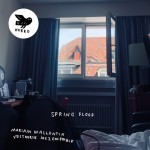
Artist: Mariam Wallentin & Vestnorsk Jazzensemble (@)
Title: Spring Flood
Format: LP
Label: Hubro (@)
Rated:

Title: Spring Flood
Format: LP
Label: Hubro (@)
Rated:
There is a particular danger in making an album about spring. Flowers, rivers, awakening bodies, longing, pale light, new beginnings: human beings have been putting these things into poems and songs for so long that one half expects a daffodil to arrive with its own publishing contract. "Spring Flood", however, manages to approach this familiar territory without turning it into a scented candle. Its spring is not merely pretty. It is restless, physical, slightly unruly, and very much alive.
The album began with Mariam Wallentin’s stay in Basel in May 2023, where the Rhine became both background noise and a stimulus for writing. The resulting notes, later brought to Bergen, were not treated as finished compositions so much as material to be opened up. Two days of recording with Vestnorsk Jazzensemble transformed these fragments into something considerably less private: a collective music in which Wallentin’s voice is constantly being reframed by strings, harp, trumpet, saxophones, electric guitar, bass and two drummers. This is important, because "Spring Flood" does not sound like a singer accompanied by a large jazz ensemble. It sounds like a singer entering a room where several different kinds of weather are already taking place.
Wallentin has spent much of her career refusing the polite border between experimental music, improvisation, jazz, soul and alternative song. Her work with Wildbirds & Peacedrums and Fire! Orchestra, alongside her Mariam The Believer project, has given her plenty of experience in treating the voice as something more flexible than a device for delivering melodies. Here she often sings as though language were another instrumental material, something capable of leaning into the arrangements, disappearing inside them or suddenly acquiring enormous physical presence. The ensemble, meanwhile, is not content to provide atmospheric decoration. Its strings can scratch and hover, the harp can glitter without becoming angelic, the horns can introduce colour or pressure, while the two-drum setup gives the music a curious elasticity: sometimes it moves like water, sometimes like a body that has just remembered it possesses muscles.
“Blanket Dance” establishes much of this vocabulary without immediately explaining it. The piece feels intimate and unstable in equal measure, its textures continually negotiating between delicacy and weight. “Basel” makes the geographical origin of the material less important than the sensation of being temporarily displaced. There is something wonderfully un-touristic about it. This is not music about visiting a beautiful European city and having thoughts beside a river; it is about what happens when a familiar inner life is forced to accommodate unfamiliar surroundings. The Rhine becomes less a subject than a pressure exerted on the music, a continuous movement against which Wallentin’s voice can measure itself.
“Red” is more overtly physical, its pulse suggesting the moment when contemplation starts becoming inconveniently corporeal. Spring here is not the gentle rebirth of greeting-card mythology but an increase in circulation, temperature and appetite. The colour is almost audible in the way the ensemble gathers intensity, with percussion and winds pushing the piece forward while the voice retains a certain vulnerability. “No Now”, by contrast, is barely long enough to settle into ordinary song form, functioning almost like a thought that interrupts itself. The album is particularly good at these changes of scale. A two-minute piece can carry as much psychological weight as a seven-minute one because Wallentin does not seem interested in filling time merely because the album has been given a running order.
“Love is Fire”, originally associated with Wildbirds & Peacedrums, introduces another useful complication. Returning to earlier material within a new collective setting could easily have become nostalgic, but here the song seems less like a look backwards than an opportunity to test what survives when the surrounding language changes. The familiar is made strange without being destroyed. That tension runs through the whole record: Basel and Bergen, private notes and public performance, composition and improvisation, tenderness and agitation, the individual voice and a group capable of swallowing it whole and then giving it back transformed.
What makes Vestnorsk Jazzensemble particularly well suited to this material is its very nature as a project-based formation rather than a permanently fixed band. The personnel can change according to the composer and the project, which means that the ensemble is less an established sound than a musical organism repeatedly assembled for particular circumstances. Kjetil Møster’s presence is especially telling, given his long involvement with Norwegian experimental jazz and his ability to inhabit both composed and improvisational environments without treating them as opposing camps. Here, nobody seems excessively interested in demonstrating how adventurous they are. The musicians listen, react, interrupt, reinforce and occasionally get out of the way. This sounds simple. It is not. Musicians are notoriously bad at leaving interesting space alone.
The final three pieces sharpen the album’s underlying idea of movement. “Wide” expands the palette without simply making everything louder, while “Now” reduces the music almost to a momentary intake of breath. Then the title track arrives for less than two minutes, and its brevity is exactly right. Rather than providing a grand finale, "Spring Flood" ends as though the phenomenon itself has passed through the room and is already continuing somewhere else. The river does not care about your preferred album structure.
That may ultimately be the record’s most convincing quality. Wallentin starts from highly personal material, but the musicians prevent it from remaining enclosed within autobiography. Feelings become textures, memories become rhythmic impulses, colours become arranging principles, and landscape becomes a set of relationships between sounds. The album is sensual without being decorative, poetic without becoming precious, and improvisational without confusing spontaneity with randomness.
"Spring Flood" understands that renewal is rarely as tidy as we would like it to be. Things thaw, swell, collide, become excessive, become beautiful, become inconvenient. Something buried starts moving again, and suddenly everybody has to deal with it. That is a rather more convincing definition of spring than the usual collection of pastel flowers.
The album began with Mariam Wallentin’s stay in Basel in May 2023, where the Rhine became both background noise and a stimulus for writing. The resulting notes, later brought to Bergen, were not treated as finished compositions so much as material to be opened up. Two days of recording with Vestnorsk Jazzensemble transformed these fragments into something considerably less private: a collective music in which Wallentin’s voice is constantly being reframed by strings, harp, trumpet, saxophones, electric guitar, bass and two drummers. This is important, because "Spring Flood" does not sound like a singer accompanied by a large jazz ensemble. It sounds like a singer entering a room where several different kinds of weather are already taking place.
Wallentin has spent much of her career refusing the polite border between experimental music, improvisation, jazz, soul and alternative song. Her work with Wildbirds & Peacedrums and Fire! Orchestra, alongside her Mariam The Believer project, has given her plenty of experience in treating the voice as something more flexible than a device for delivering melodies. Here she often sings as though language were another instrumental material, something capable of leaning into the arrangements, disappearing inside them or suddenly acquiring enormous physical presence. The ensemble, meanwhile, is not content to provide atmospheric decoration. Its strings can scratch and hover, the harp can glitter without becoming angelic, the horns can introduce colour or pressure, while the two-drum setup gives the music a curious elasticity: sometimes it moves like water, sometimes like a body that has just remembered it possesses muscles.
“Blanket Dance” establishes much of this vocabulary without immediately explaining it. The piece feels intimate and unstable in equal measure, its textures continually negotiating between delicacy and weight. “Basel” makes the geographical origin of the material less important than the sensation of being temporarily displaced. There is something wonderfully un-touristic about it. This is not music about visiting a beautiful European city and having thoughts beside a river; it is about what happens when a familiar inner life is forced to accommodate unfamiliar surroundings. The Rhine becomes less a subject than a pressure exerted on the music, a continuous movement against which Wallentin’s voice can measure itself.
“Red” is more overtly physical, its pulse suggesting the moment when contemplation starts becoming inconveniently corporeal. Spring here is not the gentle rebirth of greeting-card mythology but an increase in circulation, temperature and appetite. The colour is almost audible in the way the ensemble gathers intensity, with percussion and winds pushing the piece forward while the voice retains a certain vulnerability. “No Now”, by contrast, is barely long enough to settle into ordinary song form, functioning almost like a thought that interrupts itself. The album is particularly good at these changes of scale. A two-minute piece can carry as much psychological weight as a seven-minute one because Wallentin does not seem interested in filling time merely because the album has been given a running order.
“Love is Fire”, originally associated with Wildbirds & Peacedrums, introduces another useful complication. Returning to earlier material within a new collective setting could easily have become nostalgic, but here the song seems less like a look backwards than an opportunity to test what survives when the surrounding language changes. The familiar is made strange without being destroyed. That tension runs through the whole record: Basel and Bergen, private notes and public performance, composition and improvisation, tenderness and agitation, the individual voice and a group capable of swallowing it whole and then giving it back transformed.
What makes Vestnorsk Jazzensemble particularly well suited to this material is its very nature as a project-based formation rather than a permanently fixed band. The personnel can change according to the composer and the project, which means that the ensemble is less an established sound than a musical organism repeatedly assembled for particular circumstances. Kjetil Møster’s presence is especially telling, given his long involvement with Norwegian experimental jazz and his ability to inhabit both composed and improvisational environments without treating them as opposing camps. Here, nobody seems excessively interested in demonstrating how adventurous they are. The musicians listen, react, interrupt, reinforce and occasionally get out of the way. This sounds simple. It is not. Musicians are notoriously bad at leaving interesting space alone.
The final three pieces sharpen the album’s underlying idea of movement. “Wide” expands the palette without simply making everything louder, while “Now” reduces the music almost to a momentary intake of breath. Then the title track arrives for less than two minutes, and its brevity is exactly right. Rather than providing a grand finale, "Spring Flood" ends as though the phenomenon itself has passed through the room and is already continuing somewhere else. The river does not care about your preferred album structure.
That may ultimately be the record’s most convincing quality. Wallentin starts from highly personal material, but the musicians prevent it from remaining enclosed within autobiography. Feelings become textures, memories become rhythmic impulses, colours become arranging principles, and landscape becomes a set of relationships between sounds. The album is sensual without being decorative, poetic without becoming precious, and improvisational without confusing spontaneity with randomness.
"Spring Flood" understands that renewal is rarely as tidy as we would like it to be. Things thaw, swell, collide, become excessive, become beautiful, become inconvenient. Something buried starts moving again, and suddenly everybody has to deal with it. That is a rather more convincing definition of spring than the usual collection of pastel flowers.
Comments
Stream
Browse by Genre
Industrial Music / Industrial Metal / Aggro Industrial / Electro Metal
Industrial Noise / Power Noise / Harsh Noise
Synth Pop / Electro Pop / Synth-Electronica
Techno / Trance / Goa / Drum'n'Bass / Jungle / Tribal / Trip-Hop
Ambient / Electronica / Ethereal / Dub / Soundscapes / Abstract
Experimental / Avantgarde / Weird & Wired / Glitch / Noise / Field Recording
Dark / Gothic / Wave / New Wave / Dark Wave / Industrial Gothic
New Music / Downtown / Avantgarde Jazz / New Classical / World