
Saturday, September 26, 2026
Bertoncini · Kocher · Lehn: Critical Values
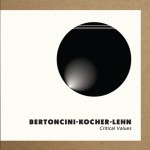
Artist: Bertoncini · Kocher · Lehn (http://www.thomaslehn.com) (@)
Title: Critical Values
Format: CD + Download
Label: Bruit Editions (@)
Rated:

Title: Critical Values
Format: CD + Download
Label: Bruit Editions (@)
Rated:
Improvised music sometimes gets described as though the musicians have simply agreed to remove the safety rails and see what happens. "Critical Values" suggests something more demanding: three experienced players meeting for the first time and discovering, in real time, which sounds can survive contact with one another. Tiziana Bertoncini’s violin, Jonas Kocher’s accordion and Thomas Lehn’s analogue synthesizer and processing do not form a conventional trio so much as a small laboratory in which acoustic identity is repeatedly placed under pressure. The laboratory happens to have microphones, and thankfully nobody is wearing a white coat.
The recording comes from a single encounter at La Voirie in Biel/Bienne on 17 September 2025, divided into just two pieces, “Complex Plane” and “Bifurcation Points”, lasting roughly twenty-three and twenty minutes respectively. Nothing has been edited or rearranged afterwards. That decision matters because the music depends on the gradual accumulation of microscopic reactions. It is not trying to give the impression of spontaneity. It actually preserves the consequences of spontaneity, including the moments when an idea has to be abandoned because another sound has unexpectedly changed the conditions around it.
Bertoncini and Lehn bring a particularly long history of musical conversation to the meeting. They have worked together since the early 2000s, developing a language in which her classically trained violin can become brittle, granular, skeletal or strangely vocal while Lehn’s analogue electronics respond not merely by accompanying it but by transforming its acoustic implications. Bertoncini’s background is unusually divided between music and visual art: after classical violin studies she also studied painting, and that visual dimension has remained part of her wider practice through installations and interdisciplinary projects. It is tempting to describe her playing in visual terms, therefore, but the more interesting thing is that she often seems to manipulate density and contour as though sound had physical edges.
Lehn has an equally distinctive history. Trained in piano and sound engineering, he has worked with analogue synthesizer systems since the late 1980s and has become one of the central figures in European live electronics, collaborating with musicians ranging from free improvisers to composers of rigorously notated experimental music. His electronics here are particularly effective because they rarely behave like an ornamental electronic layer placed underneath the violin and accordion. They alter the apparent material of the other instruments. A violin attack can become a residue; an accordion tone can acquire a metallic shadow; a tiny acoustic gesture can return with its dimensions quietly rearranged.
Kocher enters this established dyad as the destabilising third presence, although “destabilising” should not be mistaken for “chaotic”. The accordion is an instrument with an unfortunate public-relations problem: it arrives carrying decades of folk clichés, cabaret associations and the faint possibility of someone requesting a waltz. Kocher has spent years dismantling that baggage through improvisation, composition and interdisciplinary work, and here the instrument is treated primarily as a generator of pressure, friction, breath and resonance. Its familiar identity is still present, but it is increasingly difficult to locate.
“Complex Plane” develops through precisely this uncertainty. The opening does not announce a hierarchy. Instead, sounds seem to test their own boundaries, appearing as isolated events before gradually entering relationships with the others. Bertoncini can produce a narrow, almost threadlike violin presence, while Kocher introduces unstable pneumatic textures and Lehn expands or contaminates the acoustic information. The piece advances without conventional rhythmic propulsion, yet it is never static. Its movement occurs through changes in density, duration, register and response. One sound causes another to alter its behaviour, and suddenly what seemed like three independent streams has become a single unstable mechanism.
The title “Complex Plane” is particularly apt without requiring a mathematical lecture, for which everyone should be grateful. The music seems to operate through coordinates that are constantly being recalculated. A sound is not simply high or low, loud or quiet, acoustic or electronic. Its significance depends on what the other instruments are doing at that precise moment. A thin violin squeak can become substantial when surrounded by near-silence; an apparently massive electronic tone can become almost weightless when the violin cuts across it. Scale is therefore psychological rather than fixed.
“Bifurcation Points” is more restless. Its sounds appear to approach thresholds, hesitate and then split into different directions. The accordion becomes especially useful here because its physical mechanism already contains a peculiar contradiction: air produces sound, but the player can manipulate that airflow with almost absurdly fine control. Kocher exploits the instrument's capacity for pressure and interruption, while Bertoncini's violin supplies another kind of instability, moving between recognisable instrumental gestures and sounds that seem to have escaped from the instrument before anyone could identify them.
Lehn’s role is crucial in keeping this from becoming a mere catalogue of extended techniques. His processing creates relationships between sounds rather than simply making them more unusual. At times the electronics appear to enlarge microscopic details until they acquire their own environment; elsewhere they remain almost hidden, changing the listener’s perception without announcing their presence. The effect is less “electronic versus acoustic” than a continual uncertainty about where one ends and the other begins.
There is also something refreshingly physical about the recording. Despite the sophistication of the players, "Critical Values" never sounds like a demonstration of specialist knowledge. You can hear musicians listening, withholding, testing, retreating and returning. Silence becomes an active participant rather than a decorative pause, and individual gestures acquire importance because nobody rushes to fill the space after them. This is one of the reasons the uninterrupted nature of the performance works so well. The music retains its little hesitations and changes of direction, the places where thought can almost be heard happening.
The album's most compelling achievement is consequently not any particular unusual sound. It is the creation of a situation in which sounds are allowed to change their identity through proximity. The violin does not remain “the violin”, the accordion does not remain “the accordion”, and the synthesizer does not simply stand on the other side of an imaginary technological border. Each instrument becomes a set of possibilities that the others continually reshape.
That process also explains why "Critical Values" rewards attention without demanding reverence. It is austere in materials but surprisingly rich in incident. The music does not decorate its ideas, and it does not tell the listener where the important moment is supposed to occur. Instead, importance emerges retrospectively: a tiny noise heard several minutes earlier suddenly makes sense because the trio has moved somewhere else.
Perhaps that is the real meaning of the album's title. The critical value is not a particular point on a graph but the instant when a sound stops behaving as expected. A violin ceases to sound like a violin. An accordion becomes an acoustic machine. An electronic pulse acquires something almost tactile. Three musicians who have never previously made this exact conversation discover that the most interesting territory lies neither in agreement nor conflict, but in the unstable region where one sound forces another to reconsider what it is.
For forty-four minutes, "Critical Values" keeps returning to that region without settling it. No grand climax is required. The experiment works because nobody tries to prove that it has worked. The music simply keeps changing the conditions under which its own sounds can exist, which is perhaps the most convincing form of improvisational intelligence: not knowing what comes next, but being sufficiently attentive to recognise it when it arrives.
The recording comes from a single encounter at La Voirie in Biel/Bienne on 17 September 2025, divided into just two pieces, “Complex Plane” and “Bifurcation Points”, lasting roughly twenty-three and twenty minutes respectively. Nothing has been edited or rearranged afterwards. That decision matters because the music depends on the gradual accumulation of microscopic reactions. It is not trying to give the impression of spontaneity. It actually preserves the consequences of spontaneity, including the moments when an idea has to be abandoned because another sound has unexpectedly changed the conditions around it.
Bertoncini and Lehn bring a particularly long history of musical conversation to the meeting. They have worked together since the early 2000s, developing a language in which her classically trained violin can become brittle, granular, skeletal or strangely vocal while Lehn’s analogue electronics respond not merely by accompanying it but by transforming its acoustic implications. Bertoncini’s background is unusually divided between music and visual art: after classical violin studies she also studied painting, and that visual dimension has remained part of her wider practice through installations and interdisciplinary projects. It is tempting to describe her playing in visual terms, therefore, but the more interesting thing is that she often seems to manipulate density and contour as though sound had physical edges.
Lehn has an equally distinctive history. Trained in piano and sound engineering, he has worked with analogue synthesizer systems since the late 1980s and has become one of the central figures in European live electronics, collaborating with musicians ranging from free improvisers to composers of rigorously notated experimental music. His electronics here are particularly effective because they rarely behave like an ornamental electronic layer placed underneath the violin and accordion. They alter the apparent material of the other instruments. A violin attack can become a residue; an accordion tone can acquire a metallic shadow; a tiny acoustic gesture can return with its dimensions quietly rearranged.
Kocher enters this established dyad as the destabilising third presence, although “destabilising” should not be mistaken for “chaotic”. The accordion is an instrument with an unfortunate public-relations problem: it arrives carrying decades of folk clichés, cabaret associations and the faint possibility of someone requesting a waltz. Kocher has spent years dismantling that baggage through improvisation, composition and interdisciplinary work, and here the instrument is treated primarily as a generator of pressure, friction, breath and resonance. Its familiar identity is still present, but it is increasingly difficult to locate.
“Complex Plane” develops through precisely this uncertainty. The opening does not announce a hierarchy. Instead, sounds seem to test their own boundaries, appearing as isolated events before gradually entering relationships with the others. Bertoncini can produce a narrow, almost threadlike violin presence, while Kocher introduces unstable pneumatic textures and Lehn expands or contaminates the acoustic information. The piece advances without conventional rhythmic propulsion, yet it is never static. Its movement occurs through changes in density, duration, register and response. One sound causes another to alter its behaviour, and suddenly what seemed like three independent streams has become a single unstable mechanism.
The title “Complex Plane” is particularly apt without requiring a mathematical lecture, for which everyone should be grateful. The music seems to operate through coordinates that are constantly being recalculated. A sound is not simply high or low, loud or quiet, acoustic or electronic. Its significance depends on what the other instruments are doing at that precise moment. A thin violin squeak can become substantial when surrounded by near-silence; an apparently massive electronic tone can become almost weightless when the violin cuts across it. Scale is therefore psychological rather than fixed.
“Bifurcation Points” is more restless. Its sounds appear to approach thresholds, hesitate and then split into different directions. The accordion becomes especially useful here because its physical mechanism already contains a peculiar contradiction: air produces sound, but the player can manipulate that airflow with almost absurdly fine control. Kocher exploits the instrument's capacity for pressure and interruption, while Bertoncini's violin supplies another kind of instability, moving between recognisable instrumental gestures and sounds that seem to have escaped from the instrument before anyone could identify them.
Lehn’s role is crucial in keeping this from becoming a mere catalogue of extended techniques. His processing creates relationships between sounds rather than simply making them more unusual. At times the electronics appear to enlarge microscopic details until they acquire their own environment; elsewhere they remain almost hidden, changing the listener’s perception without announcing their presence. The effect is less “electronic versus acoustic” than a continual uncertainty about where one ends and the other begins.
There is also something refreshingly physical about the recording. Despite the sophistication of the players, "Critical Values" never sounds like a demonstration of specialist knowledge. You can hear musicians listening, withholding, testing, retreating and returning. Silence becomes an active participant rather than a decorative pause, and individual gestures acquire importance because nobody rushes to fill the space after them. This is one of the reasons the uninterrupted nature of the performance works so well. The music retains its little hesitations and changes of direction, the places where thought can almost be heard happening.
The album's most compelling achievement is consequently not any particular unusual sound. It is the creation of a situation in which sounds are allowed to change their identity through proximity. The violin does not remain “the violin”, the accordion does not remain “the accordion”, and the synthesizer does not simply stand on the other side of an imaginary technological border. Each instrument becomes a set of possibilities that the others continually reshape.
That process also explains why "Critical Values" rewards attention without demanding reverence. It is austere in materials but surprisingly rich in incident. The music does not decorate its ideas, and it does not tell the listener where the important moment is supposed to occur. Instead, importance emerges retrospectively: a tiny noise heard several minutes earlier suddenly makes sense because the trio has moved somewhere else.
Perhaps that is the real meaning of the album's title. The critical value is not a particular point on a graph but the instant when a sound stops behaving as expected. A violin ceases to sound like a violin. An accordion becomes an acoustic machine. An electronic pulse acquires something almost tactile. Three musicians who have never previously made this exact conversation discover that the most interesting territory lies neither in agreement nor conflict, but in the unstable region where one sound forces another to reconsider what it is.
For forty-four minutes, "Critical Values" keeps returning to that region without settling it. No grand climax is required. The experiment works because nobody tries to prove that it has worked. The music simply keeps changing the conditions under which its own sounds can exist, which is perhaps the most convincing form of improvisational intelligence: not knowing what comes next, but being sufficiently attentive to recognise it when it arrives.
Comments
Stream
Browse by Genre
Industrial Music / Industrial Metal / Aggro Industrial / Electro Metal
Industrial Noise / Power Noise / Harsh Noise
Synth Pop / Electro Pop / Synth-Electronica
Techno / Trance / Goa / Drum'n'Bass / Jungle / Tribal / Trip-Hop
Ambient / Electronica / Ethereal / Dub / Soundscapes / Abstract
Experimental / Avantgarde / Weird & Wired / Glitch / Noise / Field Recording
Dark / Gothic / Wave / New Wave / Dark Wave / Industrial Gothic
New Music / Downtown / Avantgarde Jazz / New Classical / World