
Michael Meier & Christoph Franz: The Rhythm of Design
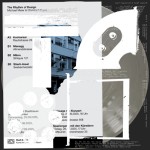
Artist: Michael Meier & Christoph Franz (@)
Title: The Rhythm of Design
Format: 12" + Download
Label: Präsens Editionen (@)
Rated:

Title: The Rhythm of Design
Format: 12" + Download
Label: Präsens Editionen (@)
Rated:
There is something almost perversely appropriate about turning the disappearance of music venues into a record, since vinyl is itself a rather good machine for preserving things that no longer exist. Michael Meier & Christoph Franz’s "The Rhythm of Design" takes this contradiction seriously, but without turning it into an exercise in cultural mourning. The Zürich-based artistic duo, whose research-driven practice repeatedly examines the social and historical layers embedded in built environments, began with six places connected to the city’s music scene: Club Zukunft, Giesshübel, Kochareal, Manegg, Mikro and Stierli-Areal. Some had already disappeared, others were threatened by redevelopment or changing urban priorities. Instead of simply photographing the remains and attaching a solemn text about gentrification, Meier & Franz removed pieces of the places themselves and had them transformed into six playable instruments with the help of specialist instrument builders. It is a beautifully literal idea: if the room is going to vanish, at least let it make some noise on the way out.
The conceptual elegance of "The Rhythm of Design" lies precisely in its refusal to separate architecture from music. The materials are not merely symbolic souvenirs of the venues; they become active components in a new musical process. Kalabrese, Tobibi Ferrari-Bienz, Rafal Skoczek, Lucien Badoux & Jeremy Sauter, Nicola Kazimir and Dualism were each asked to compose for one of these newly constructed instruments, resulting in six pieces whose stylistic coordinates stretch from experimental funk and punk towards kraut, noise and drone. The variety is important. A memorial made from a single aesthetic would risk turning a living musical culture into a tasteful museum exhibit, which is probably the last thing these places would have wanted. Instead, the record remains unruly enough to suggest that a scene is not defined by one sound but by the coexistence of incompatible ones.
The original performances made the idea even more radical. In September 2025, the six pieces were played simultaneously at their respective sites rather than presented as a conventional ensemble work. The audience had to move through the city, listening to isolated portions and constructing the larger composition through geography, memory and imagination. The city itself became the score, with distance functioning almost like another instrument. The LP inevitably changes that proposition. Six scattered events become six consecutive tracks; walking becomes sitting; architectural scale is reduced to a twelve-inch disc. Yet this apparent loss is actually where the album becomes fascinating. The record does not reproduce the original event so much as provide a second life for it. What was once spatial becomes temporal, and what depended upon physical movement can now be revisited through repetition.
That transformation also makes the individual pieces more revealing. “Club Zukunft” by Kalabrese carries the name of a place that belonged to Zürich’s nightlife but now survives here as a musical designation, while “Giesshübel” and “Kochareal” similarly convert addresses into titles that sound almost like coordinates on a map nobody needs to unfold anymore. The music consequently acquires a peculiar relationship with naming. These are not abstract compositions that happen to have urban titles attached to them; their identities are anchored to specific fragments of the city. Even when the listener has never stood in those places, the tracks retain the peculiar gravity of something made for a location rather than simply inspired by one.
The sequence becomes especially effective because the album does not insist on stylistic continuity. “Manegg”, credited to Lucien Badoux and Jeremy Sauter, gives way to Nicola Kazimir’s “Mikro” and finally Dualism’s “Stierli-Areal”, allowing the record to behave less like a unified genre statement than a collection of local dialects. That fragmentation is not a defect to be overcome. It is the point. Urban culture is messy because cities are messy, and the disappearance of a rehearsal room or club does not produce a neat hole in the cultural fabric. It redirects people, practices, friendships and sounds elsewhere, often in ways nobody can predict at the time.
The project also sits naturally within Meier & Franz’s wider artistic concerns. The duo, Michael Meier born in Wiener Neustadt in 1980 and Christoph Franz in Singen in 1982, both studied at the University of the Arts in Linz before completing Fine Arts degrees at Zurich University of the Arts. Their work repeatedly treats places not as neutral scenery but as accumulations of social, political and historical decisions. Earlier projects have dealt with urban transformation, construction, displacement and the strange ways in which apparently ordinary sites carry traces of larger systems. "The Rhythm of Design" extends that method into sound, but importantly does not treat music as an illustration of an architectural problem. Here music becomes evidence in its own right.
The title adds another layer. "The Rhythm of Design" echoes a song by the Zürich band Blue China, associated with the city’s youth and cultural protests of the 1980s. That historical reference prevents the project from presenting contemporary redevelopment as an entirely new phenomenon. Zürich has already had arguments about who gets to occupy the city, what kinds of culture deserve space, and whether urban development necessarily means cultural improvement. Apparently the city has been having this conversation for decades, which is reassuringly human in its inability to reach a final answer.
There is also something quietly political in the decision to preserve not only the memory of the venues but the materials associated with them. Photographs can document a demolished building, and an archive can catalogue its history, but an instrument made from its physical remains introduces another possibility: the past becomes capable of producing something new. The distinction matters. Nostalgia generally wants the vanished thing back exactly as it was. "The Rhythm of Design" accepts that this is impossible and asks a more useful question: what can be made from what remains?
The answer is neither purely musical nor purely architectural. These six pieces occupy the uncomfortable middle ground between document, composition and public artwork. Their real subject is therefore not simply the disappearance of Zürich’s music spaces, but the way culture survives spatial change by mutating. A venue closes; its wood or metal is repurposed; a musician writes for the resulting instrument; a performance takes place somewhere that has already ceased to be what it was; months later the performance becomes a record; eventually the record itself becomes another historical object. The process is almost absurdly elaborate for something as simple as remembering a room, but perhaps memory has always required unnecessary machinery.
That is what makes "The Rhythm of Design" more compelling than a straightforward commemorative release. It does not ask us to mourn six locations. It asks us to listen to what happens when their physical disappearance enters another form. The resulting album is fragmented because the city is fragmented, heterogeneous because scenes are heterogeneous, and slightly unstable because memory itself is a poor filing system. What survives here is not a replica of Zürich as it was, but a set of sonic residues capable of acquiring meanings beyond the places that generated them.
In that sense, the most important rhythm on "The Rhythm of Design" is not necessarily a beat. It is the rhythm of urban change itself: construction, occupation, displacement, adaptation, disappearance, recollection. Cities rarely stop moving long enough to notice what they have erased. This record does. It makes six vanished or endangered spaces audible again, not by pretending that they can be restored, but by giving their remains another function. A rather elegant form of resistance, and considerably more useful than another plaque nobody reads.
The conceptual elegance of "The Rhythm of Design" lies precisely in its refusal to separate architecture from music. The materials are not merely symbolic souvenirs of the venues; they become active components in a new musical process. Kalabrese, Tobibi Ferrari-Bienz, Rafal Skoczek, Lucien Badoux & Jeremy Sauter, Nicola Kazimir and Dualism were each asked to compose for one of these newly constructed instruments, resulting in six pieces whose stylistic coordinates stretch from experimental funk and punk towards kraut, noise and drone. The variety is important. A memorial made from a single aesthetic would risk turning a living musical culture into a tasteful museum exhibit, which is probably the last thing these places would have wanted. Instead, the record remains unruly enough to suggest that a scene is not defined by one sound but by the coexistence of incompatible ones.
The original performances made the idea even more radical. In September 2025, the six pieces were played simultaneously at their respective sites rather than presented as a conventional ensemble work. The audience had to move through the city, listening to isolated portions and constructing the larger composition through geography, memory and imagination. The city itself became the score, with distance functioning almost like another instrument. The LP inevitably changes that proposition. Six scattered events become six consecutive tracks; walking becomes sitting; architectural scale is reduced to a twelve-inch disc. Yet this apparent loss is actually where the album becomes fascinating. The record does not reproduce the original event so much as provide a second life for it. What was once spatial becomes temporal, and what depended upon physical movement can now be revisited through repetition.
That transformation also makes the individual pieces more revealing. “Club Zukunft” by Kalabrese carries the name of a place that belonged to Zürich’s nightlife but now survives here as a musical designation, while “Giesshübel” and “Kochareal” similarly convert addresses into titles that sound almost like coordinates on a map nobody needs to unfold anymore. The music consequently acquires a peculiar relationship with naming. These are not abstract compositions that happen to have urban titles attached to them; their identities are anchored to specific fragments of the city. Even when the listener has never stood in those places, the tracks retain the peculiar gravity of something made for a location rather than simply inspired by one.
The sequence becomes especially effective because the album does not insist on stylistic continuity. “Manegg”, credited to Lucien Badoux and Jeremy Sauter, gives way to Nicola Kazimir’s “Mikro” and finally Dualism’s “Stierli-Areal”, allowing the record to behave less like a unified genre statement than a collection of local dialects. That fragmentation is not a defect to be overcome. It is the point. Urban culture is messy because cities are messy, and the disappearance of a rehearsal room or club does not produce a neat hole in the cultural fabric. It redirects people, practices, friendships and sounds elsewhere, often in ways nobody can predict at the time.
The project also sits naturally within Meier & Franz’s wider artistic concerns. The duo, Michael Meier born in Wiener Neustadt in 1980 and Christoph Franz in Singen in 1982, both studied at the University of the Arts in Linz before completing Fine Arts degrees at Zurich University of the Arts. Their work repeatedly treats places not as neutral scenery but as accumulations of social, political and historical decisions. Earlier projects have dealt with urban transformation, construction, displacement and the strange ways in which apparently ordinary sites carry traces of larger systems. "The Rhythm of Design" extends that method into sound, but importantly does not treat music as an illustration of an architectural problem. Here music becomes evidence in its own right.
The title adds another layer. "The Rhythm of Design" echoes a song by the Zürich band Blue China, associated with the city’s youth and cultural protests of the 1980s. That historical reference prevents the project from presenting contemporary redevelopment as an entirely new phenomenon. Zürich has already had arguments about who gets to occupy the city, what kinds of culture deserve space, and whether urban development necessarily means cultural improvement. Apparently the city has been having this conversation for decades, which is reassuringly human in its inability to reach a final answer.
There is also something quietly political in the decision to preserve not only the memory of the venues but the materials associated with them. Photographs can document a demolished building, and an archive can catalogue its history, but an instrument made from its physical remains introduces another possibility: the past becomes capable of producing something new. The distinction matters. Nostalgia generally wants the vanished thing back exactly as it was. "The Rhythm of Design" accepts that this is impossible and asks a more useful question: what can be made from what remains?
The answer is neither purely musical nor purely architectural. These six pieces occupy the uncomfortable middle ground between document, composition and public artwork. Their real subject is therefore not simply the disappearance of Zürich’s music spaces, but the way culture survives spatial change by mutating. A venue closes; its wood or metal is repurposed; a musician writes for the resulting instrument; a performance takes place somewhere that has already ceased to be what it was; months later the performance becomes a record; eventually the record itself becomes another historical object. The process is almost absurdly elaborate for something as simple as remembering a room, but perhaps memory has always required unnecessary machinery.
That is what makes "The Rhythm of Design" more compelling than a straightforward commemorative release. It does not ask us to mourn six locations. It asks us to listen to what happens when their physical disappearance enters another form. The resulting album is fragmented because the city is fragmented, heterogeneous because scenes are heterogeneous, and slightly unstable because memory itself is a poor filing system. What survives here is not a replica of Zürich as it was, but a set of sonic residues capable of acquiring meanings beyond the places that generated them.
In that sense, the most important rhythm on "The Rhythm of Design" is not necessarily a beat. It is the rhythm of urban change itself: construction, occupation, displacement, adaptation, disappearance, recollection. Cities rarely stop moving long enough to notice what they have erased. This record does. It makes six vanished or endangered spaces audible again, not by pretending that they can be restored, but by giving their remains another function. A rather elegant form of resistance, and considerably more useful than another plaque nobody reads.
Comments
Stream
Browse by Genre
Industrial Music / Industrial Metal / Aggro Industrial / Electro Metal
Industrial Noise / Power Noise / Harsh Noise
Synth Pop / Electro Pop / Synth-Electronica
Techno / Trance / Goa / Drum'n'Bass / Jungle / Tribal / Trip-Hop
Ambient / Electronica / Ethereal / Dub / Soundscapes / Abstract
Experimental / Avantgarde / Weird & Wired / Glitch / Noise / Field Recording
Dark / Gothic / Wave / New Wave / Dark Wave / Industrial Gothic
New Music / Downtown / Avantgarde Jazz / New Classical / World